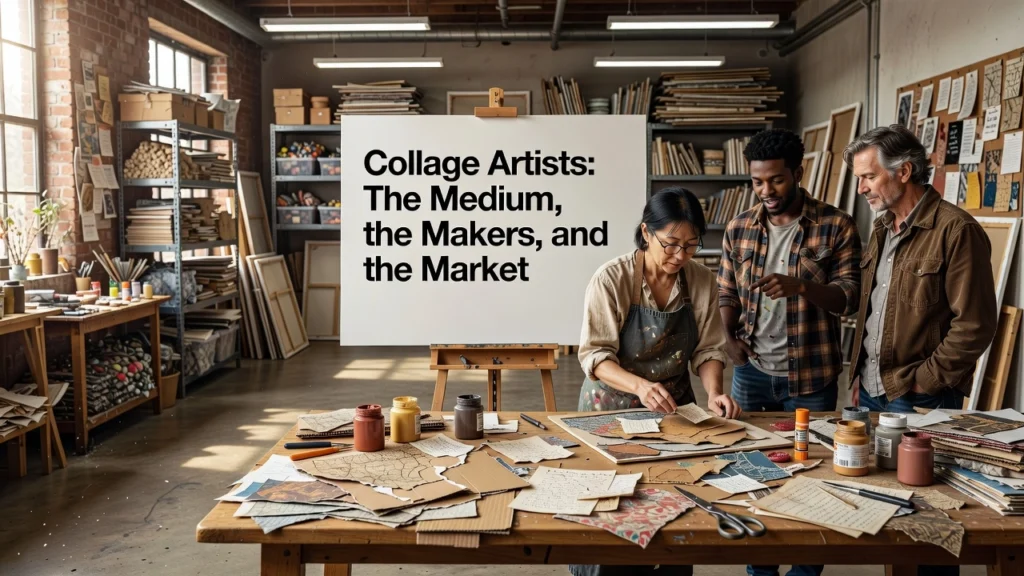
Scissors, glue, and fragments of the world reassembled into something entirely new. Collage has evolved far beyond its Cubist origins to become one of the most dynamic and commercially relevant art forms of the contemporary era. Yet despite its widespread appeal, many people still underestimate the depth of skill, intention, and market savvy required to truly excel in this medium.
Whether you are an emerging artist looking to refine your practice or an art enthusiast seeking to better understand the landscape, this guide cuts through the noise. Collage artists today operate at a fascinating intersection of tradition and innovation, physical and digital, fine art and commercial design. The names driving this space are diverse, the techniques are constantly evolving, and the market opportunities are more substantial than most realize.
In this listicle, you will discover the defining makers who have shaped the medium, the essential techniques that separate good work from great work, and the market forces that determine how collage artists build sustainable careers. Consider this your definitive overview of where collage stands right now.
What Makes Collage a Distinct Art Form
Collage is the deliberate composition of disparate found, printed, or fabricated materials into a single unified artwork. Derived from the French coller, meaning “to glue” or “to stick together,” it is fundamentally distinct from painting and drawing, which rely on the artist generating forms through direct mark-making. It also differs from assemblage, which is three-dimensional and incorporates actual objects in space. Collage is typically two-dimensional or low-relief, built by selecting, arranging, and adhering pre-existing fragments onto a flat substrate. This distinction matters because it shifts the artist’s primary skill from creation to curation and composition.
At its conceptual core, collage sustains a productive tension that no single-medium work can replicate. Each fragment retains traces of its original context, whether that is a vintage advertisement, a newspaper headline, or a scrap of patterned fabric. Yet the artist’s arrangement constructs an entirely new meaning from those fragments. The result is layered narrative: images and texts “collide,” generating multiple readings simultaneously. This double meaning allows collage artists to comment on consumerism, identity, politics, and culture with a complexity that a painted canvas rarely achieves on its own.
The practice spans three broad modes. Analog collage relies on torn paper, magazine cuttings, fabric, and ephemera assembled by hand, foregrounding texture, tactility, and irreversible decisions. Digital collage, by contrast, uses layered design software to composite and manipulate imagery with precision and flexibility. Hybrid approaches blend both, with artists scanning physical works, adding digital elements, and returning to handwork for finishing, producing pieces that inhabit both realms.
Because collage depends on found materials and cultural artifacts, every work carries a timestamp. Vintage periodicals, packaging, and personal ephemera embed the social and commercial language of specific eras, making each piece simultaneously an artwork and an inadvertent archive of the culture that produced its source materials.
This quality has significant commercial relevance in 2026. Collectors, galleries, and licensing markets are responding strongly to collage precisely because its visible handwork, torn edges, layered textures, and material authenticity are qualities that AI-generated imagery cannot replicate. Licensing platforms report that dimensional, layered collage is defining 2026 to 2027 wall art and home decor collections, as buyers actively seek evidence of human time, skill, and material decision-making in a market saturated with algorithmically produced images.
A Brief History: From Picasso to the Present
The story of collage as a recognised fine art practice begins with a single, quietly revolutionary object. In 1912, Pablo Picasso created Still Life with Chair Caning, an oval composition incorporating oil paint, a fragment of industrially printed oilcloth, and a rope border. The work is now held at the Musée Picasso in Paris, and its significance extends far beyond its modest dimensions. By introducing a manufactured, real-world material directly onto the picture plane, Picasso shattered the centuries-old convention of painting as an illusionistic window onto the world. The canvas was no longer a representation of reality; it was a constructed object made from reality itself.
Georges Braque extended this logic through papier collé, the practice of pasting cut paper and printed material into compositions, and the Cubist innovations spread rapidly. Italian Futurists adopted the fragmented, layered approach to evoke speed and mechanisation. Then Dada artists, working in the aftermath of World War I, weaponised the medium. Hannah Höch, Raoul Hausmann, and John Heartfield used photomontage to cut apart mass-media imagery and reassemble it as biting political critique. Heartfield’s anti-Nazi photomontages were so effective they earned him a place on the Gestapo’s most-wanted list.
Running parallel to Dada was Kurt Schwitters’ Merz practice, developed in Hannover from around 1918. Schwitters collected tram tickets, ration coupons, newspaper fragments, and other discarded urban ephemera and elevated them into poetic, abstract compositions. The very name “Merz” derived from a torn fragment of the word Kommerz. His work directly anticipates contemporary found-material art and assemblage, establishing the principle that transformation, not material preciousness, defines artistic value.
Decades later, Pop Art returned to collage’s roots in mass media. Richard Hamilton’s 1956 work Just What Is It That Makes Today’s Homes So Different, So Appealing? assembled images clipped from American consumer magazines into a satirical domestic scene, widely considered the first Pop Art collage. Where Dada fragmented imagery to protest, Pop Art fragmented it to interrogate the seductive logic of consumerism itself.
Into the 21st century, digital tools expanded collage’s technical possibilities considerably, enabling seamless layering, scanning, and manipulation at scale. Yet these tools have not displaced the analog tradition. If anything, the current saturation of AI-generated imagery has intensified collector and audience appetite for hand-made, tactile work with visible process, irregular edges, and the irreplaceable evidence of a human hand.
The Dada Pioneers
No movement gave collage its subversive backbone quite like Dada, the radical anti-art revolt that emerged in Zurich around 1916 and spread through Berlin, New York, and Paris as a direct response to the catastrophic irrationality of World War I.
Hannah Höch stands as the defining figure of Dada photomontage. As the only prominent female member of the Berlin group, she cut and recombined photographs from mass-circulation newspapers, magazines, and advertisements into compositions that exposed the constructed nature of gender identity and Weimar-era media culture with what can only be described as surgical compositional intelligence. Her landmark work Cut with the Kitchen Knife through the Last Weimar Beer-Belly Cultural Epoch in Germany (1919-20) layered satirical imagery across a vast canvas, simultaneously celebrating female agency and dismantling patriarchal authority. Höch anticipated media criticism by decades.
John Heartfield weaponised photomontage as direct activist communication. Working with explicitly political intent, he produced over 240 anti-fascist montages between 1930 and 1938, published in mass-circulation journals to reach working-class audiences. His approach established a clear lineage that contemporary socially engaged collage artists continue to draw from, deploying fragmented imagery to challenge power structures and political propaganda.
Man Ray expanded the medium’s conceptual boundaries through rayographs and three-dimensional assemblage, dissolving the distinctions between collage, photography, and sculpture in ways that remain influential.
Collectively, these pioneers gave collage its enduring reputation as a vehicle for critique and irreverence. As Maddox Gallery notes in their analysis of Dadaism, that anti-establishment DNA persists today, informing how collectors prize collage for its visible handwork and conceptual edge, particularly as a counterpoint to seamless AI-generated imagery.
Mid-Century Masters
Where Dada’s provocateurs had wielded collage as a weapon, the mid-century generation transformed it into a language, one capacious enough to accommodate painting, sculpture, cultural history, and monumental architecture.
Robert Rauschenberg stands at the hinge point between Abstract Expressionism and Pop Art. His “Combine” works, developed through the mid-1950s and early 1960s, incorporated newspaper cuttings, photographs, fabric, and everyday found objects directly into large-scale mixed-media paintings. Works such as Bed (1955) and Canyon (1959) retained the gestural paint strokes of Pollock’s generation while insisting that the mundane world, mass media, and consumer culture belonged on the canvas. Rauschenberg’s Combines dissolved the boundary between painting and sculpture, anticipating Pop Art’s embrace of commercial imagery and influencing artists including Andy Warhol and Jasper Johns. MoMA and the Whitney Museum hold canonical examples, confirming their permanent place in the Western art canon.
Henri Matisse demonstrated something equally significant: that collage could be a primary practice rather than a preparatory sketch. After surgery limited his mobility, Matisse began cutting gouache-painted paper into bold shapes, producing finished compositions of genuine authority. His 1947 artist’s book Jazz presented 20 vibrant cut-paper works as standalone masterpieces. The Chapelle du Rosaire at Vence, consecrated in 1951, extended this method to stained-glass windows, ceramic murals, and vestment designs, proving collage’s capacity for architectural scale.
Romare Bearden applied the medium to cultural testimony. His mosaic-style collages layered cut and torn papers, photographic elements, and paint to document African American life with extraordinary richness, capturing jazz clubs, family rituals, and the rhythms of Harlem and the rural South. His Projections series and subsequent works are now among the most studied in the medium, establishing narrative collage as a vehicle for cultural memory rather than formal experiment alone.
Together, these three artists drove collage’s postwar institutional acceptance. Museums acquired their works, galleries built programs around mixed-media practices, and collage moved from a provocateur’s tool into permanent collections. That legitimacy directly underpins today’s strong gallery representation and licensing market for collage-based works.
Contemporary Evolution
From the 1990s onward, digital tools fundamentally reshaped who could practice collage and where it could appear. Adobe Photoshop introduced precise layering and compositing capabilities that brought designers, photographers, and illustrators into the medium, translating collage’s core logic of recombination into editorial layouts, advertising campaigns, and commercial branding. Procreate later extended this accessibility to mobile creators, enabling high-quality collage output from an iPad. These tools created an entirely new category of practitioner working fluidly across fine art and commercial contexts simultaneously.
Today’s landscape is notably bifurcated. A thriving analog and handmade tradition is experiencing renewed collector interest, driven by appetite for tactile authenticity and visible craft in an era saturated with frictionless digital imagery. In parallel, the commercial digital collage sector operates at significant scale, with the broader digital art market projected at USD 6.69 billion in 2026, growing at approximately 14.66% CAGR through 2031. Both streams coexist productively, serving different audiences and revenue models.
Platforms including Instagram, Pinterest, and Artsy have accelerated discovery and market access in ways unavailable to any previous generation of collage artists. Artists now build global audiences, connect directly with collectors, and attract licensing opportunities without traditional gallery gatekeeping.
The commercial stakes are substantial. According to the Art Basel and UBS Global Art Market Report 2026, the global art market reached an estimated $59.6 billion in 2025. For collage artists positioned with strong digital visibility, this represents a genuinely accessible commercial opportunity rather than a distant aspiration.
15 Collage Artists Defining the Medium Today
The digital art market is projected to reach USD 13.26 billion by 2031, growing at a 14.66% CAGR from 2026 (Mordor Intelligence), and collage sits at the centre of this expansion. Whether analog, digital, or hybrid, collage commands serious collector attention, institutional recognition, and growing commercial licensing activity. The 15 practitioners listed below represent the global scope of the medium in 2026, spanning North America, Europe, Africa, and Australia, with consistent attention to what each artist makes, what defines their practice, and where you can find or acquire their work.
1. Wangechi Mutu (Kenya/USA) Working from her studio in Nairobi and New York, Mutu builds hybridised female figures from magazine cutouts, ink, and painted surfaces that interrogate colonialism, gender, and Afrofuturism. Her practice remains one of the most cited in postcolonial and feminist art discourse. Key work: Riding Death in My Sleep (2002). Her work is held by MoMA and the Nasher Museum; find available works through Saatchi Gallery’s artist profile and secondary market platforms including Artnet.
2. Linder Sterling (UK) Linder uses a scalpel and found magazines, cutting images from fashion, pornography, and domestic advertising to expose the mechanisms of gender and media. Her 2025 retrospective Danger Came Smiling confirmed her as one of Britain’s most influential photomontage artists. Key work: Orgasm Addict (1977 Buzzcocks cover). Her works appear through Modern Art gallery, Tate, and selected editions via major UK auction houses.
3. Jesse Draxler (USA) Based in California, Draxler occupies a rare space where fine art, fashion, and music commissioning converge. His monochromatic hybrid practice combines photography, painting, generative processes, and analog collage to produce work that is immediately recognisable in its psychological intensity. Key work: C280: Machine of Loving Grace generative collage series. Originals and prints are available through his studio site and jessedraxler.com, with institutional showings at Art Basel-adjacent fairs.
4. Martha Rosler (USA) Rosler’s House Beautiful: Bringing the War Home (1967 to 1972) remains a benchmark for politically engaged photomontage, splicing domestic advertising imagery with news photographs from the Vietnam War. Her practice established a template for activist collage that artists continue to reference. Key work: Cleaning the Drapes from the House Beautiful series. Works are held at MoMA and represented through Mitchell-Innes and Nash; institutional catalogues and exhibition prints are periodically available.
5. Alice Lindstrom (Australia) Adelaide and Melbourne-based Lindstrom is one of the most distinctive voices in Australian collage today. Her hand-cut painted-paper works and papercuts explore motherhood, character, and domestic narrative with an illustrative warmth that bridges fine art and public engagement. She has delivered workshops and projects connected to the Art Gallery of South Australia. Key work: her motherhood-themed papercut series. Originals, commissions, and workshop access are available directly through alicelindstrom.com, making her an accessible entry point for collectors building Australian art holdings.
6. Kara Walker (USA) Walker’s cut-paper silhouettes address race, violence, and American history at monumental scale, deploying collage as both aesthetic form and critical argument. Her work has expanded into installation, animation, and large-scale public projects without losing its graphic urgency. Key work: her large-scale silhouette installations including A Subtlety (2014). Represented through Sikkema Jenkins and Co.; secondary market works appear regularly on Artsy and Artnet.
7. John Stezaker (UK) Stezaker works with found photographs, film stills, and postcard imagery, overlaying them to produce unsettling, quietly surreal juxtapositions that feel inevitable in retrospect. His restraint is his signature; nothing is overworked. Key work: his ongoing Marriage series of overlaid film stills. Works are held at Tate and available through The Approach gallery in London, with editions and prints accessible via Artsy.
8. Michèle Lamy-influenced hybrid practitioners and diaspora voices (Europe/Australia) Artists working in the intersection of Australian origin and European or UK gallery systems, including collage practitioners featured on Rise Art, represent a growing diaspora voice in the medium. Rise Art’s collagists section is an active marketplace for this cohort, offering accessible price points alongside emerging critical recognition. Collectors seeking contemporary works at a range of budgets will find Rise Art a consistently useful starting point.
9. Laura Romero (Spain) Romero’s surreal analog compositions draw on European visual culture and dream logic, producing work that sits comfortably alongside Surrealist precedents while remaining distinctly contemporary. Her narrative-driven pieces are frequently cited in curated “best of” lists for analog collage. Key work: her ongoing surreal figure compositions. Available through Artupon and European gallery networks, with some works findable on Artsy.
10. Marcin Owczarek (Poland) Owczarek works at the digital-analog boundary, combining photographic source material with architectural and figurative elements to build layered, architecturally precise compositions. His practice reflects a broader Central European tendency toward technical rigour in hybrid collage. Key work: his surreal architectural collage series. Available through online platforms and European group exhibitions.
11. Kitty Callaghan (Australia) A member of the Sydney Collage Society, Callaghan represents the organised, community-anchored tier of Australian collage practice. Her experimental works have appeared in society exhibitions that have helped build collector awareness of the local scene. Key work: recent society-exhibited collage series. Accessible through Sydney Collage Society channels and local Australian gallery platforms.
12. Stephen Ormandy (Australia) Also based in Sydney and connected to the Sydney Collage Society, Ormandy pushes experimental boundaries within a contemporary paper collage framework. The Society itself has become a meaningful institutional structure for Australian collectors trying to navigate the local market. Key work: current collage practice exhibited through society events. Available through society-connected channels and local galleries.
13. Wura-Natasha Ogunji (USA/Nigeria) Working across performance, drawing, and collage, Ogunji builds layered works on paper that address diasporic identity and feminine power. Her cross-disciplinary practice expands what collage can hold conceptually. Key work: her Will I Still Carry Water performance and paper-based series. Works are available through Galerie Myrtis and appear periodically on Artsy.
14. Lotte Reiniger-influenced contemporary silhouette collagists (Europe/International) A loose cohort of contemporary practitioners continues the tradition of silhouette and cut-paper collage, reinvigorating hand-cut techniques with current political and environmental content. This strand is particularly active in European art schools and festival contexts. Key work: varies by artist. Tate and Artsy both surface relevant practitioners through curated survey pages.
15. Digital collagists featured in Contemporary Collage Magazine awards (International) The annual Contemporary Collage Magazine awards consistently surface the strongest emerging digital and hybrid voices globally, offering a reliable annual benchmark for collectors and curators tracking the medium’s evolution. Winners in recent years have demonstrated that digital collage, particularly when it incorporates found analogue materials or archival photography, is attracting serious institutional and collector interest in line with the broader digital art market’s growth trajectory. Key work: award-winning digital portfolios. Works are available through contemporarycollagemagazine.com features and linked online marketplaces including Artsy and Rise Art.
Across all 15 of these practices, the common thread is intentionality: the deliberate selection, transformation, and recontextualisation of source material into something with its own coherent visual and conceptual logic. For collectors, the clearest starting points remain Artsy for secondary market depth, Rise Art for accessible contemporary acquisitions, and direct artist sites for editions, originals, and commissions.
The Australian Collage Scene in 2026
Australia has steadily emerged as an increasingly visible contributor to the global collage conversation, underpinned by institutional endorsements from the country’s most respected public galleries and a grassroots community infrastructure that continues to grow in scope and ambition. The Sydney Collage Society, founded in 2015, remains a central hub for practitioners, organising workshops, exhibitions, and artist platforms that connect local talent with international audiences. This dual momentum, institutional above and community-driven below, positions Australia as a maturing player within the global medium.
The Art Gallery of New South Wales provided a landmark moment of institutional legitimacy with its Art of parts: collage and assemblage from the collection exhibition, which traced the medium’s evolution in Australian art from surrealist experiments of the 1940s through to contemporary political and personal directions. By platforming the form within one of Australia’s most authoritative cultural institutions, the exhibition signalled that collage was no longer a peripheral practice but a documented thread in the national art narrative. The NGV reinforced this position with Stick it!: Collage in Australian Art, the gallery’s first dedicated exhibition of the form, featuring historically significant Australian artists and affirming the medium’s place within the country’s premier gallery network.
Despite this institutional recognition, the Australian collage market remains fragmented. Gallery interest is strong, and community activity is genuine, but centralised resources for artists seeking to commercialise their work or build meaningful digital visibility are limited. Most practitioners rely on personal websites, Instagram presence, or society networks to generate sales and exposure, creating real barriers to scaling a commercial practice.
This landscape connects directly to one of the defining global art trends of 2026. Both Saatchi Art and Maddox Gallery have identified collector demand for handmade authenticity, specifically citing collage’s tactile qualities, visible layering, and irreplicable human process as a deliberate counter to AI-generated imagery. Australian collectors and artists are active participants in this same demand shift, giving the local scene renewed relevance within the broader international conversation and highlighting the growing commercial opportunity for collage artists who can establish strong digital visibility.
Australian Artists to Watch
Among Australian practitioners, Alice Lindstrom stands as one of the most compelling collage artists working today. Based in Adelaide, Lindstrom creates vibrant hand-cut paper collages built from painted paper through meticulous cut-and-paste techniques, drawing on her background in theatre design and museum studies to craft deeply narrative, character-driven compositions. Her work bridges picture books, editorial illustration, and exhibition contexts, with commissions from publishers including Simon and Schuster and appearances at the Art Gallery of South Australia. Represented by the Jacky Winter Group for commercial work, her pieces are available through her personal website and select gallery platforms, making her an accessible entry point for collectors and art directors alike.
For broader discovery, the Sydney Collage Society’s artist directory functions as a curated gateway to established and emerging Australian practitioners. Founded in 2015, the society maintains a membership roster of around twelve artists spanning analog, experimental, and mixed-media approaches, offering a reliable starting point for anyone mapping the local scene.
The commercial dimension of Australian collage practice extends further through IllustrationX Australia’s collage and montage category, where illustrators working in photomontage and found-image composition serve editorial, advertising, and publishing clients. This signals that collage in Australia is a viable professional discipline, not solely a fine art pursuit.
Notably, no dominant national platform currently unifies Australian collage artists under a single searchable presence. That gap is also a significant opportunity. Artists who invest in SEO and digital marketing now, building optimised websites and targeted content strategies, stand to capture disproportionate visibility as collector and commercial interest in the medium continues to mature.
Galleries, Societies and Community Resources
The Sydney Collage Society (SCS) stands as the primary Australian community organisation for collage practitioners. Founded in 2015, the SCS platforms local and international artists through workshops, exhibitions, collaborations, and community initiatives. Its artist directory showcases a curated roster of members with distinct practices, from founder and director Kubi Vasak through to newer members welcomed as recently as 2026. The organisation’s active exhibition program presents group shows that interrogate the contemporary possibilities of the medium, while community-facing initiatives such as the free Waverley Collage Makers program extend its reach beyond established practitioners. For any working collage artist in Australia, SCS membership and exhibition participation represent a direct pathway into a serious peer network.
At the institutional level, the Art Gallery of NSW and the National Gallery of Victoria have both demonstrated meaningful commitment to programming collage. AGNSW’s Art of Parts: Collage and Assemblage presented Australian pioneers alongside contemporary practitioners, validating the medium’s historical and current significance. NGV’s Stick It! was the institution’s first exhibition dedicated entirely to collage in Australian art, featuring canonical figures including Sidney Nolan and James Gleeson. This institutional activity creates genuine audience development opportunities; collectors and general audiences who encounter collage through major public galleries become a primed market for working artists.
Globally, the Kolaj Institute and Kolaj Magazine are the most authoritative resources in the field. Kolaj Magazine maintains an international artist directory and publishes rigorous critical discourse, while the Institute organises the flagship Kolaj Fest New Orleans, scheduled for 10 to 14 June 2026. The centrepiece Collage Art and Book Market, running 13 June at the New Orleans Healing Center, offers Australian artists a tangible international exposure opportunity worth planning around.
For commercial transactions, Artsy, Rise Art’s dedicated collagists directory, and Etsy are the primary online marketplaces where Australian buyers and sellers currently engage with collage works across different price points and audiences. Discovery and peer learning, meanwhile, are dominated by Pinterest, Instagram, and the active Reddit /r/collage community. Organic social presence builds audience and trust, but the most durable visibility stack combines consistent social activity with a search-optimised personal artist website, ensuring discoverability that no single platform algorithm can remove.
2026 Collage Trends: Why Handmade Is Winning
The 2026 art market has arrived at a decisive inflection point: collector demand and commercial licensing are actively shifting toward work that AI cannot replicate, and handmade collage sits at the exact intersection of that shift. As generative imagery saturates digital channels, buyers, galleries, and licensing firms are placing measurable premium on works that carry genuine physical evidence of human decision-making, serendipity, and time invested.
Three independent sources corroborate this trend with striking consistency. Saatchi Art’s 2026 art trends report identifies “Collage and Craft: Irreplicable Artistry” as a defining movement, noting that collectors are seeking paper collage with visible tears, layers, and the tangible marks of cutting and arranging found materials. Maddox Gallery’s 2026 forecast describes collage entering a new commercial phase defined by visible construction, segmented planes, and intentional imperfection that directly rejects AI-generated polish. Wild Apple, reporting from the commercial licensing side, confirms that layered, dimensional collage is among the most strategically relevant directions for 2026 and 2027 wall art and home decor collections. Three separate platforms, three independent assessments, all pointing to the same market reality.
A secondary driver reinforces the primary one. Agora Gallery’s 2026 trend analysis identifies eco-conscious material use as a documented buyer value, and collage’s foundational reliance on found, repurposed, and recycled materials aligns naturally with that documented preference. The medium’s sustainability credentials are built in, not bolted on.
Emotional authenticity is also functioning as a purchase driver in its own right. The tears, layers, and textures visible in analog collage fulfil a psychological need for human connection that smooth, algorithmic output simply cannot address. Buyers are not just purchasing an image; they are purchasing evidence of a process, a series of irreversible choices made by a human hand.
For working collage artists, the practical implication is direct: this trend window is time-limited and commercially significant. Artists who build digital visibility and establish licensing relationships now will be positioned to convert surging demand into consistent revenue before the window narrows.
The Anti-AI Authenticity Movement
Since 2023, AI-generated imagery has flooded commercial design, social media feeds, and stock platforms at a scale that has fundamentally altered how collectors and brands evaluate visual work. The result is a measurable market correction: buyers are placing a quantifiable premium on verifiably human-made art, seeking proof of origin, labor, and intention in ways that were largely unnecessary before algorithmic image generation became ubiquitous.
Collage occupies a uniquely advantaged position within this shift. Its visible materiality, torn edges, layered paper, foxed ephemera, glue residue, and the physical irregularities that accumulate through manual assembly, function as an inherent provenance signal. These qualities are extraordinarily difficult for AI systems to replicate in physical form. Unlike digital painting or vector illustration, which can be mimicked stylistically by generative tools with minimal visual difference, handmade collage carries embodied evidence of time and decision-making that resists algorithmic reproduction.
Saatchi Art’s 2026 Art Market Trends report makes this explicit, identifying “Collage and Craft: Irreplicable Artistry” as one of five defining market forces for the year. The platform notes that collectors are gravitating toward work that foregrounds the artist’s hand, specifically citing the “intuitive decision-making of cutting paper” and the “serendipity of found materials” as qualities that AI cannot replicate. Saatchi has reinforced this position institutionally by prohibiting the sale of solely AI-generated works. This is not a niche preference; it is a documented, platform-level market shift.
For collage artists, the strategic implication is direct. The story of your materials, your sourcing process, and your physical decision-making is a brand differentiator with genuine commercial weight. Process documentation, studio photography, and material narratives should sit at the centre of any content strategy, converting authenticity into a measurable competitive advantage.
Collage in Art Licensing and Home Decor
According to Wild Apple, a major international art licensing agency, layered and dimensional collage artwork is “quickly becoming one of the most commercially relevant art licensing directions for 2026/2027.” Retailers and manufacturers are actively refining assortments to include work that feels crafted and tactile rather than digitally polished, seeking visible construction, overlapping imagery, and textured surfaces across product categories including wall decor, stationery, dinnerware, and textiles. This commercial momentum is directly tied to the anti-AI authenticity shift explored earlier; licensing buyers are responding to the same consumer demand driving collector behaviour in gallery contexts.
For collage artists unfamiliar with the licensing model, the structure is worth understanding clearly. Rather than selling an original work outright, the artist grants a manufacturer or publisher the right to reproduce that artwork on products, in exchange for royalties, typically ranging from 3 to 10% of wholesale price, or a negotiated flat fee. A single original can be licensed across multiple product categories, territories, and timeframes simultaneously, creating recurring revenue that compounds over a portfolio of work. This model rewards artists who maintain trend-aligned collections and can present work with commercial mockups demonstrating product applications.
Copyright represents the most consequential practical barrier for collage artists pursuing licensing deals. Under Australian copyright law, fair dealing exceptions are considerably narrower than the U.S. fair use doctrine, and creating new artistic works from found or magazine imagery for commercial purposes generally falls outside permitted uses. Artists should use original imagery, public domain materials, or properly cleared elements before approaching any licensing arrangement.
The critical gap, however, sits between this surging demand and artist readiness. Many Australian collage artists producing precisely the layered, textural work licensing firms are seeking remain undiscoverable, lacking optimised portfolio presentation, SEO visibility, and the outreach infrastructure needed to get in front of art directors and licensing buyers actively looking for their style.
How Collage Artists Are Building Audiences and Selling Work Online
In 2026, collage artists are operating across three primary revenue channels, each with distinct requirements and growth potential. The first is original artwork sales through direct websites, physical galleries, and curated online marketplaces such as Rise Art and Artsy, platforms that attract buyers with verified purchase intent and serious collecting budgets. The second is print and licensing, encompassing print-on-demand services like Redbubble alongside licensing agencies supplying the booming home decor and editorial markets. The third is digital collage work for commercial and editorial clients, including book covers, advertising campaigns, and custom commissions, a channel growing rapidly as brands seek visually distinctive, human-made imagery to stand apart from AI-generated content. Artists who build across all three channels create compounding revenue and reduce dependency on any single source.
Your Website Is the Asset That Works While You Sleep
Social platforms are borrowed real estate. Algorithm shifts, policy changes, and declining organic reach are structural realities of every major social network, not temporary inconveniences. A search-optimised artist website, by contrast, delivers consistent inbound traffic from buyers, gallery directors, and licensing firms who are actively searching for exactly what you make. A well-ranked Google presence captures demand at the point of intent. When a collector searches for original collage art or a licensing firm scouts for a specific aesthetic, your website either appears or it does not. There is no middle ground, and there is no algorithmic goodwill to depend on.
Social Discovery Is the Funnel, Not the Finish Line
Instagram and Pinterest remain the dominant organic discovery channels for visual artists, and neither should be abandoned. Pinterest functions as a visual search engine with sustained shelf life; a single well-optimised pin can drive traffic for months or years after posting. Instagram builds familiarity and nurtures the kind of relationship that precedes a purchase decision. The critical limitation of both platforms is conversion. Social reach does not become a collector relationship, a licensing inquiry, or a commission brief without a website engineered to capture and retain that traffic. Email list sign-ups, portfolio pages built for browsing, and clear purchase pathways are the infrastructure that transforms a follower into a buyer.
Long-Tail Keywords Are Where Commercial Intent Lives
For collage artists targeting online sales, long-tail keyword strategy is one of the highest-return investments available. Ranking for broad terms like “collage art” means competing against institutions, publications, and established marketplaces with enormous domain authority. Ranking for “collage artist Sydney,” “handmade collage prints Australia,” or “paper collage art for sale” is both more achievable and more commercially valuable, because these searches signal specific, purchase-ready intent. The artist who appears for these targeted queries is meeting a buyer at the precise moment of decision.
The SEO Gap Australian Collage Artists Can Exploit Right Now
Australia-specific digital marketing guidance for collage artists is absent from every top-ranking resource on art sales and artist marketing. This is not a minor oversight; it is a structural content gap that represents a genuine first-mover advantage for artists who act on SEO strategy early in this market cycle. The Brand Express works with sole traders and artists across Australia to build performance-driven SEO strategies tailored to this exact challenge, converting search visibility into qualified leads, direct sales, and licensing opportunities. No comparable specialist currently offers SEO strategy built specifically for collage artists and visual creatives in the Australian market, making this a rare window where targeted action now compounds into long-term search dominance.
Resources for Collage Artists
The following structured reference list organises the most relevant resources for practising collage artists across four core categories.
Community organisations: The Sydney Collage Society remains the primary Australian hub, connecting local and international practitioners through workshops, exhibitions, and collaborative projects. The Collage Artists of America supports members internationally across analog, digital, and mixed-media practices, with educational programs and scholarship opportunities. The Kolaj Institute, based in New Orleans, operates as a non-profit dedicated to the study, documentation, and dissemination of collage through residencies, directories, and its Institute Gallery.
Galleries and exhibitions: The Art Gallery of NSW and the NGV are the leading Australian institutional reference points for collage-inclusive programming, with both having hosted dedicated exhibitions in recent years. Artsy functions as the most comprehensive online platform for researching gallery representation, exhibition history, and market positioning across thousands of collage artists globally.
Commercial marketplaces: Rise Art, Etsy, and Saatchi Art each serve distinct buyer segments, from vetted fine art collectors to casual buyers seeking accessible originals and prints. A presence across at least two of these platforms significantly broadens sales reach.
Educational and publication resources: Kolaj Magazine, a quarterly international print publication, remains the most authoritative dedicated resource for critical collage discourse, artist features, and community news. Contemporary Art Issue covers broader practices but regularly engages collage within contemporary critical frameworks.
For the calendar, Kolaj Fest, running 10 to 14 June 2026 in New Orleans, is the single most important international gathering of the year. The Collage Art and Book Market on 13 June offers direct exhibition, publication, and networking access for serious practitioners.
Informal peer-learning channels, including Reddit’s /r/collage, Facebook collage artist communities, YouTube tutorials, and Pinterest boards, complement formal membership by providing daily engagement, technique exchange, and audience building without gatekeeping.
One critically underserved resource category is copyright guidance. Australian collage artists using found or magazine images in commercial work should consult the Arts Law Centre of Australia, which provides specialised, low-cost legal advice for creators navigating transformative use and licensing questions.
The most effective resource stack in 2026 integrates all four pillars: community membership, marketplace presence, social discovery channels, and a search-optimised personal website. That last element is the only one entirely within an artist’s control, immune to algorithm changes, platform policy shifts, or third-party fee increases. Every other channel operates on borrowed infrastructure.
Final Thoughts
Collage is not having a moment; it is building sustained momentum. In 2026, collector demand for irreplicable, human-made work is translating into concrete commercial opportunity, and practicing artists who position themselves now will benefit from that shift across original sales, licensing, and editorial work.
For Australian collage artists specifically, the conditions are unusually favourable. Institutional support from the Art Gallery of NSW and NGV has established cultural legitimacy, the Sydney Collage Society provides active community infrastructure, and no dominant national platform has yet claimed the search landscape. Artists who invest in digital visibility today are entering relatively uncontested territory.
The actionable priorities are clear: build a search-optimised website that ranks for your practice, claim your presence on marketplaces like Saatchi Art and Bluethumb, document your process consistently for social audiences, and explore licensing as a parallel revenue stream alongside original sales.
For collage artists looking to grow their search visibility and convert that visibility into genuine commercial outcomes, The Brand Express specialises in performance-driven SEO strategies built around exactly this kind of niche creative practice.