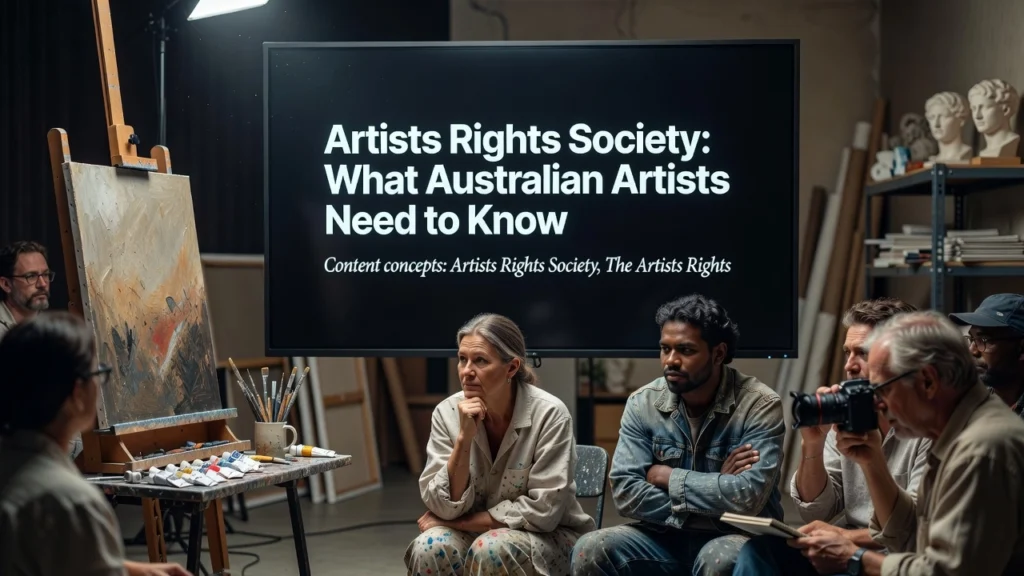
Every artist deserves to be paid fairly for their work, yet navigating the complex world of copyright protection can feel overwhelming, especially when you are just starting out. This is where understanding organisations like the Artists Rights Society becomes essential knowledge for any creative professional.
The Artists Rights Society, commonly known as ARS, is one of the most prominent copyright, licensing, and monitoring organisations for visual artists in the world. While it is based in the United States, its reach extends globally, and Australian artists frequently encounter it when their work crosses international borders or when they want to reproduce works by artists ARS represents.
In this analysis, we will break down exactly what the Artists Rights Society does, how it operates, and what Australian artists specifically need to understand about engaging with it. Whether you are a painter, illustrator, photographer, or digital artist, this guide will give you a clear and practical understanding of your rights, your responsibilities, and how organisations like ARS can either protect your creative output or place obligations on how you use the work of others.
What Is the Artists Rights Society (ARS)?
The Artists Rights Society (ARS) is the foremost copyright management organisation (CMO) for visual artists in the United States. Founded in 1987 by Dr. Theodore Feder, ARS has spent more than 35 years building the infrastructure that allows visual artists to control how their work is reproduced, distributed, and used commercially. If you have ever seen a licensing credit on a museum catalogue, a film prop, or a branded collaboration featuring a famous painting, there is a strong chance ARS was involved in making that transaction legally sound. Its official home at arsny.com serves as the central gateway for licensing requests, membership information, and rights advocacy.
ARS operates with a clear dual mandate. On one side, it licenses reproduction rights to a wide range of clients including brands, museums, publishers, and film productions, enabling them to legally use copyrighted visual works. On the other side, it actively monitors for unauthorised uses of its members’ work and pursues enforcement action when infringement occurs. You can explore how ARS supports museums and cultural institutions through its dedicated licensing services. This two-pronged approach distinguishes ARS from a passive registry; it functions as both a facilitator and a guardian of artists’ intellectual property.
Globally, ARS holds membership in CISAC, the International Confederation of Societies of Authors and Composers, connecting it to a worldwide network of rights organisations across more than 40 countries. This affiliation means an artist represented by ARS receives protection well beyond US borders.
ARS represents an exceptionally broad community of creators, including painters, sculptors, photographers, architects, illustrators, and the estates of deceased artists. Its roster spans over 122,000 artists and estates worldwide, covering celebrated names such as Andy Warhol, Pablo Picasso, and Georgia O’Keeffe alongside thousands of emerging and mid-career practitioners. To extend its reach into the digital era, ARS launched Arsnl Art, a dedicated online platform providing access to its full licensing repertoire and supporting emerging areas such as blockchain-based works and digital reproduction rights, signalling a clear commitment to evolving alongside the modern creative economy.
How ARS Was Founded and Why It Still Matters
Before ARS existed, visual artists in the United States had almost no collective mechanism to control how their work was reproduced commercially. By the mid-1980s, publishers, advertisers, and merchandise companies were routinely reproducing paintings, sculptures, and photographs without licensing agreements, compensation, or even basic attribution. Dr. Theodore Feder founded ARS in 1987, partly at the invitation of France’s ADAGP, to bring structured rights management to a sector that had long been left unprotected. You can explore the full history of ARS directly on their website.
The gap ARS filled was significant. Music creators had benefited from collective licensing organisations for decades, with ASCAP operating since 1914 and BMI since 1939. These performing rights organisations gave composers and songwriters centralised systems for licensing and royalty collection. Visual artists had no equivalent, leaving them uniquely vulnerable. ARS adapted that proven collective model specifically for reproduction rights across publications, films, exhibitions, and commercial uses, as detailed in the ARS About page.
From that US-focused foundation, ARS grew into a genuinely global rights body. Through affiliations with more than 40 international societies via CISAC, ARS now represents over 122,000 visual artists and estates across multiple countries, including major figures like Picasso, Warhol, and Georgia O’Keeffe.
ARS’s continued relevance is demonstrated clearly by its participation in the 2026 Annual Art Law Conference at Brooklyn Law School, where its Vice President joined panels examining copyright, artificial intelligence, and visual art. That founding mission, securing compensation and control over reproductions, is arguably more urgent today than in 1987, as generative AI scrapes millions of copyrighted images without permission at a scale no analogue reproduction era could match.
What ARS Actually Does: Licensing, Monitoring, and Advocacy
ARS operates across three distinct but interconnected functions, and understanding each one clarifies why this organisation holds such a central place in the visual arts ecosystem.
Licensing reproduction rights is the most visible of the three. When a brand, museum, publisher, or filmmaker wants to use a work by a represented artist, they contact ARS directly through arsny.com. ARS then verifies rights availability, negotiates appropriate fees, issues the formal licence, and collects payment on behalf of the artist or their estate. This single-point-of-contact model removes a significant administrative burden from artists while ensuring commercial users can access world-class IP through a reliable, legally sound process.
Monitoring for unauthorised use is where ARS goes beyond passive administration. The organisation actively patrols for infringements across print, digital, and commercial channels, using tools such as the Automatic Image Recognition (AIR) project to detect unlicensed reproductions at scale. This kind of systematic surveillance is something individual artists and estates simply cannot replicate on their own.
Advocacy rounds out the three pillars. ARS campaigns for legislative change on resale royalties through the ART Act, and has become increasingly vocal on digital rights and AI-related copyright concerns, as reflected in submissions to the US Copyright Office and endorsement of the Generative AI Copyright Disclosure Act.
The royalty distribution model ARS uses sets it apart from both legal firms and individual agents. Rather than billing hourly or taking a cut of one-off deals, ARS collects licensing fees and distributes net proceeds to rights holders on an ongoing basis, operating more like a performing rights organisation than a transactional service provider. This structural, continuous model is precisely what makes it suitable for managing high-value estates and living artists simultaneously.
The calibre of IP under ARS management underscores its authority. The organisation represents works by Pablo Picasso, Andy Warhol, Georgia O’Keeffe, Damien Hirst, and Judy Chicago, alongside hundreds of other major figures. You can explore the full scope via the Artists Rights Society Wikipedia overview or directly through arsny.com. ARS is not a law firm and does not provide courtroom representation; it delivers something arguably more valuable for most artists, which is permanent, organised protection of their intellectual property across every commercial context where their work might appear.
Who Does ARS Represent and How Large Is Its Reach?
As of 2026, ARS represents the intellectual property interests of over 122,000 visual artists and estates worldwide, a scale that firmly positions it as the largest visual arts collective management organisation in the United States. This figure, cited directly across ARS’s represented artists page and independent sources, reflects decades of sustained growth since the organisation’s founding in 1987. No comparable US body comes close to matching this breadth of representation.
A critical detail that beginners often overlook is that ARS represents not only living creators but also the estates of deceased artists. Copyright protection in the United States typically extends for the life of the creator plus 70 years, meaning ARS actively manages licensing and enforcement long after an artist has passed. The estates of Pablo Picasso, Andy Warhol, Georgia O’Keeffe, and Henri Matisse all fall within this protective umbrella, generating ongoing royalties for heirs and preserving the integrity of each artist’s legacy.
The organisation’s scope has also broadened in step with the digital economy. ARS now explicitly includes illustrators alongside traditional fine artists, acknowledging that creators working in books, advertising, and digital media deserve the same structured protections. According to ARS’s representation overview, membership is free and open to painters, sculptors, architects, photographers, printmakers, and illustrators alike, covering an impressively wide range of visual disciplines.
Beyond formal representation, ARS maintains an active Instagram presence with 7,100+ followers, using the platform to share member spotlights, copyright education, and licensing news. This engagement signals a genuine commitment to the broader creative community, not just established names. For artists researching rights management, exploring ARS’s team and network offers a clear entry point into understanding what collective representation can look like in practice.
Does the Artists Rights Society Apply to Australian Artists?
The short answer is no, not directly. ARS is a US-based organisation, and Australian artists cannot become members or register their works with ARS independently. However, this does not mean Australian artists are left without protection in the American market. Through ARS’s membership in the International Confederation of Societies of Authors and Composers (CISAC), a global network of reciprocal agreements connects collecting societies across more than 120 countries, creating meaningful indirect protections for Australian creators.
The CISAC Network in Practice
Here is how the system works for an Australian artist. When a US publisher, museum, or brand wants to reproduce an Australian artwork, they approach ARS to obtain the necessary licence. Because ARS participates in CISAC’s reciprocal framework, it can grant that licence on behalf of the international repertoire, collect the applicable royalty fee, and then remit those funds back through the CISAC network to the Australian equivalent organisation. That organisation is then responsible for passing the payment on to the artist. You may have seen licensing credits that read: “© [Artist Name] / Copyright Agency. Licensed by Artists Rights Society (ARS), New York.” This is precisely that system working as intended.
The Practical Entry Point for Australian Artists
For Australian visual artists, including painters, sculptors, photographers, and illustrators, the correct starting point is the Copyright Agency. This not-for-profit CMO manages licensing and royalty collection for Australian creators, and since absorbing Viscopy in 2017, it has served as the consolidated home for visual arts rights management in Australia. By joining Copyright Agency, Australian artists automatically gain access to the broader CISAC network, which includes ARS as a partner for US-based licensing activity.
The scenarios where this international framework becomes most relevant include Australian artworks reproduced in US publications or exhibition catalogues, loans to American museum exhibitions, commercial campaigns featuring Australian art, and digital media uses across US platforms. For any artist with international ambitions, understanding this pipeline is a practical first step toward ensuring their work is properly licensed and compensated whenever it crosses borders.
How International Copyright Networks Work (CISAC Explained)
The international framework that makes cross-border royalty collection possible rests on a single global body: CISAC, the International Confederation of Societies of Authors and Composers. CISAC functions as the umbrella organisation connecting over 225 national collective management organisations (CMOs) across 116 countries, representing more than five million creators worldwide. It does not collect royalties directly. Instead, it establishes the standards, model agreements, and governance structures that allow its member CMOs to operate as a seamless international network.
The engine driving this system is the reciprocal representation principle. Under this arrangement, each member CMO grants fellow member CMOs the authority to administer its repertoire within their home territory. When a work is used commercially in a foreign country, the local CMO handles licensing and collection, then remits the royalties back to the originating CMO, which distributes the funds to the rights holder. This eliminates the need for individual artists to establish legal representation in every country where their work appears.
A practical example brings this to life. If an Australian photographer’s image appears in a US advertising campaign, ARS collects the applicable royalties within the United States under its reciprocal agreement with Australia’s Copyright Agency. ARS then transfers the net amount to the Copyright Agency, which distributes the payment to the photographer. The artist never needs a US agent or legal team to access that income.
This same infrastructure supports comparable organisations across major markets, including DACS in the United Kingdom, VG Bild-Kunst in Germany, and ADAGP in France. Each operates within the CISAC framework, meaning royalties flow consistently and equitably across borders. For Australian artists who exhibit, license, or sell internationally, understanding this network is not optional knowledge; it is the foundation for protecting and monetising creative work on a global scale.
Australia’s Equivalent: The Copyright Agency
For Australian visual artists, the equivalent of the Artists Rights Society is the Copyright Agency (copyright.com.au), the country’s primary collective management organisation for visual arts licensing. As a not-for-profit body, the Copyright Agency licenses visual arts, images, text, and related works on behalf of more than 60,000 visual artist members from across the world, including painters, illustrators, photographers, cartoonists, and sculptors. It operates across both Australia and New Zealand, giving it significant regional reach.
The Copyright Agency’s core function is straightforward but essential. It collects licensing fees from organisations that reproduce copyrighted works, including educational institutions, government departments, businesses, and media outlets. Those fees are then distributed as royalties to rights holders after administrative costs are deducted. The agency also administers Australia’s resale royalty scheme under the Resale Royalty Right for Visual Artists Act 2009, collecting a 5% royalty on eligible commercial resales of original artworks.
Joining is free for eligible artists. Once registered, Australian visual artists receive royalties whenever their work is reproduced in commercially or educationally licensed contexts, making membership an immediate practical priority rather than an optional extra.
The broader Australian ecosystem also includes two important supplementary organisations. The Arts Law Centre of Australia (artslaw.com.au) provides legal information, advice, and resources covering copyright, contracts, and moral rights. APRA AMCOS handles performing and mechanical rights for musical works, relevant for artists working across disciplines involving sound.
For any Australian visual artist serious about protecting their creative output, registering with the Copyright Agency is the single most important first step.
ARS vs the Copyright Agency: Key Differences for Australian Creatives
Understanding how these two organisations differ is essential for any Australian creative who wants to protect their work effectively on both a domestic and international level.
Jurisdiction is the most fundamental distinction. ARS operates primarily under US copyright law, advocating for and licensing visual artists’ works within the American legal framework. The Copyright Agency, by contrast, is governed by the Australian Copyright Act 1968 and operates under the specific statutory licensing schemes established by Australian law. This means the two organisations are not interchangeable; they serve distinct legal environments with different obligations, protections, and enforcement mechanisms.
Membership eligibility also differs in a practical sense. While ARS technically accepts members from around the world, its focus is on representing artists in the US market. For Australian-based creators, the Copyright Agency is the natural primary home. Membership is free and open to anyone with a copyright interest in visual works, including painters, illustrators, and photographers. Registering with the Copyright Agency ensures you are represented within Australian statutory licensing schemes from day one.
Scope and scale reflect each organisation’s geographic priorities. ARS represents over 122,000 artists globally but channels most of its licensing activity through the US market. The Copyright Agency focuses on the Australian and New Zealand markets, licensing works from a substantial pool of international artists through its reciprocal networks.
One meaningful difference involves resale royalties. Australia has a mandatory resale royalty scheme, which entitles visual artists to a 5% royalty on eligible commercial resales of their works valued at $1,000 or more. The US currently has no equivalent federal right, and ARS continues to advocate for its introduction.
For Australian artists, the decision framework is straightforward. Register with the Copyright Agency as your primary CMO to secure domestic protections and resale royalty entitlements. ARS will handle US-based reproductions of your work automatically through the CISAC reciprocity network, meaning you benefit from international coverage without needing to join ARS directly.
ARS, Generative AI, and the Fight for Visual Artists’ Rights in 2026
Generative AI represents the most significant threat to visual artists’ rights in recent memory. The core problem is scale: AI image models have been trained on datasets containing billions of images scraped from the web, the overwhelming majority collected without the knowledge, consent, or compensation of the original creators. Artists have described this as a systematic extraction of human creative labour, with one prominent illustrator calling it “the greatest art heist in history.” These models learn to replicate artistic styles, generate competing imagery, and flood commercial markets, all while the artists whose work made that learning possible receive nothing in return.
ARS has responded with direct legislative advocacy. The organisation has formally endorsed the Generative AI Copyright Disclosure Act, a bill that would require AI developers to notify the US Register of Copyrights before releasing or substantially updating a generative AI system. Crucially, that notice must identify the copyrighted works used in training datasets, creating a public accountability record that currently does not exist. ARS’s position is clear: companies that build AI systems on creative work must disclose what they used and whose work it was. The bill carries civil penalties for non-compliance and has drawn broad support across creative industries.
On the market side, ARS supports the Fairly Trained certification program, a nonprofit initiative that awards certification exclusively to AI products trained on licensed or permissioned content. For artists and buyers alike, this certification functions as a practical signal, distinguishing responsible AI developers from those who have built products on unlicensed material. It creates a commercial incentive for ethical training practices rather than waiting solely for legislation.
The US Copyright Office has also reinforced a critical protection for human creators. In its 2025 report, reaffirmed through 2026, the Office confirmed that fully AI-generated outputs are generally not copyrightable. Human authorship remains a prerequisite for copyright protection, meaning that the creative labour of real artists retains a legal distinction that AI outputs cannot replicate.
Finally, litigation is reshaping the landscape in real time. Lawsuits targeting training data scraping, style imitation, and failure to license visual works are advancing through US courts in 2026, with at least one major jury trial scheduled. These cases are pressuring AI companies toward greater transparency and licensing, signalling that the commercial cost of ignoring artists’ rights is rising steadily.
What Australian Artists Need to Know About AI and Copyright
Australia’s Copyright Act 1968 does not include a broad text-and-data-mining (TDM) exception for AI training purposes. This is a critical legal reality for Australian artists: if an AI company scrapes and trains on your copyrighted images or illustrations without a licence, that activity may already constitute copyright infringement under existing law. In October 2025, Attorney-General Michelle Rowland confirmed that the Albanese Government would not introduce a TDM exception, prioritising creator remuneration over unrestricted AI access. This is a stronger position than many other jurisdictions have taken, and it gives Australian artists meaningful legal ground to stand on.
The policy debate remains active both locally and internationally. Australia has established the Copyright and Artificial Intelligence Reference Group (CAIRG) to consult on licensing models and enforcement pathways. The UK has similarly retreated from a broad commercial TDM exception following significant opposition from creative industries, and is now moving toward market-led licensing frameworks. Outcomes from both governments are expected to shape commercial licensing structures globally, making 2026 a pivotal year for how AI companies lawfully access creative work.
While legislation continues to develop, Australian artists should act now rather than wait. Practical steps include watermarking digital files to deter scraping and support infringement claims, adding machine-readable opt-out signals to your website via robots.txt directives targeting known AI crawlers such as GPTBot and ClaudeBot, registering with the Copyright Agency to access collective licensing opportunities, and documenting original creation dates through metadata, timestamps, or dated drafts.
An increasingly important strategy is Answer Engine Optimisation (AEO), which involves structuring your portfolio website and artist statements so that AI-powered search tools correctly attribute your work to you rather than producing anonymous outputs. Using structured data markup, clear authorship signals, and FAQ-style content helps AI systems cite your work accurately.
Proactive digital presence and rights registration remain the most actionable protections available to Australian artists in 2026. Legislative resolution may take years; your documented, well-structured online identity cannot wait that long.
Why Copyright Protection Alone Is Not Enough in 2026
Copyright registration and collecting society membership establish legal ownership, but legal ownership alone does not pay an artist’s bills. If potential licensees, collectors, and buyers cannot find an artist’s work through a simple online search, that protection exists only on paper. The commercial value of registered rights depends entirely on visibility, and in 2026, visibility is a search engine problem as much as a legal one.
The digital visibility gap facing independent Australian artists is substantial. The overwhelming majority of sole-trader creatives and independent photographers have minimal organic search presence for the niche terms that actually drive licensing inquiries and commission requests. When a buyer searches for “Australian botanical illustrator for licensing” or “Sydney-based portrait photographer,” the results that appear are not necessarily the most talented artists available. They are the most optimised ones. Without strong search rankings, inquiries and sales default to whoever ranks higher, regardless of creative merit or rights registration status.
The challenge is compounded further by how search itself now functions. In 2026, a significant proportion of Google searches end without a single click to an external website, because AI Overviews, featured snippets, and image carousels resolve the query directly on the results page. For visual artists, this shift is particularly acute. AI-generated summaries and curated image results tend to surface established, well-optimised sources, bypassing individual artist websites entirely. An artist whose work is technically indexable but poorly optimised is effectively invisible, even when someone is actively searching for exactly what they create.
This is why rights protection and discoverability must be treated as a connected strategy, not separate concerns. An artist who holds Copyright Agency membership and also ranks in search results for their specific niche is positioned to capture both collective licensing income and direct commissions simultaneously. Registration creates the legal foundation; SEO converts that foundation into active revenue.
Bridging that gap requires a deliberate, performance-driven approach. The Brand Express works with growth-minded artists and sole-trader creatives to build bespoke SEO strategies that improve organic search visibility, optimise images for AI-influenced search environments, and attract the qualified leads that rights protection alone cannot deliver.
How Search Visibility Connects Directly to Licensing Opportunities
Commercial licensees, including publishers, brand marketing teams, and film productions, are no longer relying solely on gallery relationships or agency directories to find artists for collaboration. In 2026, search is the primary discovery channel. A brand looking for a botanical illustrator or an architectural imagery licence will typically begin with a Google search, not a phone call to a dealer. This shift fundamentally changes what it means to be a “visible” artist. Visibility is now a technical as much as a creative achievement, and artists who understand this are securing licensing enquiries that their equally talented peers are missing entirely.
Image SEO is the mechanism that makes an artist’s portfolio findable in Google Images, Google Lens, and visual search results. Three practices carry the most weight. First, image filenames should be descriptive and keyword-relevant before uploading; a file named “coastal-abstract-oil-painting-jane-smith.jpg” communicates far more to search engines than “IMG_4421.jpg”. Second, every image on a portfolio site should carry alt text written in plain, accurate language that describes the subject, medium, and style of the work. Third, structured data markup, also called schema, gives Google richer context about the image, its creator, and its licensing status, which can improve how results are displayed. Together, these optimisations make an artist’s work indexable across all visual search entry points.
Google evaluates every website, including artist portfolios, through the E-E-A-T framework: Experience, Expertise, Authoritativeness, and Trustworthiness. For artists, this means that a professional biography detailing exhibition history and credentials, combined with visible copyright notices and rights registration information, sends credibility signals that improve search rankings. ARS membership or Copyright Agency registration, when clearly communicated on a portfolio site, directly contributes to the Trustworthiness component of this framework.
An emerging layer sits on top of traditional SEO: Answer Engine Optimisation (AEO). AI tools such as ChatGPT and Google AI Overviews increasingly answer licensing queries directly. Artists with well-documented biographies, consistent mentions across authoritative sources, and clearly structured portfolio content are far more likely to be cited accurately in those AI-generated responses. This matters because AI-driven discovery is growing rapidly, and a single accurate citation in an AI response can generate inbound enquiries at scale.
Critically, the same content strategy that improves licensing discoverability produces compounding benefits across every revenue stream. Optimised portfolios attract collector enquiries, exhibition invitations, and direct commission leads simultaneously, making search investment one of the highest-return activities an artist can undertake in the current digital landscape.
Practical Steps for Australian Artists: Protect Your Work and Get Found
Understanding your rights is only half the equation. Acting on them is what separates artists who build sustainable creative businesses from those who remain invisible online and vulnerable to exploitation. The following six steps form a practical, actionable framework for Australian visual artists who want to protect their work and grow their digital presence simultaneously.
Step 1: Register with the Copyright Agency. Visit copyright.com.au and complete the free membership application. The process is straightforward, entirely online, and typically completed in under an hour. Once registered, you authorise the Copyright Agency to license your work for statutory uses, such as educational and government reproduction, and to collect royalties on your behalf. Critically, membership also connects you to the CISAC international network, meaning royalties generated when your work is reproduced in countries such as the United States, the United Kingdom, France, and beyond flow back to you through reciprocal agreements with partner organisations including ARS.
Step 2: Document and date your work. Maintain a private archive containing creation dates, preliminary sketches, draft files, and original digital file metadata such as EXIF data. This documentation creates contemporaneous evidence of authorship, which is essential in any copyright dispute. In the context of AI-related claims, where proving that your work predates a model’s training dataset may become legally significant, timestamped records are not a formality; they are your first line of defence.
Step 3: Implement image SEO on your portfolio site. Add descriptive, keyword-rich alt text to every image, for example: “watercolour portrait of Melbourne laneway by [Artist Name], 2025.” Rename your image files descriptively rather than leaving default camera filenames. Add structured data using schema.org VisualArtwork markup so search engines can accurately interpret your content. Ensure your site is mobile-optimised and fast-loading, as Core Web Vitals directly influence how Google ranks your pages.
Step 4: Add machine-readable opt-out signals. Use robots.txt directives to block known AI crawlers, including GPTBot, ClaudeBot, and Google-Extended. Embed IPTC Photo Metadata declarations in your image files to signal that your work is prohibited for generative AI and machine learning training. These signals are not legally binding in every jurisdiction, but they establish clear intent and are widely recommended across 2025 and 2026 artist protection guidance.
Step 5: Build your digital authority. Publish long-form content about your creative practice, your medium, your influences, and your perspective. This content builds E-E-A-T signals, which stands for Experience, Expertise, Authoritativeness, and Trustworthiness, and these signals are a core factor in how Google ranks content. Consistent, substantive publishing also creates an attributable online identity that AI-powered search tools can cite accurately, which matters increasingly as zero-click and AI overview searches reshape how artists are discovered.
Step 6: Seek specialist support. A bespoke SEO strategy built specifically for visual artists can compress years of organic growth into months. The Brand Express partners with sole-trader creatives to build search visibility that converts into real commercial outcomes, including licensing enquiries and commission leads, through performance-driven strategies tailored to the specific demands of the creative economy.
Frequently Asked Questions About Artists Rights Society and Australian Artists
Is the Artists Rights Society open to Australian artists?
Australian artists cannot join ARS as direct members, since ARS is a US-based organisation. However, via CISAC reciprocity, ARS actively collects US-based royalties on behalf of Australian artists who are registered with the Copyright Agency. This means that if your work is reproduced commercially in the United States, the royalties flow back to you through this international network without requiring any direct relationship with ARS itself.
How do I license my artwork in Australia?
The simplest and most effective step is to register with the Copyright Agency at copyright.com.au. The Copyright Agency is Australia’s primary collective management organisation for visual artists, managing reproduction licensing both domestically and through its international partner network. Registration is free for eligible creators, and once you are a member, you gain access to royalty distributions from licensing schemes, educational reproductions, and the statutory Resale Royalty Scheme, which pays 5% on eligible commercial resales of original artworks valued at $1,000 or more.
Can AI companies legally use my artwork for training without my permission?
Under current Australian law, there is no broad text-and-data-mining exception for AI training purposes. The Australian Government formally ruled out introducing such an exception in late 2025, meaning unauthorised use of your copyrighted visual work for AI training may constitute infringement. Enforcement remains genuinely complex given jurisdictional challenges and the global scale of AI datasets, but the legislative direction is clear: compensation and licensing, not blanket exceptions, are the preferred framework.
What is the Copyright Agency and how do I join?
The Copyright Agency is Australia’s peak CMO for both visual art and text licensing. Joining is free via copyright.com.au, with no ongoing renewal fees. Registration opens access to royalty distributions, international reciprocity payments, and advocacy representation in AI policy discussions.
What is Fairly Trained certification and should Australian artists care?
Fairly Trained is an independent non-profit certification for AI products trained exclusively on licensed or consented content. Supporting this standard reinforces a clear message to AI companies: the creative community expects fair compensation. Given Australia’s firm stance against TDM exceptions, Fairly Trained certification aligns directly with the domestic policy direction and deserves attention from every working Australian artist.
Protecting and Promoting Your Art in the Digital Age
The Artists Rights Society remains the definitive benchmark for visual arts rights management in the United States, and Australian artists are not without equivalent protections. Through the Copyright Agency and the reciprocal CISAC global network, Australian creatives access collective licensing, royalty collection, and cross-border recognition that mirrors the ARS model. The infrastructure exists. The question is whether you are using it.
2026 is a pivotal moment. Generative AI has reshaped how images are created, distributed, and monetised, and the legal landscape is still catching up. Proactive registration with the Copyright Agency, consistent documentation of your creative process, and a strong, optimised digital presence are the most actionable steps available to you right now. These are not optional extras; they are the foundation of a sustainable creative practice.
Register your membership, implement proper image SEO across your portfolio, and start building the online authority that puts your work in front of licensees, collectors, and collaborators who are actively searching. Visibility and protection must work together.
For artists ready to accelerate that visibility, The Brand Express offers specialist SEO strategies built specifically for the creative sector, converting search traffic into genuine commercial opportunities.
Conclusion
Understanding your rights as an artist is not optional; it is essential. Here are the key takeaways every Australian creative should remember. First, the Artists Rights Society operates globally, meaning your work can fall under its scope even from Australia. Second, licensing and reproduction rights are serious legal matters that require proper authorisation. Third, knowing when to contact ARS directly can protect you from costly infringement disputes. Finally, Australian artists have local resources and organisations that work alongside international bodies to support your creative career.
Now it is time to take action. Review your current portfolio, assess any international exposure your work has, and familiarise yourself with both ARS and your local copyright organisations. Your creativity deserves strong protection. The more informed you are about copyright systems, the more confidently you can share your work with the world and get paid fairly for it.
Pingback: How to Avoid Copyright Strikes in Music Distribution - Blockplay