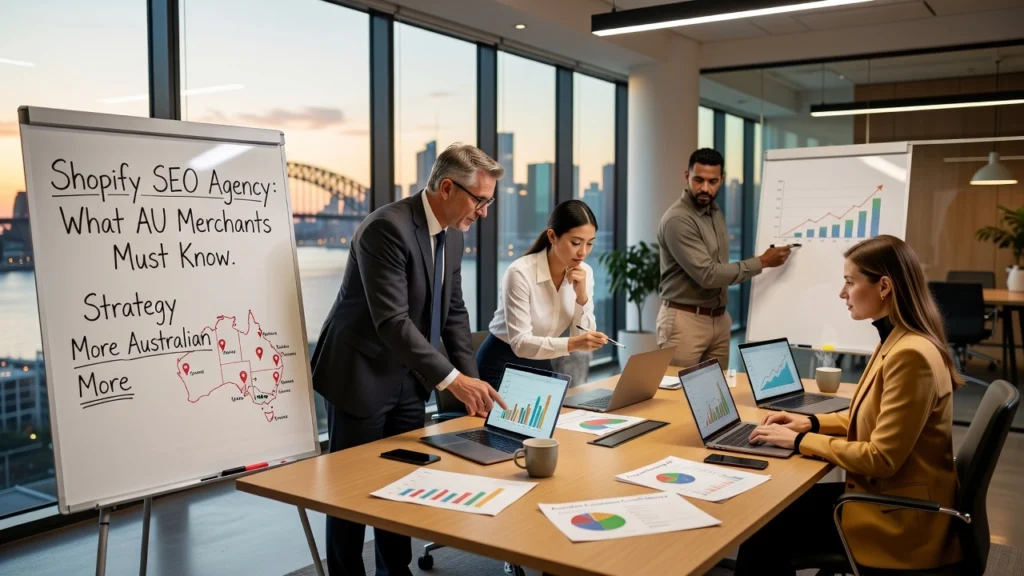
Running an online store in Australia means competing in a market that rewards visibility. If your Shopify store is not ranking where it should, the problem often comes down to one thing: strategy. More Australian merchants are turning to a Shopify SEO agency to close the gap between where they are and where their customers are searching.
But not all agencies are created equal, and choosing the wrong partner can cost you time, money, and organic growth you cannot afford to lose. Whether you have dabbled in SEO before or you are ready to make a serious investment, understanding what these agencies actually do, what results to expect, and how to evaluate them is critical before signing any contract.
This guide cuts through the noise. You will find a clear breakdown of what a qualified Shopify SEO agency should offer Australian merchants, the key questions you need to ask before committing, and the red flags that signal an agency is not worth your budget. If you want to grow your store’s organic traffic with confidence, you are in the right place.
Why Shopify SEO Is a Distinct Discipline
Shopify operates as a closed, opinionated platform, and that architecture creates a category of SEO challenges that simply do not exist on more flexible systems. Understanding these challenges is not optional for merchants who want to compete in organic search. It is the baseline requirement for any strategy worth investing in.
1. Platform Architecture Creates Structural SEO Conflicts
Shopify’s URL structure is rigid by design. A single product can be accessed via /products/product-name and also via /collections/collection-name/products/product-name, generating two live URLs pointing to identical content. While Shopify inserts canonical tags intended to resolve this, those canonicals frequently conflict, fail to consolidate link equity effectively, or surface as Search Console errors such as “Duplicate, Google chose different canonical.” On top of this, pagination parameters, tag-filtered collection URLs, and variant-specific paths compound the problem at scale. These issues differ fundamentally from what you would encounter on WordPress or a custom build, where URL structures, redirects, and canonicalisation logic are far more configurable. Resolving them on Shopify requires Liquid-level theme edits, deliberate internal linking strategy, and, in many cases, platform-specific technical interventions that generic SEO experts are rarely equipped to execute.
2. Speed Is Strong, But Rankings Require More
Approximately 93% of Shopify stores load quickly, and the platform’s edge caching infrastructure gives merchants a genuine performance advantage. However, speed is one signal among many. Core Web Vitals matter, but structured data, crawlability, and internal linking architecture carry equal weight in determining whether a page ranks and converts. Third-party apps, unoptimised theme scripts, and bloated plugin stacks can erode that performance advantage quickly. Treating site speed as the finish line rather than the starting point is one of the most common mistakes made when applying generic SEO thinking to Shopify stores.
3. Structured Data Requires Platform-Specific Implementation
Shopify includes a built-in structured_data Liquid filter that outputs basic Product schema, but eligibility for rich results, including price badges, aggregate ratings, availability indicators, and breadcrumb trails, requires considerably more. Implementing accurate ProductGroup schema for variant-heavy catalogues, populating GTINs via metafields, and building CollectionPage or OfferCatalog markup into theme templates demands hands-on knowledge of how Shopify models its data. Generic agencies frequently apply one-size-fits-all JSON-LD snippets that ignore the platform’s native data structure entirely, leaving significant rich result eligibility on the table.
4. Faceted Navigation Can Silently Destroy Crawl Efficiency
Shopify filter pages, sorted by colour, size, price, tag, or any combination thereof, can generate thousands of indexable URLs overnight. Many of these pages are thin, near-duplicate, and contribute nothing to rankings while consuming crawl budget that Google would otherwise spend on revenue-generating product and collection pages. Real-world audits regularly uncover Shopify stores with tens of thousands of indexed filter URLs driving minimal traffic. Without strategic canonical management, selective noindex directives, and robots.txt refinements, faceted navigation becomes a silent drain on the entire site’s SEO performance.
5. Specialisation Is Not a Premium, It Is a Prerequisite
A Shopify SEO agency that does not understand collections, metafields, app-generated content conflicts, and Liquid template constraints is not applying Shopify SEO. It is applying generic SEO to a platform that will actively resist it. The result is wasted budget, missed technical opportunities, and strategies that look thorough on paper but fail to account for how the platform actually behaves in practice. Shopify rewards specialists who build inside its constraints, not generalists who work around them.
The Shopify SEO Landscape in 2026
The numbers behind organic search make a compelling case for prioritising it above almost every other acquisition channel available to Shopify merchants. Organic search drives approximately 43% of e-commerce traffic and is directly linked to around 23.6% of all online orders, making it one of the highest-leverage revenue channels on the platform. Unlike paid media, which requires continuous spend to maintain visibility, a well-executed SEO strategy compounds over time, building an asset that generates traffic and conversions long after the initial investment. For merchants operating on tight margins, that distinction is not academic; it is the difference between a scalable business and one perpetually dependent on ad budgets.
One of the more significant developments shaping the 2026 search landscape is the rise of AI Overviews, Google’s AI-generated summaries that now appear on approximately 48% of all searches. For merchants selling informational content, this shift creates real exposure. However, pure e-commerce queries tell a different story: AI Overviews appear on only around 4% of product and shopping-intent searches. This means product pages, collection pages, and category-level content on Shopify stores remain largely insulated from the AI-driven click-through rate compression that is disrupting publishers and content-heavy sites. That insulation is a structural advantage worth understanding and protecting through consistent on-page and technical optimisation.
Where AI Overviews do appear, the impact on organic click-through rates is measurable and meaningful. Per Seer Interactive research, CTRs on affected queries compressed to as low as 1.3% before partially recovering to around 2.4% in early 2026. The implication for Shopify merchants is clear: prioritising rankings for transactional and commercial queries, where AI Overviews are far less prevalent, protects organic traffic in a way that chasing informational rankings simply cannot guarantee.
Content quality has become a sharper competitive edge than at any point in recent memory. With 69% of Shopify merchants now using AI tools for content generation, product descriptions and category copy have become increasingly uniform across the platform. Google’s ongoing E-E-A-T updates are designed precisely to surface this problem, penalising template-like content that lacks original expertise, genuine product knowledge, or first-hand experience. Merchants who invest in differentiated, authoritative copy are not just following best practice; they are pulling away from the majority who are inadvertently triggering quality signals that suppress rankings.
The economics of paid media are accelerating this shift. Rising costs across Google Ads and Meta are pushing more merchants toward organic SEO as a sustainable alternative. The cost of inaction is no longer abstract; every quarter that passes without a compounding organic presence is a quarter where paid acquisition costs climb and competitors consolidate their search visibility.
The competitive environment itself is intensifying. Shopify reported 11% year-on-year store growth in Q1 2026 and now supports merchants across 175 or more countries. More stores entering any given product category means more pages competing for the same search real estate. For growth-minded merchants, the question is not whether SEO deserves investment in 2026; it is whether they can afford to delay it any further.
What a Shopify SEO Agency Should Actually Deliver
Not every agency that lists Shopify SEO as a service actually understands the platform at an architecture level. Here is what separates credible execution from surface-level work, broken down across the six core deliverables that move the needle on organic revenue.
1. A Platform-Specific Technical Audit
The foundation of any credible engagement is a technical audit scoped to Shopify’s actual infrastructure, not a generic crawl report. Duplicate content is endemic to the platform: collection URLs, variant pages, and filter parameters routinely generate multiple indexable paths to the same product, fragmenting ranking signals across competing URLs. A competent audit addresses canonicalisation settings, verifies that self-referencing canonicals are intact and not overridden by apps or theme updates, reviews robots.txt to ensure critical paths are accessible to Googlebot, and benchmarks Core Web Vitals scores against the thresholds that influence ranking: LCP under 2.5 seconds, CLS under 0.1. App-generated code bloat is an equally common culprit; third-party scripts installed and then abandoned continue loading on every page, degrading crawl efficiency and user experience simultaneously. Refer to Shopify’s technical SEO audit guide for a structured starting point on what this process should cover.
2. On-Page Optimisation That Goes Beyond the Basics
Title tags and meta descriptions represent the minimum, not the deliverable. A Shopify SEO agency should implement product schema markup in JSON-LD format to qualify for rich results in search, including price, availability, and review data that lifts click-through rates significantly. Breadcrumb structured data improves both SERP display and internal navigation signals. Internal linking deserves particular attention: connecting collection pages to relevant product pages and anchoring both to supporting blog content distributes authority through the site architecture and increases session depth. Image alt text should be written to match actual search intent, describing what a user would search for rather than what the image contains generically.
3. Content Strategy Built Around Topical Authority
Publishing blog posts on a consistent calendar is not a content strategy. A results-driven approach maps keyword targets across three layers: commercial queries tied directly to product and collection pages, comparison and consideration queries that capture users mid-funnel, and informational queries that build topical authority around the categories you sell in. This architecture creates an acquisition funnel from initial discovery through to purchase, rather than generating traffic that has no logical conversion path. With 69% of Shopify merchants now using AI tools for content generation, differentiation comes from depth, first-hand expertise, and content that demonstrates genuine experience with the product category, qualities that align directly with Google’s E-E-A-T standards. Review Shopify’s SEO checklist for guidance on aligning content structure with platform best practices.
4. Link Acquisition Prioritising Relevance Over Volume
A single editorial link from a relevant industry publication or a trusted supplier carries more ranking authority than a catalogue of low-relevance directory citations. Effective link acquisition for e-commerce is built around earning links through genuinely useful content, such as original research, detailed buying guides, or product-focused resources that publishers in your niche would reference organically. Supplier relationships, expert contributions to trade publications, and brand mention reclamation are all legitimate acquisition channels. Volume tactics show diminishing returns; topical relevance and natural placement are the signals that correlate with sustained ranking gains.
5. Reporting Tied to Revenue, Not Rankings
Keyword ranking movement is a leading indicator, not a business outcome. Reporting should be structured around organic sessions to product and collection pages, assisted conversions attributed to organic traffic in GA4, and changes in average order value among SEO-driven visitors. These metrics connect agency activity directly to revenue, making performance visible at the commercial level rather than the positional one. Agencies that default to ranking dashboards without revenue attribution are measuring effort, not impact.
6. Generative Engine Optimisation as a Forward-Looking Priority
While AI Overviews currently appear on only around 4% of pure e-commerce queries, the trajectory is clear and the preparation required is substantive. Structuring product content with accurate schema, conversational FAQs, and authoritative supporting material positions Shopify store pages to be cited in AI-generated summaries across platforms including Google, Perplexity, and ChatGPT. This is not a speculative investment; it is the logical extension of strong on-page and content work applied to the emerging layer of search behaviour where commercial queries are increasingly answered before a user clicks anywhere.
Red Flags to Watch for When Evaluating an Agency
Choosing the right Shopify SEO agency requires more than reading a sales page. The warning signs are often embedded in how an agency communicates its service before you sign anything. Knowing what to look for protects your budget and your store’s long-term search health.
1. They promise guaranteed rankings.
No legitimate agency can guarantee a specific position on Google, and Google’s own guidelines make this explicit. Search rankings are influenced by algorithm updates, competitor behaviour, seasonal demand shifts, and dozens of factors outside any agency’s control. Agencies that lead with “#1 ranking guaranteed” are either misrepresenting their capabilities or relying on short-term tactics that create long-term penalties. What a credible agency can guarantee is a rigorous, transparent process tied to revenue outcomes, not a position on a search result page that may shift overnight.
2. Their audit report could belong to any store.
A genuine Shopify SEO audit references your specific theme, whether that is Dawn, a custom build, or a heavily modified commercial template. It accounts for your installed app stack, your URL configuration, your product catalogue hierarchy, and your existing duplicate content exposure. If the report you receive reads like a checklist that could have been generated for any e-commerce store, the agency has not performed a diagnostic. They have performed a template exercise, and that process will never surface the platform-specific issues costing your store rankings.
3. Technical SEO is absent from their service description.
If Core Web Vitals, structured data, and duplicate content management are not explicitly mentioned in how the agency describes its work, their knowledge does not extend to the technical layer where many Shopify stores quietly lose visibility. One analysis found that default Shopify configurations without proper product schema and canonical handling can cost stores significant traffic on product pages. Agencies that skip over these foundations are leaving high-impact opportunities untouched.
4. Content deliverables are measured in volume, not strategy.
“Six blog posts per month” is an output metric, not a strategic commitment. Without a topical authority framework, search intent mapping, and content aligned to your product and collection pages, that volume produces noise rather than rankings. Effective content in 2026 is built around competitive gap analysis and conversion pathways, not a publishing calendar filled with generic articles.
5. Offshore content production lacks E-E-A-T oversight.
With 69% of Shopify merchants already using AI tools for content generation, Google has sharpened its ability to identify and discount generic, unsubstantiated copy. Agencies that rely on offshore production pipelines without editorial oversight or E-E-A-T protocols expose your product pages to exactly the kind of content quality penalties that have intensified through recent algorithm updates. First-hand experience signals, verified expertise, and authentic brand voice are now ranking differentiators, particularly on competitive product and collection pages.
6. Their reporting centres on keyword positions rather than revenue.
Keyword rankings are a supporting metric, not a business outcome. If an agency’s monthly report leads with position tracking across a keyword list but offers no visibility into organic traffic to revenue-generating pages, conversion rates, or assisted revenue attribution, they are optimising for the metric that looks impressive in a presentation rather than the one that reflects actual commercial performance. Agencies focused on sustainable results tie their reporting directly to the pages and queries that drive transactions, not to rankings that can move independently of revenue entirely.
Questions to Ask a Shopify SEO Agency Before You Sign
The questions you ask before signing with a Shopify SEO agency reveal as much about the agency as their pitch deck ever will. Use these eight questions as a structured filter to separate platform-literate specialists from generalists recycling generic SEO advice.
1. How do you handle Shopify’s duplicate URL issues and canonicalisation?
Shopify automatically generates multiple URLs for the same product when it appears across different collections, for example /collections/accessories/products/leather-wallet alongside the primary /products/leather-wallet. A knowledgeable agency will explain how they audit Liquid templates, implement or correct canonical tags to point to the primary product URL, and manage filtered or paginated collection pages with self-referencing canonicals. If an agency gives you a vague answer about “fixing duplicate content,” push harder. The technical mechanics matter, and best-practice Shopify SEO strategies for 2026 confirm that unresolved canonicalisation remains one of the most common and damaging issues on the platform.
2. Can you walk me through a recent Shopify technical audit?
Ask for a real example, not a templated checklist. Strong agencies will describe the three most common issues they encounter, typically duplicate content from collection paths and faceted navigation, Core Web Vitals failures driven by app bloat and unoptimised images, and indexation problems caused by thin tag pages or misconfigured robots.txt files. More importantly, ask how they prioritised those fixes. The answer should reflect a logic based on revenue impact: canonical and indexation issues first, then site speed, then schema and internal linking. Prioritisation discipline distinguishes an agency that executes strategically from one that works through issues randomly.
3. How do you build content strategy around a product catalogue?
A credible approach starts with keyword mapping that assigns commercial-intent terms to collection pages and long-tail, specific queries to individual product pages to prevent cannibalisation. The agency should identify your top 10 to 20 highest-value collections first, based on search volume, current performance in Google Search Console, and business margin. From there, they build topical authority by treating collection pages as content hubs supported by buyer guides, FAQs, and blog clusters that link back internally. This structure signals expertise to Google and positions your catalogue as the authoritative resource in its category.
4. What does your reporting include beyond keyword rankings?
Rankings tell you where you sit; revenue data tells you whether it matters. Insist on reports that include organic traffic and sessions, impressions and clicks from Google Search Console, organic conversion rate, and revenue attributed to organic search through GA4 and Shopify analytics. The best agencies tie specific activities to measurable outcomes, showing how a batch of technical fixes or new collection page content contributed to a lift in organic sessions or transactions that month.
5. How are you adapting for AI Overviews and generative search in 2026?
While AI Overviews appear on roughly 48% of all searches, they affect only around 4% of pure e-commerce queries, which means product and collection pages have relative protection from click-through compression. That said, a forward-thinking agency will explain how they use structured data, schema markup, E-E-A-T signals, and thorough topical coverage to position your pages as citable sources within AI-generated responses. Generative Engine Optimisation is becoming a parallel discipline alongside traditional SEO, and your agency should be building for both simultaneously.
6. Have you worked with stores similar to mine?
Ask for case studies with specifics: niche, store size, starting baseline, timeline, and outcomes. Results achieved for a high-volume fashion retailer may not translate directly to a boutique homewares store, so relevance matters. Request before-and-after metrics covering organic traffic, rankings, and ideally revenue growth. If an agency cannot share specifics due to confidentiality, they should at least describe the store type and the strategic approach used.
7. What is your link acquisition approach for e-commerce?
White-hat link building for Shopify stores should be anchored in relevance. The agency should describe creating linkable assets tied to your product categories, such as guides or original data, outreaching to niche-aligned publications, and earning contextual links that point directly to collection or product pages rather than just the homepage. Links from thematically unrelated domains carry minimal value and can introduce risk.
8. What assets will we own if we part ways after six months?
Everything the agency creates or installs on your store should belong to you. That includes full audit documentation, keyword research and content maps, all written content published to product and collection pages, technical fixes implemented in your theme, and a structured handover report detailing what was done and why. Clarify ownership clauses before signing, not after.
Why Australian Shopify Merchants Face Unique Challenges
Australian Shopify merchants operate in a market that global SEO agencies are structurally ill-equipped to serve. Understanding why requires looking at five specific mismatches between what the dominant agency landscape offers and what local merchants actually need.
1. The agency landscape is built for North America
Browse any major roundup of top Shopify SEO agencies and a pattern emerges immediately. Directories like Clutch, Siege Media, and Break the Web feature rosters populated almost entirely by US-based firms optimising for .com domains, American search volumes, and North American competitor sets. These agencies have refined their methodologies against the largest English-language market in the world, which is a genuine strength in that context. Applied to an Australian merchant, however, the keyword research baselines, backlink benchmarks, and content frameworks are calibrated to the wrong audience entirely. The result is strategy that looks coherent on a reporting dashboard but misses the actual search behaviour of Australian buyers.
2. Australian search intent and seasonal patterns require local calibration
Search intent in Australia is not simply a translated version of US behaviour. Seasonal retail peaks follow a different calendar: EOFY promotions in June and July, Boxing Day sales on December 26, and a growing but secondary Black Friday influence all create traffic and conversion patterns that diverge sharply from the Thanksgiving-to-Christmas cycle that US agencies optimise around. A content calendar built on Northern Hemisphere retail logic will consistently mistime promotional pushes, category page optimisation, and blog content that captures buying intent at the wrong moments. Australian consumers also demonstrate distinct price sensitivity and comparison-shopping habits, particularly around shipping costs tied to geographic distances, which feed into keyword intent in ways that US benchmarks do not capture.
3. Small merchants and sole traders are an afterthought for most agencies
Approximately 97 to 98 percent of Australian businesses are classified as small, with sole traders making up a substantial share of that figure. This demographic is well represented among Australia’s Shopify merchant base, spanning independent artists, wellness practitioners, handmade goods sellers, and specialty retailers. Most established global agencies structure their services around mid-market and enterprise clients, with retainer pricing and campaign complexity to match. Smaller Australian merchants are left choosing between unaffordable packages designed for seven-figure stores and generic low-cost providers that lack platform-specific expertise. Neither option serves the actual needs of a growing independent business.
4. Local competitors carry offline brand authority that demands a localisation strategy
In categories like homewares, fashion, wellness, and artisan goods, Australian Shopify merchants frequently compete against established brands with decades of physical retail presence. That history translates directly into domain authority advantages online, accumulated through years of press coverage, directory listings, customer reviews, and organic backlinks from local publications. A generic SEO approach does not account for this dynamic. Closing the authority gap requires geo-specific content, Australian English keyword variants, local link-building through relevant industry and community sources, and positioning that speaks to the Australian buyer’s preference for supporting domestic brands.
5. Timezone alignment is a practical operational requirement
A 12 to 16 hour timezone gap between AEST and US business hours means that algorithm updates, Google Search Console alerts, and site-level technical emergencies can go unaddressed for the better part of a trading day. For a merchant running a time-sensitive promotion or dealing with a sudden ranking drop, that delay carries a real revenue cost. An agency operating within Australian business hours can respond, investigate, and implement fixes during the window that matters, rather than picking up the issue the following morning after the damage has accumulated overnight.
How The Brand Express Approaches Shopify SEO
Every Shopify store that comes to The Brand Express receives a strategy built from scratch around its specific architecture, product catalogue, competitive landscape, and business objectives. There are no templated packages applied uniformly across clients, because a ceramics artist selling handmade pieces through a twelve-product Shopify store has fundamentally different structural needs, keyword priorities, and content requirements than a multi-category retailer with hundreds of SKUs. The agency conducts a full audit of each store before making a single recommendation, mapping technical gaps, on-page weaknesses, and authority deficits specific to that merchant’s situation rather than pulling from a pre-written deliverable list.
One of the more consequential differentiators in how The Brand Express operates is its explicit commitment to smaller operators. Growth-minded businesses, sole traders, and artists are positioned as primary partners, not secondary accounts managed by junior staff while larger budgets receive senior attention. If you are a side-hustle founder scaling a Shopify store in the evenings, or a creative building an audience-driven product business, you will receive the same quality of strategic thinking and technical execution as any other client. That commitment is structural, not marketing language.
The framing that guides every engagement is SEO as a revenue lever rather than a rankings exercise. Improving a position in Google’s results is not the goal; it is a mechanism for driving targeted organic traffic that converts into high-value leads and orders. This distinction shapes how success is measured. Reporting is tied to metrics that reflect actual business growth, including qualified traffic trends, lead quality, and revenue contribution from organic channels, rather than vanity data points that look impressive but do not connect to income.
Technical Shopify SEO, on-page optimisation, content strategy, and link acquisition are treated as components of a single integrated system. Weaknesses in one area limit the performance of all others, so they are addressed together and measured together rather than as disconnected deliverables.
Australian market knowledge and AEST availability underpin the entire service. Familiarity with local search behaviour, the competitive dynamics of Australian e-commerce categories, and the ability to communicate within business hours are built into the offering from day one, not retrofitted onto a global template after the fact.
Choosing the Right Shopify SEO Agency: Key Takeaways
Every conclusion worth reaching comes down to five principles. Shopify SEO is a platform-specific discipline, not a generic service with a Shopify logo stamped on it. Insist on demonstrated fluency with collections architecture, duplicate URL handling, and theme-level technical constraints before committing to any retainer.
The 2026 SEO landscape rewards experience-driven, conversion-oriented strategies tied directly to revenue. Agencies still quoting keyword ranking reports and monthly blog volumes are operating from a playbook that pre-dates E-E-A-T enforcement, AI Overviews, and profit-focused measurement. That gap in thinking translates directly into missed revenue for your store.
Australian merchants face structural disadvantages when working with globally-oriented agencies. Local search behaviour, Australian competitor context, and timezone-aligned communication are material to execution quality, not optional extras.
Use the questions outlined in this guide as a hard filter before signing anything. Genuine expertise answers them with specificity; recycled templates deflect with generalities.
If you are ready to treat SEO as the revenue lever it genuinely is, The Brand Express offers a no-obligation discovery conversation. Start with an audit enquiry at thebrandexpress.com.au.