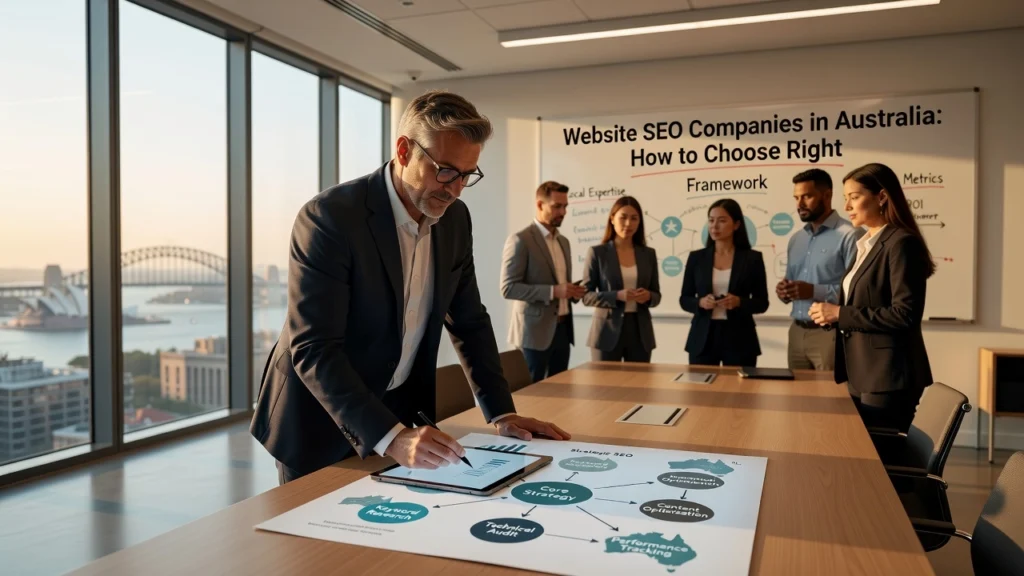
Choosing the wrong SEO partner can cost your business thousands of dollars and months of wasted time. With hundreds of website SEO companies operating across Australia, the decision feels overwhelming, and the stakes are high. Not every agency delivers what it promises, and without the right framework for evaluation, it is easy to fall for polished sales pitches over genuine expertise.
This guide cuts through the noise. Whether you are a business owner scaling your digital presence or a marketing manager vetting potential partners, you need more than a list of agency names. You need a clear, structured way to compare your options based on what actually drives results.
In the following sections, we break down the key criteria that separate high-performing Australian SEO agencies from the rest. We cover pricing models, contract structures, reporting transparency, specialisation, and red flags to watch for during the sales process. By the end, you will have a practical comparison framework that helps you make a confident, informed decision rather than an expensive mistake.
What Do Website SEO Companies Actually Do?
Website SEO companies operate across four interconnected service pillars that together build sustainable organic visibility. Technical SEO forms the foundation, ensuring search engines can efficiently crawl, index, and render your site. This covers site architecture, broken links, duplicate content, HTTPS security, schema markup, and Core Web Vitals, the trio of loading speed, interactivity, and visual stability that Google uses as direct ranking signals. Content strategy goes well beyond individual keyword targeting; agencies build topical authority by clustering related keywords into pillar pages and supporting content, mapping each piece to buyer intent, and establishing E-E-A-T signals through original research, expert authorship, and depth of coverage. Link building focuses on earning high-quality backlinks through digital PR, ethical outreach, and unlinked brand mention reclamation, growing domain authority in ways that compound over time. Local SEO rounds out the core offering, optimising Google Business Profiles, building consistent directory citations, and creating geo-targeted landing pages to capture “near me” searches and map pack visibility.
Where website SEO companies separate themselves from freelancers and in-house teams is in their combination of enterprise tooling, specialist depth, and adaptive strategy. A single agency retainer typically includes access to platforms like Ahrefs, Semrush, and Screaming Frog, tools that can collectively cost thousands of dollars per month to license individually. More importantly, agencies bring multi-disciplinary teams covering technical audits, content production, link outreach, and data analysis under one roof. Freelancers suit one-off projects or narrow scopes but lack the bandwidth for complex, evolving campaigns. In-house teams offer cultural alignment but often carry significant overhead and narrower expertise. For growth-focused businesses, understanding what a full-service SEO agency actually delivers helps set the right expectations before signing any retainer.
The scope of SEO work has expanded significantly in 2026. Modern agencies now include AI visibility optimisation alongside traditional ranking work. With Google AI Overviews reaching approximately 2 billion monthly users and AI search traffic growing by 527% in a single recent year, appearing in generative search results has become a legitimate business priority. Agencies structure content with clear headings, modular summaries, and schema markup so AI engines can extract and cite it accurately, across Google AI Overviews, ChatGPT, and Perplexity. Building a strong entity footprint across the web has become essential for brand recognition by both traditional algorithms and AI systems.
In terms of month-to-month deliverables, a well-run agency relationship typically includes technical and content audits with prioritised recommendations, keyword clustering reports and content briefs, backlink outreach logs with acquired link documentation, ranking dashboards that track both traditional SERP positions and AI citation visibility, and regular strategy reviews that assess performance against business goals rather than surface-level metrics.
That revenue focus matters because, according to HubSpot, SEO ranks as the top ROI-generating marketing channel across industries, ahead of paid social and email marketing. Strong agencies translate this potential into measurable outcomes by targeting high-intent keywords, connecting organic traffic to qualified leads through attribution modelling, and integrating conversion rate optimisation into their content work. The distinction between a high-performing agency and an average one often comes down to whether they report on revenue impact or simply celebrate keyword position gains.
The 2026 Shift: Why Your SEO Company Must Understand AI Search
The search landscape your business operates in today looks fundamentally different from even two years ago, and the website SEO companies worth your investment in 2026 are the ones who recognise this without prompting.
Google AI Overviews now reach approximately 2 billion monthly users, spanning more than 200 countries and 40 languages. This single data point should reshape how you evaluate any SEO provider. When a prospective customer types a query into Google, there is now a meaningful probability that an AI-generated summary answers their question before a single traditional blue link enters their field of vision. If your SEO company does not have a deliberate strategy for earning citations within those AI summaries, a growing segment of your highest-intent audience is effectively invisible to your brand. Optimising for AI Overviews requires structured content, demonstrable expertise signals, and entity-level authority that older SEO frameworks were never designed to produce.
The zero-click reality compounds this challenge considerably. More than 60% of searches now conclude without a user clicking through to any website. Agencies that continue presenting rank improvements and traffic volume as the primary measures of success are selling an incomplete picture. The more productive conversation with your SEO partner should centre on revenue attribution, assisted conversions, and citation visibility across AI-mediated results. If an agency cannot articulate how their work influences outcomes beyond the click, that is a significant gap in their service model.
The Multi-Engine Imperative
AI search traffic surged 527% in a single recent year, and ChatGPT now commands approximately 17% of search query share as an alternative discovery platform. These are not niche metrics. They reflect a structural diversification of how people find information, products, and services online. A credible SEO partner in 2026 builds visibility simultaneously across Google, Bing, and generative engines including ChatGPT, Perplexity, and Gemini, tracking referral traffic, citation frequency, and brand sentiment across each platform. Agencies optimising exclusively for Google’s traditional index are leaving an accelerating traffic channel unaddressed.
Gartner’s forecast of a 25% decline in traditional search volume by 2026, driven directly by AI chatbot adoption, makes Generative Engine Optimization (GEO) and Answer Engine Optimization (AEO) non-negotiable service components for any forward-thinking agency. GEO focuses on structuring content so that generative AI systems synthesise and cite it in responses. AEO prioritises direct, authoritative answers to specific questions, increasing the likelihood that your business surfaces in answer-style results. Neither discipline is optional for businesses that rely on organic discovery.
Entity SEO as a Competitive Differentiator
Brand-first and entity SEO has become one of the sharpest dividing lines between agencies equipped for 2026 and those operating on legacy assumptions. Agencies that invest in structured entity recognition, consistent NAP (Name, Address, Phone) data, schema markup, and authoritative brand mentions across credible third-party sources help clients get cited by AI systems rather than simply indexed by crawlers. This distinction matters enormously: being indexed means you might appear in traditional results; being cited means you appear in the AI-generated answers that now intercept the majority of informational queries.
According to Semrush data, nearly 70% of businesses report higher ROI from AI-integrated SEO strategies. When evaluating any SEO provider, push them specifically on this point. Ask how they monitor AI citations for your brand, what GEO testing processes they run, how they conduct entity audits, and how they report on cross-platform visibility beyond Google Search Console. The agencies with considered, specific answers to those questions are the ones building strategies designed for the search environment that actually exists today.
Types of SEO Companies: Which Model Fits Your Business?
Not every business needs the same type of SEO partner, and choosing the wrong model is one of the most common reasons SEO investments underdeliver. The market broadly splits into four distinct agency types, each with different pricing structures, capabilities, and ideal client profiles.
Enterprise and Full-Service Agencies
Large full-service agencies operate with teams of 50 to 250-plus specialists and serve mid-market to corporate clients with budgets typically ranging from $3,000 to $10,000 or more per month. Their value proposition centres on infrastructure: proprietary reporting dashboards, dedicated cross-functional teams across technical SEO, content, link acquisition, and paid integration, plus hundreds of documented case studies. These agencies are well-resourced for AI search readiness, with proprietary tools built to track performance across Google AI Overviews and evolving generative search environments. The trade-off is rigidity. Scope tends to be structured around standardised retainer tiers, which means smaller or niche businesses often pay for capacity they do not use. For a sole trader or a creative business competing in a specific Australian suburb or vertical, this model rarely delivers proportional returns.
Mid-Tier Generalist Agencies
Mid-tier agencies occupy the $1,000 to $3,000 per month range and serve a broad cross-section of SMBs and growing businesses. They cover the fundamentals competently, including technical audits, content calendars, and basic reporting, but breadth is the defining characteristic, not depth. According to 2026 SEO pricing data, mid-size agencies frequently apply templated retainer structures that work well for standard eCommerce or service businesses but struggle to accommodate the specificity demanded by hyper-local Australian geo-targeting, niche creative industries, or businesses that need entity-based optimisation for AI visibility. If your competitive landscape requires genuine differentiation rather than competent execution of a standard playbook, the mid-tier model often falls short.
Boutique and Specialist Agencies
Boutique agencies maintain smaller client rosters deliberately, because selectivity enables the depth and responsiveness that larger operations cannot sustain. Bespoke strategies, direct access to senior practitioners, faster communication cycles, and genuine niche expertise define this model. For growth-minded small businesses, sole traders, and artists, a boutique agency is typically the highest-value option because the strategy is built around the specific business rather than adapted from a template. Current SEO trends for 2026 confirm that boutique models are particularly well-positioned to address AI search readiness at a local level, combining Google Business Profile optimisation, citation building, and entity recognition strategies that help businesses appear in both traditional results and generative AI answers.
Freelance SEO Consultants vs. Agencies
Freelancers offer genuine cost advantages for focused, single-channel work such as a technical audit, a content strategy brief, or a local citation clean-up. Hourly rates typically sit between $75 and $150, making them accessible for businesses with narrow, well-defined needs. However, the limitation becomes apparent when a business requires integrated execution across technical SEO, content development, link building, and measurable reporting simultaneously. Most freelancers lack the multi-disciplinary bandwidth to deliver that cohesively, and coordination overhead falls back on the business owner.
Comparison Matrix: Five Dimensions That Matter
When evaluating any SEO partner, assess them across these five dimensions before committing to a retainer.
| Dimension | Enterprise | Mid-Tier | Boutique/Specialist | Freelancer |
|---|---|---|---|---|
| Pricing Transparency | Quote-based, high minimums | Moderate, variable | Tailored, often clearer | Hourly or project-based |
| Niche Specialisation | Broad | Shallow | Deep | Variable |
| AI Search Readiness | Strong (proprietary tools) | Developing | Agile, niche-focused | Limited |
| Australian Local SEO | Capable at scale | General | Strongest fit | Single-location only |
| Reporting Standards | Extensive dashboards | Standard metrics | High-touch, personalised | Basic |
The right model is determined by your growth stage, budget, and how specifically your business needs to compete. For businesses operating in defined Australian markets or creative niches, boutique and specialist agencies consistently deliver the most relevant, measurable outcomes relative to investment.
Top Website SEO Companies in Australia Compared
Choosing the right SEO partner requires more than scanning a top-ten list. Agency fit depends on your business size, budget, growth stage, and whether you need a pure SEO specialist or a broader digital marketing partner. The five agencies compared below represent a cross-section of what the Australian market offers in 2026, from boutique performance specialists to enterprise-grade operators.
The Brand Express
The Brand Express is a boutique SEO agency serving Brisbane, Sydney, and Melbourne, with a clearly defined niche that most agencies avoid: sole traders, artists, and growth-minded small businesses. While larger agencies focus their sales pitch on ecommerce brands and corporate retainers, The Brand Express builds bespoke, brand-first SEO strategies designed for AI entity recognition, local pack visibility, and Answer Engine Optimization (AEO). This matters in 2026 because search is no longer purely a ranking game; being cited by Google AI Overviews and generative engines requires structured entity signals that many small businesses have never built.
Pricing is positioned as a major differentiator. The agency claims up to 60% cost savings compared to typical agency plans, with flat-rate packages starting around $500 to $750 per month and month-to-month flexibility rather than locked-in contracts. Case studies on their site reference outcomes including 220% increases in enquiries and 748% ROI examples for clients who had previously received little measurable value from SEO spend. For sole traders and creatives seeking performance-driven results without enterprise-level pricing, The Brand Express represents the most accessible and purpose-built entry point in this comparison.
Best for: Small businesses, sole traders, and artists entering competitive search landscapes without large SEO budgets.
StudioHawk
StudioHawk is Melbourne-based and positions itself as Australia’s largest dedicated SEO agency, with over 120 SEO specialists and offices in Sydney, London, and Atlanta. The agency has built a strong reputation for technical SEO depth and has been an early mover on AI search strategies, adapting its service stack to address generative engine visibility alongside traditional rankings. StudioHawk works primarily with ecommerce brands and mid-market clients who have established SEO budgets and require sophisticated, scalable campaigns. Its pricing reflects both the specialization and the operational scale involved, making it less suitable for businesses just starting their SEO journey.
Best for: Established ecommerce businesses with dedicated SEO investment seeking advanced technical and AI-optimized strategies.
Dilate Digital
Dilate Digital is a Perth-based full-service digital agency that bundles SEO with paid media, web design, social media management, and content marketing under one roof. For businesses that want to consolidate their digital marketing relationships rather than managing separate specialist providers, Dilate offers genuine breadth. Their SEO work sits within an integrated strategy framework, which suits clients who need organic and paid channels to work in coordination. The trade-off is that SEO is one of several services rather than the agency’s singular focus, which can mean less depth on purely technical or content-led SEO challenges.
Best for: Businesses seeking consolidated digital marketing management rather than a pure-play SEO specialist.
SIXGUN
SIXGUN is a Melbourne agency with a data-driven methodology and a reputation for transparent reporting tied directly to revenue outcomes. The agency emphasizes measurable ROI across ecommerce SEO and integrated digital campaigns, with Clutch ratings of 5.0 reflecting consistent client satisfaction in quality, communication, and cost-effectiveness. SIXGUN’s approach suits growth-stage businesses and online retailers who want granular accountability in their SEO investment, with clear reporting frameworks rather than vanity metrics. Hourly rates sit around $100 to $149, with project minimums starting from $1,000, positioning it as a mid-market option with boutique-level attention to results.
Best for: Online retailers and growth-stage businesses that prioritize data accountability and transparent performance tracking.
Clearwater Agency
Clearwater Agency operates primarily out of Melbourne and Sydney, with a client history that skews toward larger brands, enterprise accounts, and not-for-profit organisations. The agency brings strong technical SEO capability and a multi-channel approach that integrates SEO with PPC, content, and social strategies. Multiple APAC and Global Search Award wins speak to its execution quality on complex technical projects including site migrations. However, minimum engagement sizes and hourly rates around $150 mean the barrier to entry is higher, making Clearwater less practical for small businesses or sole traders with limited budgets.
Best for: Mid-market and corporate clients in Sydney and Melbourne requiring enterprise-grade SEO and integrated digital strategy.
The Defining Difference
Across this comparison, the agencies diverge sharply on who they actually serve. StudioHawk, SIXGUN, and Clearwater all operate at a scale and price point that assumes an established business with a real SEO budget already in place. Dilate Digital suits those who want fewer agency relationships rather than deeper SEO specialization. The Brand Express is the only agency in this group that has explicitly built its entire offer around small businesses and sole traders, including AI-ready entity SEO and brand-first strategies designed for how search actually works in 2026. For smaller Australian businesses entering competitive digital markets for the first time, that specificity is not a minor detail; it is the difference between a strategy built for your reality and one adapted down from an enterprise template.
7 Questions to Ask Any SEO Company Before You Sign
Before committing budget and months of effort to any SEO partner, these seven questions will quickly separate credible, forward-thinking agencies from those selling yesterday’s playbook.
1. How Do You Approach AI Search Optimization?
This question alone will reveal whether an agency is operating in 2026 or 2021. A credible partner should speak fluently about Generative Engine Optimization (GEO), Answer Engine Optimization (AEO), entity building, and strategies for securing citations within Google AI Overviews and generative search platforms. GEO focuses on structuring content so platforms like Google AI Overviews, Perplexity, and ChatGPT extract and cite your brand in direct responses. AEO targets featured snippets and People Also Ask placements. Entity building ensures consistent schema markup and E-E-A-T signals so AI systems recognise your brand as authoritative. If an agency responds with “we focus on keyword rankings,” that is a significant red flag given that AI Overviews now reach approximately two billion monthly users.
2. Can You Show Me Results for a Business Similar to Mine?
Vague testimonials without supporting data are a yellow flag at best. Request anonymized case studies showing before-and-after organic traffic volume, lead generation numbers, or revenue attribution tied to specific tactics. Documented lifts in the 200 to 400 percent range across comparable niches, supported by verifiable metrics, represent the gold standard. If an agency cannot produce concrete evidence from similar clients, their process likely lacks the accountability structure that drives real commercial outcomes.
3. What Does Your Reporting Include and How Often?
Monthly reporting is the baseline expectation, not a premium add-on. Reports should cover organic traffic trends, keyword movement across target terms, backlink growth and acquisition quality, conversion attribution connected to revenue goals, and increasingly, AI visibility changes such as citations or impressions within generative search tools. Agencies that present only rankings dashboards without connecting data to business outcomes are measuring activity rather than performance. Insist on reports that answer one central question: is this investment generating measurable return?
4. How Do You Handle Algorithm Updates?
Google released multiple core updates throughout 2025, including rollouts in March, June, and December, each lasting two to three weeks and prioritising E-E-A-T signals, content usefulness, and spam detection. Your agency should have a documented response process: continuous monitoring via Search Console and analytics platforms, rapid diagnosis of ranking fluctuations, recovery strategies anchored in content quality and entity signals, and proactive adjustments before updates impact performance. Ask specifically whether they can share a recovery example from a recent core update. An agency that treats algorithm changes as surprises rather than anticipated events is not equipped to protect your rankings.
5. What Is Included in Your Technical SEO Audits?
Depth matters here. A credible audit covers crawlability and indexing health, JavaScript rendering, site architecture and internal linking logic, Core Web Vitals performance (targeting LCP under 2.5 seconds, stable CLS, and responsive INP scores), schema markup implementation for entity recognition and rich results, mobile-first indexing compliance, and structured data validation. Schema markup has become particularly critical for AI visibility, as it helps generative systems understand and surface your content accurately. A surface-level automated scan using a single tool does not constitute a technical audit; it constitutes a starting point.
6. How Transparent Is Your Link Building Process?
Ask agencies to name their outreach methods specifically: digital PR, guest posting, niche edits, or manual publisher outreach. They should be able to provide examples of domains secured, including authority metrics and topical relevance. Grey-hat tactics such as purchased links, private blog networks, and link farms carry serious long-term penalty risk, particularly given Google’s intensified spam detection focus. Transparency in link building is non-negotiable; reputable agencies document link types, placements, and performance as standard practice rather than treating their process as proprietary.
7. What Are the Contract Length and Exit Conditions?
SEO compounds over time, and reputable agencies will require a minimum commitment of six to twelve months to demonstrate meaningful results. That is a reasonable and honest position. What is not reasonable is a multi-year lock-in with no performance benchmarks, restrictive exit penalties, or opaque scope definitions. Look for contracts that define monthly deliverables clearly, include performance milestones, and allow flexibility to adjust strategy based on results. A confident agency does not need to trap clients; their results retain them.
What Makes The Brand Express Different From Other SEO Companies
Most website SEO companies are built to serve mid-market and enterprise clients. Their pricing models, account structures, and service packages reflect that reality. For sole traders, artists, and growth-minded small businesses, this creates a persistent gap between what quality SEO requires and what most agencies are actually designed to deliver at smaller budgets. The Brand Express was built specifically to close that gap.
A Brand-First Strategy Built for AI-Driven Search
Where most agencies default to a technical checklist approach, The Brand Express centers its methodology on entity recognition: the process of getting search engines and AI systems to associate your brand with specific topics, services, and geographic areas. This distinction matters more in 2026 than it ever has. Google AI Overviews now reach approximately 2 billion monthly users, and generative engines increasingly surface brands by reputation and topical authority rather than by raw ranking position. A business that ranks third but has strong entity signals can outperform a business that ranks first but lacks them in AI-cited results. Building that recognition requires a fundamentally different approach to content, structure, and brand signals, which is precisely where The Brand Express focuses its strategy from the outset.
Niche Expertise for Smaller Operators
Large agencies are not structurally optimized for sole traders and small businesses. Their account management ratios, service tiers, and reporting cadences are designed for clients with complex sites, large content teams, and substantial monthly budgets. The Brand Express takes a deliberately different position, building bespoke strategies that reflect each client’s actual competitive landscape, realistic growth targets, and business size. A local artist competing for visibility in a single city requires a completely different approach than a national e-commerce retailer. Recognizing that distinction and building accordingly is what separates meaningful ROI from wasted spend.
Accessibility Without Sacrificing Performance
Typical SEO agency retainers sit between $1,500 and $5,000 per month for standard service packages. The Brand Express structures its pricing to deliver up to 60% savings compared to those benchmarks, making performance-driven SEO accessible to business owners who previously assumed quality work was financially out of reach. This is not a budget compromise; it reflects a lean, focused operating model without the overhead layers that inflate agency pricing at larger firms.
Local Intelligence Across Brisbane, Sydney, and Melbourne
Active client work across three of Australia’s major cities means strategies are informed by genuine geographic search behaviour rather than templated national approaches. Local SEO performance depends heavily on city-level competitive dynamics, regional intent patterns, and map visibility nuances that vary significantly between markets. That on-ground experience translates directly into more precise targeting and stronger local results.
Outcomes Over Vanity Metrics
Strategy at The Brand Express is anchored to traffic growth, lead quality, and conversion outcomes rather than isolated ranking movement. This aligns with how credible SEO is being evaluated across the industry in 2026, where ranking reports that do not connect to revenue are increasingly recognised as insufficient measures of real performance. Every strategic decision is tied back to business impact, giving clients a clear line of sight between SEO activity and commercial results.
Red Flags to Avoid When Choosing an SEO Agency
Knowing what to look for in a strong SEO partner is only half the equation. Recognising the warning signs that signal a poor fit, wasted budget, or outright risk to your site’s performance is equally important. These six red flags appear consistently across agencies that fail to deliver, and spotting them early can save you significant time, money, and lost ground in search.
Guaranteed #1 Rankings
Any agency promising a guaranteed first-position ranking on Google should be dismissed immediately. No legitimate SEO professional can control Google’s algorithm, predict competitor activity, or account for the ongoing shifts in search intent that influence ranking outcomes. Google’s own guidelines explicitly warn against working with providers who claim guaranteed rankings or special access to the search engine. In practice, these promises typically signal one of two things: the agency is being deliberately misleading to close a sale, or they lack the foundational understanding to know why such guarantees are impossible. Neither scenario ends well for your business.
No Mention of AI Search or GEO
In 2026, an SEO agency that does not actively address AI Overviews, entity optimisation, or generative engine citation strategies is not operating in the current search environment. Google AI Overviews now reach approximately two billion monthly users, and AI search traffic grew by 527% in a single recent year. An agency pitching only traditional keyword rankings and backlink acquisition, without referencing how your brand will be cited or represented in generative search results, is working from an outdated framework. Ask directly how they approach GEO and Answer Engine Optimisation; a credible agency will have a clear answer.
Vague or Locked Reporting
Reporting should connect SEO activity directly to business outcomes, including traffic, lead generation, and revenue. Agencies that rely on proprietary dashboards you cannot independently access, or that report exclusively on keyword position movements without context, are not giving you the data you need to evaluate real value. Reputable partners provide access to Google Analytics and Search Console alongside their own reporting, and they tie performance metrics to goals that matter to your business rather than metrics that simply look impressive in a slide deck.
Extremely Low Pricing with Immediate Results Promises
The global SEO services market is valued at approximately $83.9 billion in 2026, and that figure reflects the genuine cost of skilled strategy, quality tooling, content production, and technical execution. Retainers priced suspiciously below market rates typically indicate templated or automated work, low-quality outsourced content, or tactics that risk triggering Google penalties. When extremely low pricing is combined with promises of results within 30 days, treat it as a serious warning. Sustainable SEO typically produces measurable results over a three-to-six-month horizon, and any agency dismissing that reality is not being honest about how search works.
No Clear Onboarding or Strategy Documentation
A professional agency does not pitch a package before understanding your site. A thorough onboarding process includes a technical site audit, competitor landscape analysis, and keyword research conducted before any recommendations are made. Agencies that skip this step and present generic retainer options are not offering bespoke strategy; they are recycling the same plan across every client regardless of context. Before signing any agreement, ask to see a sample audit, a documented onboarding process, and a sample strategy roadmap. If those materials do not exist or are vague, the work itself will likely reflect the same lack of rigour.
Cookie-Cutter Content with No Topical Authority Planning
Publishing isolated blog posts without a content cluster strategy, internal linking architecture, or alignment to E-E-A-T principles will not build the authority signals that Google’s quality raters and AI search systems use to evaluate your site. In 2026, topical authority is built through structured pillar and cluster content frameworks that demonstrate comprehensive expertise across a subject area. Scattered, unconnected content may generate short-term impressions but fails to establish the depth and coherence that both human evaluators and AI systems reward. An agency that cannot articulate a topical authority plan for your content is not equipped to build lasting organic visibility.
Choosing the Right SEO Partner: What to Do Next
The research, frameworks, and comparisons throughout this guide all point toward the same conclusion: the quality of your SEO partner directly determines the quality of your organic growth. With 68% of online experiences beginning with a search engine and organic search driving between 47 and 53% of all website traffic, the cost of a poor decision is not simply wasted budget. It is lost leads, lost revenue, and lost ground to competitors who chose more wisely.
Five takeaways deserve your immediate attention. First, define the services you actually need before speaking to any agency. Second, prioritise partners with genuine AI search capabilities, including GEO and AEO experience. Third, apply the 7 questions framework before any sales call. Fourth, match the agency model to your business size and growth stage. Fifth, commit to SEO as a minimum 6 to 12 month investment or do not start at all.
If a bespoke, Brand-first approach sounds like the right fit, book a free strategy session with The Brand Express to map a clear path forward.