
You opened a browser tab to research SEO for your small business, and thirty seconds later you were drowning in a 47-step checklist written for a marketing team with a five-figure budget and a full-time content manager. Sound familiar?
Here is the thing: most SEO advice is not written for you. It is written for companies with dedicated resources, weekly strategy meetings, and someone whose entire job is updating meta descriptions. If you are a sole trader running everything yourself, that kind of advice does not just feel overwhelming, it is genuinely the wrong advice.
The good news is that effective SEO for small business does not require all of that. It requires a small number of high-leverage moves, done well, repeated consistently. That is exactly what this guide gives you.
Over the next few sections, you will learn the five SEO actions that actually move the needle for one-person businesses, how to sequence them into a simple quarterly rhythm, and what to measure so you know it is working. No agency required. No 40-point checklist. Just the moves that compound over time while you get on with running your business.
Why Most SEO Advice Fails Sole Traders
Most SEO advice is written for marketing teams: dedicated staff, paid tool subscriptions, and blocks of time that do not exist in a one-person business. If you are a sole trader with eight free hours a week, a 40-point checklist is not a roadmap, it is a reason to close the tab.
Conventional small business SEO guides routinely cover technical audits, schema markup, content calendars, link outreach, and competitor gap analysis in a single resource. Stacked together for a solo operator, they produce paralysis, not progress.
The cost of that paralysis is measurable. The top result on Google captures a 27.6% click-through rate (Backlinko via SBDC, 2025). First-page placement is a direct revenue lever, and every week your business remains invisible is a week competitors collect those leads by default. Businesses already ranking earn authority and traffic automatically while yours stays off the map.
This pattern affects sole traders across every field. If it feels familiar, it runs deeper than most realise for small creative and service businesses in Australia.
This piece does not chase comprehensive SEO mastery. It identifies the minimum viable stack of three to five moves that build compounding visibility over time, without an agency or a full-time content operation behind you.
What Makes an SEO Move Worth a Sole Trader’s Time
The filter is leverage. Ask one question about any SEO task: does it compound over time with minimal ongoing effort, or does it need constant feeding to stay alive? If the latter, it is not built for a solo operator.
High-leverage moves share three traits. They are completed once or revisited quarterly. They send persistent trust signals to search engines rather than spiking and fading. And they target the queries your actual buyers are typing, not the queries that sound impressive in a marketing deck.
Small business SEO also plays a different game than enterprise SEO. Local and niche specificity routinely outperforms broad national ranking strategies for service-based sole traders. As member artists in the Victorian Artists Society discover when examining their own search visibility, showing up precisely where your audience searches matters more than ranking broadly for everything.
Every recommendation in this piece clears a firm time threshold: under three hours for initial setup, under thirty minutes for quarterly maintenance. If it exceeds that, it is not minimum viable.
The five moves below are deliberately sequenced. Each builds on the last, and doing them in order accelerates compounding returns faster than picking them at random.
Move 1: Claim and Optimise Your Google Business Profile (2 Hours, Once)
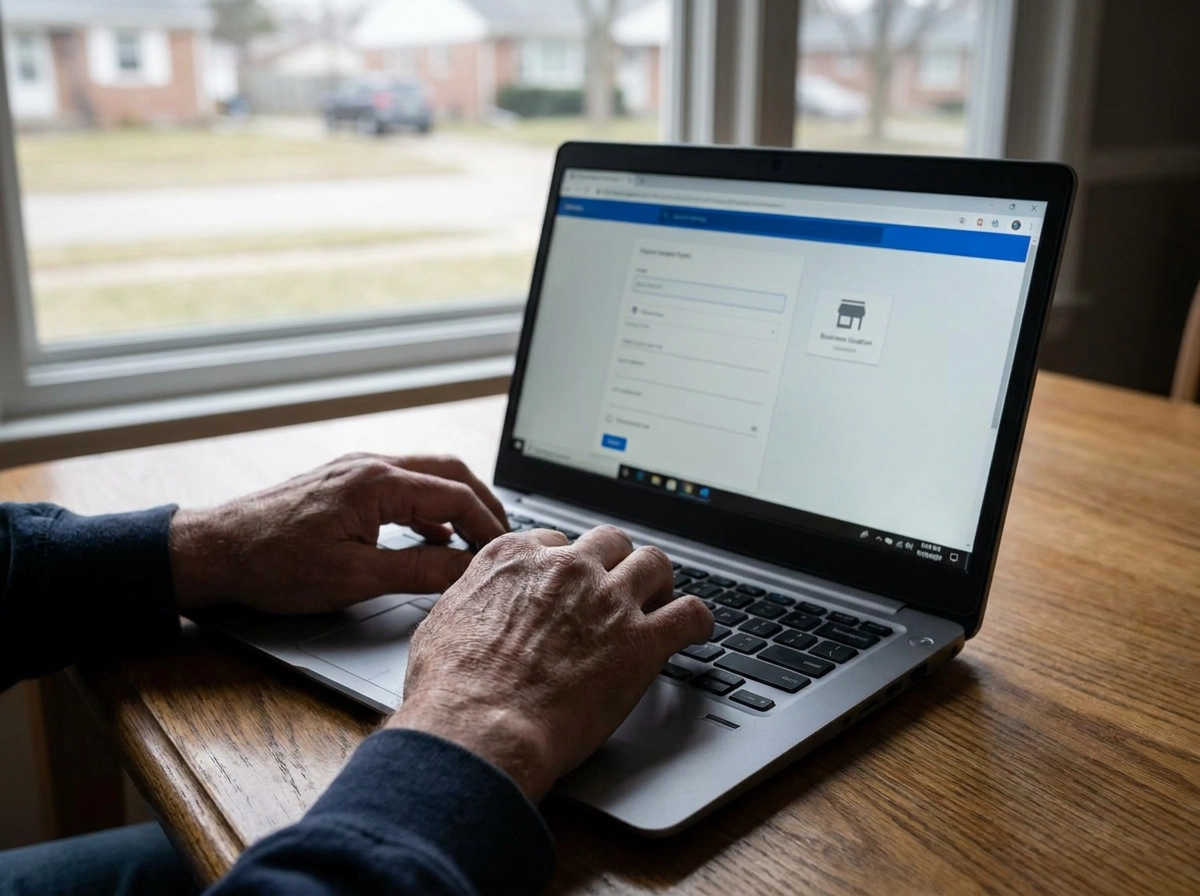
Start here: this costs nothing and works even if your website is brand new.
For service-based sole traders, a fully optimised Google Business Profile is arguably the highest-ROI SEO action available. It drives local pack visibility based on relevance and completeness, not domain authority, so a new business can outrank an established competitor with a neglected profile.
Complete every field without exception: business category, service areas, trading hours, a keyword-rich description, and a minimum of five photos. Incomplete profiles are consistently outranked by complete ones.
The description field is where most sole traders undersell themselves. Don’t write “I am a bookkeeper in Brisbane.” Write “bookkeeping for tradies and freelancers in Brisbane who want tax time handled without the stress.” Answer the question your ideal client is already typing.
Reviews are the other lever. Set up a post-project email with a direct review link once and send it after every job. Five minutes to build; generates the social proof that directly influences local pack rankings.
Time investment: two hours for initial setup, then roughly twenty minutes each quarter to add photos, respond to reviews, and confirm your details are current.
If your profile sits on a WordPress site, the plain-language WordPress SEO guide for Australian business owners covers how to align your on-site signals with what you have just set up here.
Move 2: Build One Service Page Done Properly (3 Hours, Once)
Most sole trader websites have one generic “Services” page targeting nothing in particular. Search engines cannot rank a page for a query it does not address.
Build one dedicated service page targeting a single specific query. Think “graphic design for small business Sydney” rather than “design services.” Write 400 to 600 words of focused copy, keep your meta title under 60 characters, and your meta description under 155 characters.
The page needs to answer three questions every prospective client is silently asking: what exactly do you do, who is it for, and what happens when they get in touch.
On-page signals matter more than most sole traders realise. Your title tag, H1, first 100 words, and every image alt text are all read by search engines. Use your target keyword naturally in each.
Once the page is live, link to it from your homepage and About page. Internal links tell search engines which page you want ranked. The same principle applies to any other content asset, including an artist website designed to rank and convert.
Time investment: two to three hours to build once. Quarterly, spend thirty minutes checking your rankings for the target keyword, updating stale information, and adding a client result or testimonial.

Move 3: Publish One Piece of Content That Answers a Real Client Question (2 Hours, Quarterly)
Your service page targets a specific query. This move answers the questions that come before a prospect even lands on that page.
You do not need a content calendar or a publishing strategy. You need one useful piece of content per quarter, targeting a question your clients are already searching.
The fastest source material is sitting in your inbox. Think back to the last three things a prospective client asked before hiring you. Those are search queries, and you already know the answers.
Specificity beats length every time. A 600-word post that directly answers “do I need an ABN to freelance in Australia” will outperform a 2,000-word generic overview of freelancing. Searchers want their exact question answered, not a broad education. This applies whether you are a bookkeeper, a photographer, or a designer. (See how targeted content works for abstract artists building search visibility.)
Each post is a permanent asset that accumulates impressions for months or years. The time-per-click cost drops continuously, which is compounding SEO value in its simplest form.
Write for the reader first. Then confirm the target question appears in the title, the opening paragraph, and at least one subheading. That is the entire optimisation checklist.
Time investment: one to two hours to write, thirty minutes to publish and add a meta description. Four posts per year. That is a manageable, compounding content base any sole trader can build.
Move 4: Decide Whether You Are Playing Local or Broad (30 Minutes, Once)
Before any of that content creation pays off, there is one decision that sequences everything else: are you targeting local search terms or broad ones?
This is one of the most overlooked choices in SEO for small business, and getting it wrong wastes months of effort. If you serve clients in a specific area, go local. Ranking for “copywriter Fremantle” is achievable in months. Ranking for “copywriter Australia” can take years against established directories and high-authority competitors.
If your work is fully remote, national, or highly specialised, a different path applies. A niche consultant or digital product creator often wins faster by owning one specific question category rather than chasing location-based terms.
The 30-Minute Test
Open an incognito browser window and search your main service term. Scan the first page. If you see local businesses dominating, local SEO is your fastest path. If you see national directories and large brands filling every result, narrow topic authority is the smarter play.
This single decision shapes every other move in the stack. It determines which keywords belong on your service page, which location to specify on your Google Business Profile, and which questions your quarterly content should answer. Getting it right before you build anything else is why the SEO framework Australian small businesses actually need starts with clarity over keywords, not content volume.
Time investment: thirty minutes, once.
Move 5: Earn One Credible Backlink Per Quarter (1 Hour, Quarterly)
With your local versus broad decision made, backlinks are the final move in the stack and the most consistently skipped.
A backlink is simply another website linking to yours. Search engines treat these as votes of credibility, and sole traders underinvest here because “link building” sounds technical. It is not, at this scale.
The minimum viable target is one credible, relevant link per quarter. That might be a guest post on an industry blog, a supplier listing your website in their directory, a local business association adding your details, or a mention in a regional publication.
Australian niche directories and industry association websites are particularly underused. A listing with a relevant trade body is a legitimate, durable backlink that typically takes under an hour to secure, yet it rarely appears in generic small business SEO guides.
Quality over quantity is non-negotiable. One link from a respected industry association outweighs twenty from low-authority generic directories. Avoid any service promising hundreds of backlinks for a flat fee, that approach does more damage than doing nothing.
The simplest quarterly habit: after finishing a project, ask the client or collaborator whether they would mention your business on their website with a link. Most will say yes if asked directly. For a real-world example of how visibility gaps affect even talented operators, the experience of Australian landscape artists who are easy to find online illustrates exactly what a few credible links can change.
Four links per year. Modest, compounding, and well within reach.
The Quarterly Rhythm: Your One-Page Execution Plan

Now that the five moves are clear, here is how they fit together across a calendar year.
Q1 (Foundation): Claim and optimise your Google Business Profile (2 hours), decide local versus broad (30 minutes), and build your first properly structured service page (3 hours). Total: under 6 hours.
Q2 (First content cycle): Publish one piece of content answering a real client question (2 hours), pursue one credible backlink opportunity (1 hour), and review your service page for anything outdated (30 minutes).
Q3 (Compounding phase): Repeat the content and backlink cycle. If your first service page is beginning to rank, add a second. This is where early investments start returning consistent impressions.
Q4 (Measurement review): Open Google Search Console, check which queries are driving impressions and clicks, update any pages where rankings have plateaued, and plan your next four content topics based on questions prospects have asked in the past three months.
The total annual time investment across all five moves sits at roughly 15 to 20 hours. That is approximately half a working week, spread across a year.
No software subscriptions. No agency retainer. No technical background required. The only input this rhythm demands is consistency, and consistency is precisely what separates sole traders who build visible businesses from those who stay invisible.
What to Measure and What to Ignore
Once the quarterly rhythm is running, you need to know what to watch and what to ignore.
Google Search Console is free and the only analytics tool you need in your first twelve months. It shows which queries trigger your pages, how many impressions you receive, and which pages get clicked.
Two metrics matter right now: impressions (is Google surfacing your pages?) and clicks (are people visiting?). Ignore domain authority scores, keyword difficulty ratings, organic traffic benchmarks, social shares, time on page, and bounce rate. They tell you little about whether SEO is working early on. Watch for your target queries appearing in your Search Console impression data instead.
On timelines: Google Business Profile visibility can appear within two to four weeks of optimisation. Service page rankings for low-competition local queries typically emerge within three to six months. Content assets begin accumulating impressions within two to four months of publishing. These are practitioner observations, not guarantees, and results vary by competitiveness.
Set a quarterly calendar reminder for a thirty-minute Search Console check. Look for unexpected queries driving impressions. Those surprises are often your best content ideas for the next quarter.
When the Minimum Viable Stack Is No Longer Enough
Once your Search Console data starts showing consistent impressions and clicks, you will know the minimum viable stack is doing its job. And it will keep doing it, reliably, for any sole trader who applies these moves with quarterly discipline over six to twelve months.
There is a ceiling, though. Once your Google Business Profile is sitting in the local pack, your service pages are appearing on page one for low-competition queries, and your content base has grown to eight to twelve pieces, the returns from this approach begin to plateau. That is not a failure; it is a graduation point.
The next-level moves, including technical SEO audits, structured content clusters, active link building campaigns, and conversion rate optimisation, require either a significant lift in your own time or the support of an experienced SEO partner. Neither option is wrong; they just suit different stages.
That is where The Brand Express works with sole traders and small teams to build on an existing foundation with bespoke, performance-driven SEO strategies. The difference is compounding slowly versus compounding fast.
The honest framing: the minimum viable stack gets you visible. Expert support gets you dominant. Deciding which phase you are in is a business decision, not an SEO decision.
Start With One Move This Week
The stack is built. Now it just needs you to start.
Every quarter you wait, the top Google result is capturing 27.6% of all clicks for your best search terms. That traffic is going somewhere, and right now it is going to competitors who simply showed up first.
No agency, no budget, and no prior SEO knowledge required. Move one is claiming your Google Business Profile; you can complete it this week in two hours. Each move after that builds on the last.
Pick one. Block two hours. Begin. The compounding value of SEO for small business only activates when you start, which is precisely why this stack was trimmed to its minimum.
If you have already completed the foundation moves and are ready to accelerate, The Brand Express builds bespoke SEO strategies for sole traders and small businesses ready to move beyond the minimum viable phase.
Conclusion
SEO does not have to be overwhelming for sole traders. The minimum viable stack strips the strategy back to what actually moves the needle: a complete Google Business Profile, one strong service page, targeted content that answers real questions, and a single quality backlink every quarter.
These four moves, done consistently, build compounding visibility without consuming your working week.
The key insight is this: perfect execution later loses to imperfect action now. Every week you delay, competitors are quietly capturing clicks you could own.
Start with one move this week. Block the time, complete the task, and let each step build on the last. The foundation is simple by design because simple things get done.
When you are ready to move beyond the minimum, that is when expert support turns slow compounding into fast growth. The starting line is right here.
Frequently Asked Questions
How much time does SEO really take for a sole trader?
The minimum viable SEO stack requires approximately 15 to 20 hours per year, spread across quarterly cycles. Initial setup takes about 6 hours in Q1 (Google Business Profile, local vs. broad decision, and service page), while subsequent quarters require roughly 3-4 hours of maintenance and content updates. This breaks down to roughly half a working week annually, making it manageable for any solo operator without sacrificing time spent on running the business.
What's the most important first step I should take?
Start by claiming and optimizing your Google Business Profile. This is the highest-ROI SEO action for service-based sole traders because it drives local pack visibility based on relevance and completeness rather than domain authority. You can outrank established competitors with a neglected profile simply by completing every field with keyword-rich descriptions and quality photos. It costs nothing and works even if your website is brand new, taking just 2 hours for initial setup.
Should I focus on local SEO or try to rank nationally?
The answer depends on your service area. Use the 30-Minute Test: search your main service term in an incognito browser and scan the first page. If local businesses dominate, pursue local SEO—ranking for 'copywriter Fremantle' is achievable in months. If national directories and large brands fill the results, focus instead on narrow topic authority by owning one specific question category. This decision shapes everything else in your SEO strategy, so clarifying it before building anything else is crucial.
How do I know if my SEO efforts are actually working?
Use Google Search Console—it's free and the only analytics tool you need in your first twelve months. Focus on two metrics: impressions (is Google surfacing your pages?) and clicks (are people visiting?). Ignore domain authority scores, bounce rates, and social shares as they tell you little about early SEO success. Set a quarterly calendar reminder for a 30-minute Search Console check to track which queries are driving traffic. Google Business Profile visibility appears within 2-4 weeks, service page rankings within 3-6 months, and content assets begin accumulating impressions within 2-4 months.
What's the difference between the minimum viable stack and when I need professional SEO help?
The minimum viable stack gets you visible through consistent quarterly effort over 6-12 months. However, there's a ceiling—once your Google Business Profile ranks in the local pack, service pages appear on page one for low-competition queries, and you have 8-12 content pieces, returns begin to plateau. At this graduation point, next-level moves like technical SEO audits, structured content clusters, and active link building campaigns require either significant additional time or professional SEO support. Expert help accelerates compounding growth, turning slow progress into fast growth.