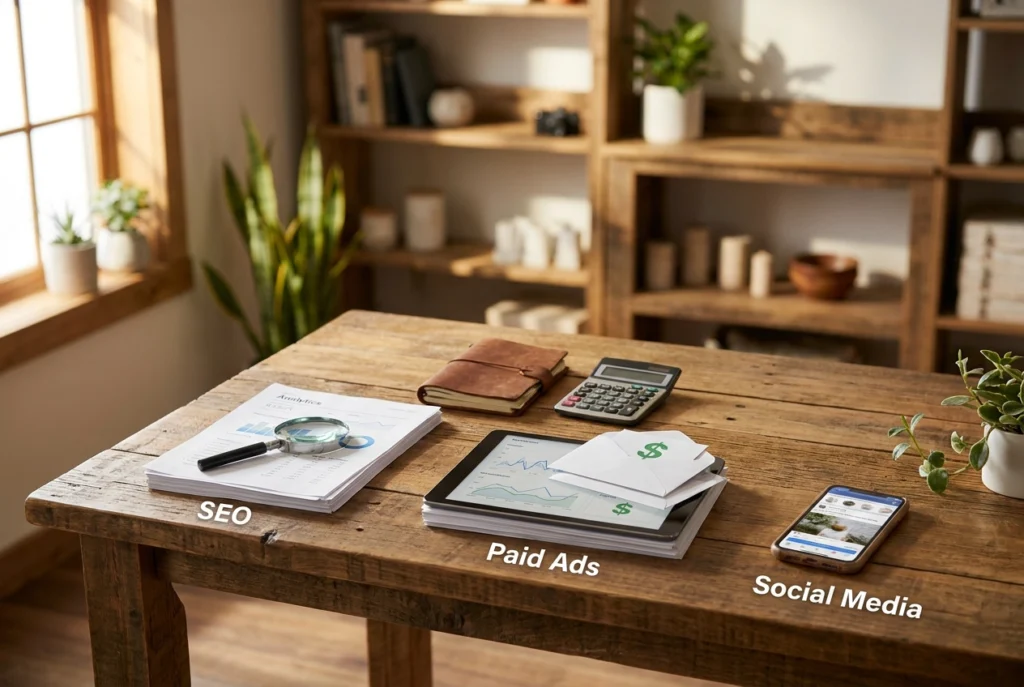
If you only have the budget to fund one serious marketing channel this year, the pressure to pick the “right” one can feel paralysing. Most advice frames this as a battle between channels, but that misses the point. The real decision is about budget allocation and how long you can wait for a return. This post reframes the tired ‘which channel is best’ argument and shows why, for most Australian small businesses, the honest answer is to fund search first. We will explain why investing in SEO and small business growth is different from renting attention with paid ads or chasing organic social reach. Unlike paid and social spend, which resets to zero every month, a well-executed search strategy builds pages and signals that become a lasting asset, generating enquiries long after the invoice is settled. You will learn what each channel actually buys, how to use a wait-time framework based on your cash flow, and see a worked budget example. We will also cover common mistakes and provide actionable takeaways. Please note, this piece is published by The Brand Express and promotes its services.
Why ‘Which Channel Is Best’ Is the Wrong Question
You are not choosing the best channel. You are choosing what kind of return you are buying: attention that expires, or an asset that keeps working.
A single dollar behaves differently in each. A paid click or a boosted post stops producing the moment funding stops. A published page, plus the signals pointing to it, can keep generating enquiries after the invoice is settled.
The honest answer for most Australian small businesses is not “do SEO instead of ads.” It is “fund search first, because the asset survives the month it was paid for.” The reasoning behind that claim, including why SEO wins past the six-month mark for long sales cycles, is the author’s reasoned position on how budgets behave, not a documented market fact. Every payback figure later is an estimate with assumptions attached.
Here is what follows: a per-channel profile, a worked budget example, a wait-time decision framework, and the counter-case where paid ads or social genuinely should lead.
A Note on Where This Advice Comes From
You now know the position. Before you weigh it, you should know who is making it. The Brand Express sells search engine optimisation services, so this article concludes in favour of the channel the company provides. Weigh that.
A disclosure does not make the argument wrong, but it does mean the reasoning has to stand alone rather than lean on brand authority. So the piece is held to a standard: assumptions stated in plain language, cost figures labelled as examples rather than market rates, and the counter-case included rather than buried. Our work with the Victorian Artists Society shows the approach applied to a real audience.
Test the framework against your own numbers, quotes and cash flow timeline before acting on any of it.
Small Business Online Marketing: What Each Channel Actually Buys
With that standard set, look at what each channel actually buys. Paid ads buy placement in an auction: you bid for a position, pay per click (cost per click) or per thousand impressions, and the position disappears when the budget or card does. Small business SEO buys eligibility, not placement. Work on crawling (how search engines discover pages), indexing (storing them), keywords (the phrases buyers type), rankings (where a page appears), relevance and links lets pages appear without a per-click fee. Organic social buys distribution in someone else’s feed. Its ranking algorithm decides who sees a post, measured as organic reach, and most post audiences fade within days.
Click through rate is the share who click after seeing an ad or result; attribution is linking an enquiry to its channel. Because no verified Australian benchmarks are available here, compare these on time-to-payback and decay, not a feature table. Affordable SEO for Small Business: What It Really Costs shows how to price the search side.
Small Business SEO: The Only Spend That Becomes an Asset
Every dollar spent on small business SEO leaves you owning something. An optimised service page, a deliberate internal link, an earned citation: each is a durable file on your own domain, and none of them expires when the invoice is paid. For a beginner, the cleanest explanation of the mechanics is Google’s own Search Central documentation, which sets out how crawling, indexing and serving actually work rather than repeating folklore about ranking factors.
That library compounds. Pages that rank keep producing enquiries from queries you are not paying for per click, so your cost per enquiry tends to fall as the library grows.
Be realistic about the lag. Search visibility typically builds over months rather than days, and how fast depends on competition, content quality and site health. It suits an owner with waiting room in their cash flow. It also needs maintenance: consistent publishing, technical fixes and Search Console monitoring. Start with a quarterly audit routine, because an abandoned site depreciates like any other asset.
Paid Ads: Renting Attention One Month at a Time
Search assets are built to outlast invoices; paid ads are the opposite. Every campaign runs as an auction, where your budget, bid, ad quality and the number of competitors bidding together set the price of a click. That price is renegotiated each time you run. When the budget is exhausted or the card declines, delivery stops and enquiries stop with it. Ads are therefore rent, not an asset.
The strengths are real: immediate visibility, tight geographic targeting for a defined service area, and fast, cheap testing of an offer, price point or headline before you commit content budget. But the reset problem is sharp. Pause for a month and next month’s enquiry volume can fall close to zero, so you must keep funding the same attention to hold the same volume. Competitors lifting bids or seasonal demand shifts can mean the same budget buys fewer clicks. Do not accept an Australian cost per click figure without a cited source, and check pay-for-performance SEO terms before signing anything.
Organic Social: Reach That Resets Every Month
Organic social is distribution inside someone else’s feed. Each platform’s ranking system decides who sees a post, and organic reach is typically a fraction of follower count. Followers are an audience, not a demand forecast.
Social still earns its place: recognition, trust, community, visual proof, local credibility, recruitment and repeat exposure, outcomes a search page rarely delivers for a small brand.
Then it fades. A strong post performs for a few days and effectively stops. No old ranking page equivalent quietly collects enquiries for years. Consistent posting also costs owner hours, a real budget item even without an invoice. And when you need reliable reach, platforms push paid promotion, which turns organic social back into the same monthly rent as ads. Track it honestly against SEO KPIs that actually show ROI rather than likes.
A Worked Budget Example With Stated Assumptions
With social’s monthly reset in mind, model one fixed monthly figure. Assume an illustrative $1,000 per month for twelve months to show how each channel behaves, not a quoted agency rate; substitute your own quotes. Spent as ad budget, content and community time, or a search retainer covering page building and technical work. After a year, ads own attention that stops when spending stops, social owns posts that have faded, and search owns pages and signals still producing enquiries. Ads pay back within the funded month, search pays back late then keeps returning, and social mostly buys brand recognition that is hard to attribute to a dollar. A hybrid variant might use a smaller search retainer plus a short ad burst for launches or quiet months. Sensitivity check: slower builds, more competitor publishing or seasonal demand can change the ranking, so test your assumptions against your own cash flow. Before committing to a retainer, see how to choose a local SEO consultant in Australia without wasting your budget.
The Wait-Time Framework: How Long Can Your Cash Flow Hold?

That worked example shows behaviour; your own cash flow decides which pattern you can afford. So ask first: how many months can this business fund a channel that does not return cash next week without risking wages or suppliers? Treat these bands as estimates, not benchmarks. With no patience at all, buy ads or boost social for immediate enquiries. With roughly three to six months, run a small ad budget while starting one search page. With six to twelve months or more, fund search first. Owners on thin margins should shrink search scope, not abandon it, because the asset survives. One well-built service page targeting one clear buyer query is a legitimate first asset, so the starting cost of SEO for a small business need not be a big retainer; compare scopes in Affordable SEO for Small Business: What It Really Costs. Sequencing beats either-or: let search build quietly behind an ad budget you can switch off.
When Paid Ads or Social Should Come First
If your runway answer is “not long”, paid visibility often leads. Buy it when waiting is not an option.
- Urgent revenue gaps: a tradie with empty days next month, or a business that just lost its biggest client, cannot wait months for rankings. Ads buy enquiries now.
- New offer testing: a short ad test gives a fast read on demand, price sensitivity and messaging before you build months of content around a service nobody wants.
- Short seasonal windows: Christmas, end of financial year or a tourism peak reward immediate visibility more than a slow compounding build.
- Social-first businesses: hospitality, retail, creatives and artists sell on look, feel and local connection, especially when their audience already follows them.
Whichever you choose, fund the path after the click: a landing page or profile that converts, tracking so spend can be judged, and a written stop rule for cutting what is not working.
How SEO Marketing for Small Business Fits Into a Tight Split

Where paid or social leads, that is a sequencing decision, not a permanent one. For most owners, the stronger structure is a modest, ongoing search asset funded first, a small ad budget kept for testing and seasonal demand, and social treated as organic effort rather than a core paid line.
A starting shape worth arguing with: put the majority of your budget into building and maintaining search, a minority into one tightly targeted ad test, and close to nothing into boosted posts until ads prove they convert.
Fund specifics, not vague “SEO”: one page per service or buyer query, technical fixes for speed and mobile, local signals if you serve a defined area, and regular Search Console review. Check technical health and spend monthly, but judge search progress over quarters. A one-month sample misleads in both directions.
The Brand Express offers bespoke, performance-driven SEO strategy for growth-minded businesses, sole traders and artists. The basics are doable in house, so compare any quote on scope, pages delivered and reporting.
Common Mistakes When Splitting a Small Marketing Budget

Even a sensible split can fail in execution. The most common mistakes are:
- Spreading a small budget across search, ads and social so thinly that no channel reaches a measurable level. Pick one lead channel.
- Judging SEO on a one-month sample and cancelling just before pages mature. That wastes the one spend designed to compound.
- Judging ads on one month without checking whether the landing page or enquiry tracking was the real problem.
- Counting followers, likes and impressions as demand instead of enquiries, quotes and booked jobs.
- Running any split without per-channel tracking. Without it, allocation becomes guesswork, re-litigated every time cash flow tightens.
Track enquiries from each channel before you adjust the split.
Actionable Takeaways
The fix for all of that is a simple discipline, not a bigger budget. Start by writing down your wait time in months before you choose a channel, and let that number pick the channel rather than the trend of the week. If your runway allows it, fund search first and treat it as an asset with a maintenance plan covering pages, technical health and monitoring. Keep paid ads for launches, seasonal windows and hypothesis testing, always with a stop rule and a landing page worth sending traffic to. Use organic social for trust and brand building, and count it as time rather than as your core budget line. Review the split quarterly with per-channel enquiry data, and change it because the numbers changed, not because a channel became fashionable. Fund the asset that keeps producing after the invoice is settled.
Conclusion
The question isn’t which channel wins. It’s what your cash flow can hold while a channel matures. Fund search first when runway allows, because SEO is the only spend that becomes an asset with a maintenance plan. Treat paid ads as a tool for launches and testing, always with a stop rule and a landing page worth the click. Count organic social as time, not your core budget line. Above all, track enquiries per channel and review the split quarterly. Your next step: open your books, write down your wait time in months, and let that number pick your lead channel. Fund the asset that keeps producing after the invoice is settled.
Frequently Asked Questions
Why does the post say the real decision is not 'which channel is best'?
The post argues that you are not choosing the best channel but the kind of return you are buying: attention that expires when funding stops (paid ads and organic social), or an asset that keeps working (search). The real decision is about budget allocation and how long you can wait for a return.
Why does the post recommend funding search first for most Australian small businesses?
Because a published page and the signals pointing to it can keep generating enquiries after the invoice is settled, while paid and social spend resets to zero every month. The post presents this as the author's reasoned position on how budgets behave, not as a documented market fact.
What is the difference between what paid ads and SEO buy?
Paid ads buy placement in an auction, paid per click or per thousand impressions, and the placement disappears when the budget runs out. Small business SEO buys eligibility rather than placement, so pages can appear without a per-click fee, and the work builds a lasting library on your own domain.
How long does SEO take to show results?
The post says search visibility typically builds over months rather than days, and the speed depends on competition, content quality and site health. That is why SEO suits an owner with waiting room in their cash flow.
How does the wait-time framework work?
Ask how many months the business can fund a channel that does not return cash next week without risking wages or suppliers. With no patience, buy ads or boost social; with about three to six months, run a small ad budget while starting one search page; with six to twelve months or more, fund search first. The post presents these bands as estimates, not benchmarks.