
To really get keyword research right, you first need to get inside your audience's head. It’s all about understanding their problems and the exact words they use when looking for answers online.
The process involves figuring out your core business topics, digging up the specific search terms people use around those topics, and then analysing which ones are actually worth your time. At its heart, it’s about decoding what a user really wants so you can create content that hits the mark, every single time.
Why Smart Keyword Research Is Your Greatest SEO Asset
Too many people think keyword research is just about finding popular search terms and calling it a day. The reality? It’s a core business intelligence process. You’re not just trying to get more visitors; you’re trying to attract the right visitors—the ones who are actively searching for the solutions you offer. Think of it as old-school market research, but for the digital age.
Nailing this process shapes your entire online strategy. You'll end up creating content that genuinely connects with your audience, but you’ll also uncover insights that can guide everything from product development to your broader business goals. To really make this work, you have to understand how to choose keywords for SEO effectively.
Understanding the Core Concept of Search Intent
The single most important part of modern keyword research is search intent. This is the why behind every search query someone types into Google. Honestly, if you get this wrong, nothing else matters. Your content simply won't rank if it doesn't match what the user is looking for.
There are four main types of search intent you'll come across:
- Informational: The user is hunting for information. Think queries like "what is a good credit score" or "how to bake sourdough bread." They want answers, not products.
- Navigational: The user knows where they want to go and is just using Google to get there. Searches like "Facebook login" or "The Brand Express blog" fit here.
- Commercial: The user is in research mode, weighing up their options before a purchase. You'll see searches like "best running shoes for men" or "Mailchimp vs ConvertKit."
- Transactional: The user has their wallet out and is ready to buy. These are high-value queries like "buy iPhone 15 pro" or "emergency plumber Brisbane."
Just look at this example of how Google serves up completely different results based on a subtle change in wording.

As you can see, a slight tweak completely changes the intent, shifting the search results from informational blog posts to product pages.
The Business Case for Keyword Research
The numbers in Australia really drive home how crucial this is. Google absolutely dominates the local market, holding over 93% of the search market share. Getting your strategy aligned with how Aussies search isn't just a good idea; it's essential.
Recent data shows that a massive 68% of all website traffic in Australia comes from organic search, making it the number one way people find businesses online. What's more, a staggering 74% of Australian businesses with a proper content strategy report seeing three times the ROI.
Journalist Tip: The biggest misconception about keyword research is that it's just a technical SEO task. It's not. It’s a direct line into the collective psyche of your target market. A well-researched keyword report is essentially a business intelligence document that reveals your customers' biggest pain points, questions, and purchasing triggers in their own words.
This entire process is fundamental to the bigger picture of optimising your website. To see how it all fits together, check out our guide on what is Search Engine Optimisation. When you start with a solid keyword strategy, you're setting yourself up for an SEO campaign that actually drives traffic and grows your business.
Finding Your Seed and Long-Tail Keywords

Alright, with a solid grip on search intent, it's time to roll up our sleeves and start the real work: unearthing the keywords that will fuel your growth. The whole process kicks off with what we call seed keywords. These are the broad, foundational terms that define your entire niche.
Think of them as the main categories in a bookshop. They're the simple, one- or two-word phrases that describe what you do at the highest level. If you're roasting artisan coffee beans, your seed keywords are straightforward terms like "coffee beans," "espresso," and "cold brew."
You're rarely going to rank for these broad terms on their own, but that's not the point. They're the essential starting blocks for building a much larger, more valuable list of specific phrases your customers are actually searching for.
Brainstorming Your Core Seed Keywords
The best place to start isn't with a fancy SEO tool. It’s by stepping into your customer's shoes and looking at your business from their perspective. Your goal here is to map out the problems you solve and the everyday language your customers use, not just list the services you sell.
A few practical ways to get this done:
- List your core services: Write down every product or service you offer in its simplest form. For a Brisbane-based marketing agency, this would be things like "SEO services," "content marketing," and "PPC management."
- Talk to your sales team: Your customer-facing staff are a goldmine. Ask them about the questions they field every single day. The language they hear from prospects is the purest form of customer vocabulary you can get.
- Scour Reddit & Forums: Find the subreddits where your ideal customers hang out. Look for threads starting with "How do I…", "Can anyone recommend…", or "What's the best way to…". The raw, unfiltered language used here is a treasure trove of authentic keyword ideas.
- Map customer problems: Forget your solutions for a minute. What problems drive people to you? A financial advisor doesn't just sell "investment advice"; they solve problems like "how to save for retirement" or "managing inheritance."
After this exercise, you should have a solid list of 5-10 core seed keywords. This list is your launchpad for the next, far more strategic phase: uncovering long-tail keywords. You can find more detail on this in our guide to SEO keywords for blogging.
Unlocking High-Intent Long-Tail Keywords
While seed keywords get you started, long-tail keywords are where the real magic happens. These are longer, more specific phrases—usually three or more words—that signal much higher user intent.
Think about it: someone searching for "shoes" is just window shopping. But someone searching for "best waterproof hiking boots for wide feet"? They're ready to buy.
In Australia, these longer queries are completely dominant, making up about 70% of all search queries. This is huge because these specific searches nearly always have lower competition and attract a far more qualified audience. In fact, companies that nail their local keyword optimisation report a 27% increase in leads.
To really tap into this, Australian businesses have to think locally. Using terms like "bathers" instead of "swimsuits" or "tradie boots" instead of work boots is how you truly connect.
The easiest way to find long-tail keywords is to think like a customer and use the same free tools they do. The conversational phrases you find in Google's autocomplete or Reddit threads are often the exact terms your ideal customer is typing into the search bar.
Using Modifiers to Expand Your List
One of the simplest yet most powerful techniques is adding "modifiers" to your seed keywords. These are just words that make the search query more specific.
Here are the common types to play with:
- Question-based: how to, what is, why do (e.g., "how to choose coffee beans")
- Qualifier-based: best, top, review, cheap (e.g., "best espresso beans 2024")
- Audience-based: for small business, for beginners, for students (e.g., "SEO services for small business")
- Location-based: Brisbane, Sydney, near me (e.g., "coffee bean delivery Brisbane")
By systematically tacking these modifiers onto each of your seed keywords, you can rapidly build out a comprehensive list of potential long-tail targets that cover a huge range of user intents.
Using Tools for Data-Driven Keyword Analysis
Your brainstorming sessions have probably given you a fantastic raw list of potential keywords. That’s a great start, but a list of ideas is just that—ideas. To turn it into a powerful SEO strategy that actually drives traffic, you need to layer in hard data.
This is where keyword research tools shift from being helpful to absolutely essential. They let you analyse, filter, and prioritise with confidence, moving beyond intuition and making decisions based on what the numbers are telling you. Without data, you’re just guessing.
The Key Metrics That Truly Matter
When you first open a keyword research tool, you'll be hit with a dashboard full of metrics. It's easy to get overwhelmed. But honestly, a few core data points will guide the vast majority of your decisions. If you can get your head around these, you're well on your way.
- Search Volume: This is the big one everyone looks at first. It estimates how many times a keyword is searched per month in a specific location, like Australia. While a huge number looks tempting, it almost always means crazy high competition. A 2022 analysis revealed a sobering stat: 90.63% of content gets zero traffic from Google. A big reason for this is targeting keywords that are simply too competitive.
- Keyword Difficulty (KD): Usually shown as a score from 0-100, this metric estimates how hard it will be to crack the first page of Google. For a newer website, or one that hasn't done much SEO, targeting keywords with a KD score below 20 is a realistic and smart place to start.
- Cost Per Click (CPC): This is technically a paid search metric from Google Ads, showing what advertisers are willing to pay for a click. So why should you care? A high CPC is a massive clue. It signals strong commercial or transactional intent, meaning those searchers are looking to buy. That makes it a valuable keyword for organic SEO, too.
- Traffic Potential: This metric, made popular by tools like Ahrefs, is often more insightful than search volume alone. It estimates the total organic traffic the top-ranking page for a keyword gets. A single page can rank for hundreds of related long-tail keywords, so this gives you a much better idea of the true prize.
By balancing these four metrics, you can find the "sweet spot" keywords—those with decent search volume, manageable difficulty, and clear user intent that lines up perfectly with what your business offers.
Choosing Your Keyword Research Toolkit
The market is flooded with keyword research tools, each with its own strengths. The good news is you don't need to subscribe to all of them. A smart combination of free and paid tools can give you everything you need.
Free Tools for Foundational Insights
If you're just starting out or working with a tight budget, free tools offer a surprising amount of power. They're perfect for the initial discovery phase and for getting a quick feel for a keyword's potential.
- Google Keyword Planner: Originally built for advertisers, it's a goldmine for SEOs. It gives you search volume ranges and CPC data straight from the source, making it the most authoritative place to validate your initial ideas.
- AnswerThePublic: This tool visualizes search questions and queries around your seed keyword. It's fantastic for finding question-based keywords and understanding the full spectrum of user curiosity around a topic.
- Ubersuggest: Neil Patel's tool is super user-friendly and gives you a limited number of free searches each day. It’s excellent for quick analyses, delivering data on search volume, difficulty, and even content ideas for a given keyword.
Paid Tools for Deep Competitive Analysis
When you're ready to get serious, paid tools provide the depth and competitive intelligence that free options just can't match. There's a reason platforms like Ahrefs and Semrush are the industry standard.
Let's look at a case study. A Brisbane-based accountant used Ahrefs' "Keywords Explorer" and typed in "small business accountant Brisbane." The dashboard immediately showed a KD score of 15 (very achievable), a monthly search volume of 250, and a traffic potential for the top page of over 400. By creating a comprehensive service page targeting this term and several related long-tails (like "BAS statement help Brisbane"), they were able to rank on page one within four months, leading to a 35% increase in qualified leads from their website. This level of detail is what separates a basic keyword list from a strategic content roadmap that drives real business growth.
Comparison of Popular Keyword Research Tools
Choosing the right tool depends on your budget, goals, and how deep you need to go. Here’s a quick comparison of the most popular options available to Australian marketers to help you decide.
| Tool | Key Features | Pricing Model | Best For |
|---|---|---|---|
| Google Keyword Planner | Official Google search volume data, CPC estimates, new keyword ideas. | Free (with a Google account) | Initial keyword discovery and validating commercial intent with CPC data. |
| AnswerThePublic | Visualises search queries into categories (who, what, why), uncovers question-based keywords. | Freemium | Brainstorming blog topics and understanding user questions around a seed keyword. |
| Ahrefs | Industry-leading KD score, Traffic Potential metric, deep backlink analysis. | Paid Subscription | In-depth competitive analysis, building a long-term content strategy, and link building. |
| Semrush | Comprehensive SEO toolkit, position tracking, content gap analysis. | Paid Subscription | All-in-one SEO management, from keyword research to performance monitoring. |
By combining these tools, you can build a workflow that covers all your bases. You might start broad with Google Keyword Planner, get quick insights with Ubersuggest, and then do a deep dive with Ahrefs or Semrush to finalise your targets. This tiered approach ensures you make informed, data-backed decisions at every stage.
Finding Hidden Gems in Competitor Strategies
One of the smartest shortcuts in keyword research is realising your competitors have already done most of the heavy lifting. They've poured time and money into figuring out what works, creating a goldmine of data you can ethically tap into to find your own high-value keyword opportunities.
This isn't just about spying on your direct business rivals. In the world of SEO, your real competitors are the websites that consistently own the first page of Google for the keywords you want to target. Sometimes that’s a direct competitor, but more often than not, it’s an industry publication, a niche blogger, or an informational site you never even considered a threat.
Identifying Your True Organic Search Rivals
First things first, you need to pinpoint who you're actually up against in the search results, not just in the marketplace. While you know your main business competitors, your organic search rivals might be a completely different crowd.
Think about it this way: a local Brisbane bakery’s business rival is the shop down the street. But its search rival for "best sourdough recipe" could be a national food blog with millions of readers.
To find these organic competitors, start by searching for your main seed keywords in an incognito browser window. Take note of the domains that consistently pop up on page one. These are the sites Google already trusts for your core topics, making them your prime targets for analysis.
Performing a Content Gap Analysis
Once you have a list of your top three to five organic competitors, the real detective work begins with a content gap analysis. This technique is all about finding the keywords your competitors are ranking for that you aren’t. It’s one of the fastest ways to build a list of proven, high-value keywords you’ve completely missed.
Platforms like Ahrefs and Semrush make this dead simple. You can plug in your domain and your competitors' domains, and the tool will spit out a list of keywords they rank for where you have zero visibility. This isn't just a list of random ideas; it's a battle-tested list of terms already driving traffic to businesses just like yours. Using the best free competitor analysis tools can give you a serious edge in uncovering these hidden opportunities efficiently.
This screenshot from Semrush shows exactly how you can compare your domain (purple) against competitors (orange and blue) to find those unique keyword opportunities.
The "Missing" tab in a report like this is where you'll strike gold. It highlights valuable keywords where your website is completely invisible.
By systematically analysing the keyword gaps between you and your top three search competitors, you can often build a content plan for the next six months based entirely on proven topics that you know your audience is searching for.
Dissecting Top-Ranking Pages
Just finding the keywords is only half the battle. The next critical step is to figure out why your competitors are ranking for them in the first place. This means getting out of the spreadsheets and manually analysing the top-ranking pages for your most important target keywords.
As you review their content, ask yourself these crucial questions:
- What format is the content? Is it a blog post, a product page, a video, a free tool, or a downloadable guide?
- How deep does it go? Is it a short, 500-word overview or an exhaustive 3,000-word ultimate guide?
- What user intent does it satisfy? Is it giving a quick answer (informational), comparing options (commercial), or pushing for a sale (transactional)?
- What’s the structure like? Pay close attention to the headings, subheadings, use of images, and the overall user experience.
This reverse-engineering approach shows you exactly what type of content Google is already rewarding for a specific search. A recent study found that the average word count of a top-ranking Google result is over 1,400 words, suggesting that comprehensive content often wins.
But context is everything. If all the top results for a keyword are short, concise definitions, creating a massive guide would likely miss the mark on user intent. Learning from your competitors' wins—and their failures—helps you create content that is strategically better, not just longer.
Turning Your Keyword List into a Content Plan
So you’ve got a massive, meticulously researched list of keywords. Great start. But that’s all it is—a list of possibilities, not a strategy. The real work starts now, turning that raw data into a structured, actionable content plan that will actually guide your entire SEO effort.
This is where you move from theory to execution. Without a solid plan, you'll end up creating content randomly, which is a fast track to wasting time and money. A strategic content plan makes sure every article, landing page, and blog post you create has a specific purpose, tied directly to a keyword that helps you hit your business goals.
Prioritising Your Keywords Effectively
First things first, we need to bring some order to the chaos. Not all keywords are created equal, and trying to chase everything at once is a recipe for disaster. I use a simple but incredibly effective framework to focus on the terms that will actually move the needle. You'll want to score each keyword based on three core pillars:
- Business Relevance: How closely does this keyword align with what you actually sell? A term with high commercial intent that speaks directly to your core services should score much higher than a broad, purely informational one.
- Search Volume: This isn't the be-all and end-all, but it gives you a decent idea of the potential audience size. You're looking for a sweet spot—not so low that it's pointless, but not so ridiculously high that it's impossibly competitive from the get-go.
- Ranking Difficulty: Time for a reality check. How much authority and sheer effort will it take to crack the first page for this term? Be brutally honest about your website's current strength and focus on keywords you can realistically win.
This process transforms a messy spreadsheet into a clear roadmap. The keywords with the highest combined scores become your top priorities, forming the backbone of your content calendar for the next few months.
Keyword Prioritisation Matrix
To make this process more concrete, here’s a simple matrix to score and prioritise your keywords based on key business and SEO metrics, ensuring you focus your energy on the highest-impact terms first.
| Keyword | Monthly Volume | Difficulty Score (1-100) | Business Relevance (1-10) | Final Priority Score |
|---|---|---|---|---|
| e.g., affordable brisbane seo | 150 | 25 | 9 | Calculate based on your formula |
| e.g., how to do local seo | 500 | 45 | 6 | Calculate based on your formula |
| e.g., best digital marketing agency | 1200 | 70 | 8 | Calculate based on your formula |
How to use this: Create a simple scoring formula, for example: (Volume / 10) - Difficulty + (Relevance * 5). The exact formula doesn't matter as much as applying it consistently. The keywords with the highest score are your top priorities.
Grouping Keywords into Thematic Clusters
Once you know your priorities, the next step is to group related keywords into thematic clusters. This approach, often called the "pillar page" or "topic cluster" model, is absolutely fundamental to building topical authority in Google's eyes. Instead of writing random, one-off articles, you create a central "pillar" page covering a broad topic, then surround it with "cluster" content that dives deep into specific subtopics.
Let's say a marketing agency's pillar page is "A Complete Guide to Digital Marketing." Its cluster content would then go after more specific, long-tail keywords, like:
- "how to create a social media calendar"
- "email marketing tips for small business"
- "local SEO strategies for Brisbane companies"
Each of those cluster posts links back to the main pillar page. This sends a powerful signal to Google that you have comprehensive expertise on the entire subject, helping you rank for both the broad, high-volume terms and the niche, high-intent queries all at once.
This infographic gives you a simplified flow for finding, analysing, and targeting keyword opportunities, which is exactly what you'll be doing to build out your content clusters.
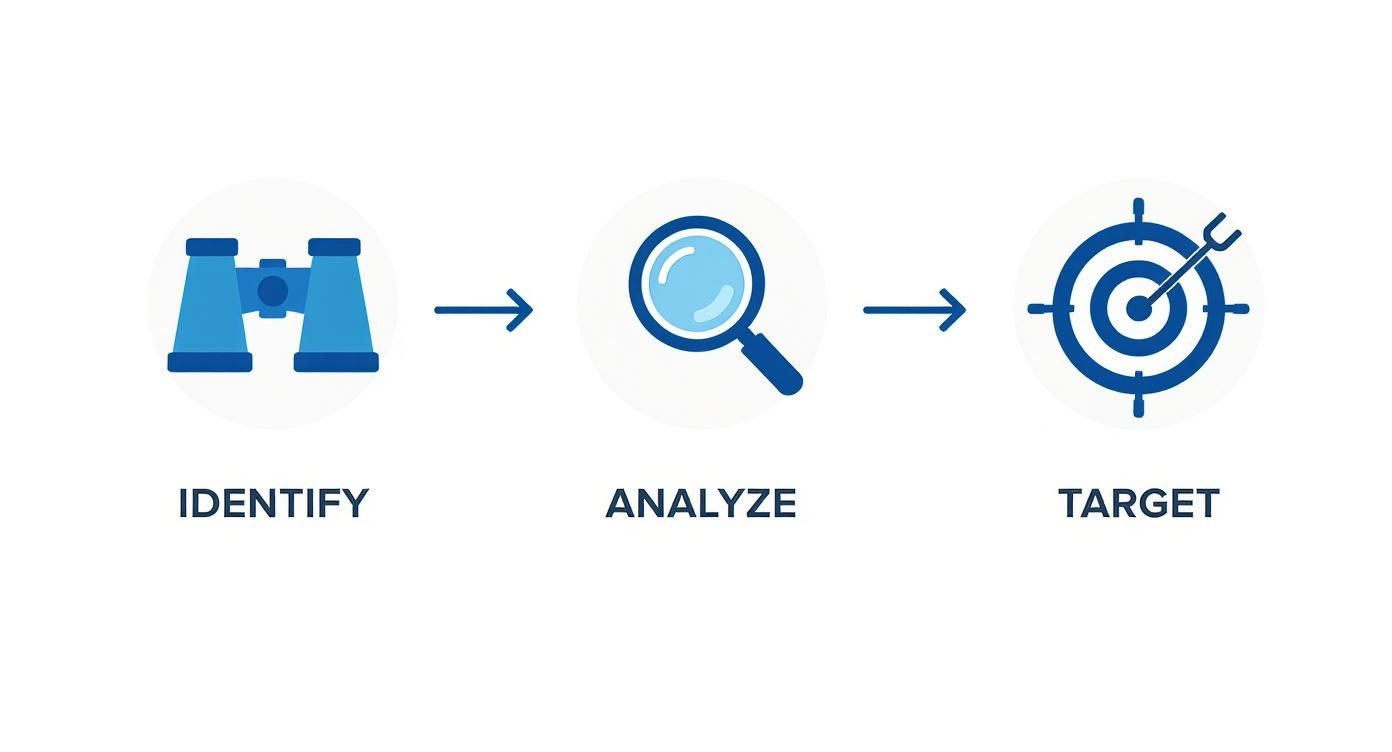
Following a systematic process like this is what separates a powerful content strategy from a bunch of disconnected blog posts.
Mapping Keywords to Specific Pages
Keyword mapping is the final, tactical piece of the puzzle. It’s simply the process of assigning a primary keyword (and a few secondary ones) to every important page on your website. This is non-negotiable for two big reasons: it prevents keyword cannibalisation and it builds a logical site architecture that search engines love.
Keyword cannibalisation is what happens when multiple pages on your own site start competing for the same keyword. It confuses search engines and massively dilutes your authority. Proper mapping ensures every single page has a unique job to do.
Journalists often ask what the biggest rookie SEO mistake is. It's skipping keyword mapping. Without it, you're building a library with no catalogue system—a chaotic mess where even your best content gets lost.
Your mapping strategy should look something like this:
- Homepage: Target your broadest, brand-level keywords (e.g., "Brisbane SEO agency").
- Service Pages: Assign commercial-intent keywords that describe exactly what you offer (e.g., "e-commerce SEO services").
- Blog Posts: Use these to go after long-tail, informational, and question-based keywords (e.g., "how to improve website loading speed"). This is also a goldmine for leveraging local search trends.
The explosion of local and voice search in Australia really underscores how important it is to map question-based keywords. With SEO spending in Australia projected to hit $1.5 billion in 2025 and 93% of consumers searching online for local businesses, a targeted approach is vital. Around 33% of Australians now use voice search daily, often with longer phrases, and about 8% of local searches are questions. Mapping keywords like 'best coffee shop near me?' directly to your content is how you capture this high-intent traffic.
By mapping your keywords correctly, you create a clear roadmap that tells both users and search engines exactly what each page is about. This process is a core part of any effective on-page SEO strategy, as it ensures your content is perfectly aligned with what people are actually searching for. You can find a detailed breakdown of this in our comprehensive on-page SEO checklist.
Common Questions We Hear About Keyword Research
Even with a solid plan, a few questions always seem to surface. Getting the hang of keyword research means clearing a few common hurdles first. In this final section, we’ll tackle some of the most frequent queries we get, giving you quick, actionable answers to sharpen your strategy.
Think of these as the last few pieces of the puzzle, locking in the core lessons from this guide and clearing up any confusion about tools, metrics, or tactics.
How Many Keywords Should I Target Per Page?
This is a classic, and the answer is all about focus. For any single page—whether it's a blog post or a core service page—you should zero in on one primary keyword. This is your north star, the phrase that perfectly sums up what that page is about.
To support your primary keyword, it’s a smart move to weave in two to three closely related secondary keywords. These aren't just random terms; they should be semantic variations or more specific long-tail versions of your main target. For instance, if your primary keyword is "local SEO Brisbane," your secondary keywords might be "local SEO services for small business" or "how to improve local search ranking."
Trying to cram a dozen different keywords onto a page is an old-school tactic that just doesn't work anymore. It dilutes the page's relevance. Search engines are sophisticated now; they reward pages that provide a deep, authoritative answer on a single topic, not a shallow overview of many.
This focused approach helps you build content that thoroughly answers a specific user's need, which is exactly what Google wants to see.
What Is a Good Keyword Difficulty Score to Target?
There’s no magic number here. The "right" keyword difficulty (KD) score is completely relative to your website's current authority. If your site is brand new with few backlinks, you’re like a new boxer stepping into the ring—you don’t go straight for the heavyweight champion.
Here’s a practical way to think about it, using Ahrefs' KD scale as a guide:
- For a new or low-authority site: Stick to keywords with a difficulty score under 20. These are your "low-hanging fruit" – genuine opportunities to gain some early traction and build momentum.
- For an established site with some authority: You can confidently go after keywords in the 20-50 range. You’ve got a fighting chance here, especially if you bring top-tier content to the table.
- For a high-authority site: Terms with a KD score of 50+ are fair game. These are seriously competitive, but a strong, established domain can hold its own.
The key is to be realistic. One of the most common mistakes we see is businesses wasting huge amounts of effort chasing keywords that are simply out of their league, leading to zero return. Find that sweet spot where you can actually compete and win.
How Often Should I Do Keyword Research?
Keyword research isn't a "set and forget" job. Markets change, customer search habits evolve, and new competitors are always popping up. Your strategy needs to be a living, breathing part of your marketing.
Here’s a rhythm that works well:
- Annually: Do a major review and refresh of your entire keyword strategy. This is the time to re-evaluate your core topics, see what your competitors are up to, and identify the big new opportunities for the year ahead.
- Per Piece of Content: This is non-negotiable. You need to perform fresh, specific keyword research for every single new blog post or page you create. This makes sure every piece of content is perfectly dialled in from the moment it goes live.
- Monthly: Keep a close eye on your keyword rankings. Use a tracking tool to monitor how you’re performing for your target terms. This allows you to spot new opportunities, identify keywords where you might be losing ground, and make quick, smart adjustments to your content plan.
Revisiting your research consistently is what keeps your SEO strategy sharp and effective over the long haul.
At The Brand Express, we build data-driven search strategies that deliver real commercial impact for businesses across Brisbane and Australia. If you're ready to move beyond guesswork and start targeting keywords that drive high-value leads, let's talk. Discover how our performance-led SEO consultancy can help you dominate the search results.