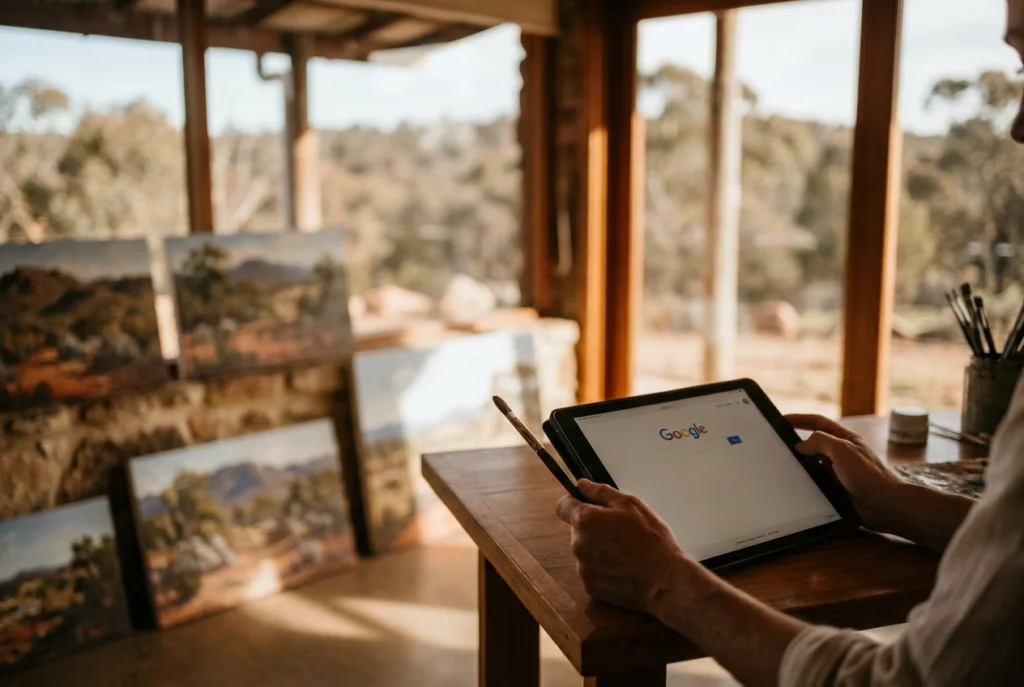
Finding quality Australian landscape artists online should not feel like searching for a needle in a haystack, yet for many art enthusiasts, that is exactly what it becomes. With thousands of creators scattered across social media platforms, gallery websites, and personal portfolios, knowing where to look and who deserves your attention makes all the difference.
Australian landscape art carries a distinct visual identity. From the sun-scorched outback to lush coastal escarpments, the continent offers artists a palette unlike anywhere else on earth, and the painters, photographers, and illustrators who capture it have developed devoted followings for good reason.
This list cuts through the noise. Whether you are looking to purchase original work, find inspiration for your own practice, or simply deepen your appreciation of the genre, these australian landscape artists have one important thing in common: they are genuinely accessible online. Their work is easy to browse, their contact details are straightforward to find, and their digital presence reflects the same care they bring to their craft. Expect names spanning traditional oil painting, contemporary abstraction, and everything in between.
What Makes Australian Landscape Art Distinct (and Searchable)
Australian landscape art possesses something no generic competitor can manufacture: a visual vocabulary so geographically specific that it becomes keyword real estate by default. The rich red earth of the Outback, the silver-green of coastal eucalyptus, dramatic ochre formations, and the particular quality of Australian light are not interchangeable with any other landscape tradition on earth. As Wentworth Galleries notes, European artists arriving on Australian soil in the late 18th century had to invent an entirely new artistic language because their existing traditions could not capture what they were seeing. That irreproducibility is the foundation of a genuine search advantage. Every subject-specific noun, from Kimberley gorge to Flinders Ranges ochre to Hawkesbury River light, is a phrase that generic international competitors simply cannot claim.
Geographic specificity compounds this advantage at the keyword level. A buyer searching red dirt landscape oil painting or coastal Australian watercolour has already narrowed their intent considerably. These long-tail queries face a fraction of the competition of broad terms like landscape painting, and they attract buyers with strong purchase intent rather than casual browsers. Research into collector psychology confirms that buyers are often searching for a specific place they love or feel connected to, meaning regional place names carry emotional weight that amplifies commercial intent.
Understanding how buyers actually phrase their searches is where most artists miss a significant opportunity. Queries like large abstract bush painting for living room or original Kimberley landscape watercolour reflect spatial placement intent layered over emotional connection. Buyers describe what they want using feeling, scale, and room context, not the formal labelling language artists tend to use.
Medium and style specificity compound the advantage further. A listing titled textured oil on linen, Australian outback targets a narrower, higher-converting audience than landscape art for sale, making precise labelling a deliberate commercial strategy rather than a limitation.
Finally, distinguishing between informational searches (famous Australian landscape painters, Heidelberg School history) and transactional searches (buy original Australian landscape painting online) allows artists to build content that intercepts buyers at every stage of their discovery journey, from initial curiosity through to purchase decision.
Notable Australian Landscape Artists and What Their Online Presence Reveals
The history of Australian landscape painting is not just an art historical record. It is a masterclass in how identity, consistency, and institutional validation translate directly into digital authority, even when the artists themselves never optimised a single webpage.
The Heidelberg School: Legacy as Organic Authority
Arthur Streeton, Tom Roberts, and their Heidelberg School contemporaries established the foundational visual language of Australian landscape painting during the 1880s and 1890s. Working outdoors in natural light, they produced a distinctly Australian impressionism that broke from European convention and gave the continent its first widely recognised painterly identity. More than 130 years later, their names continue to generate substantial search volume across gallery platforms, auction house databases, educational resources, and editorial content. This accumulated citation history functions as what modern SEO practitioners would call legacy organic authority: a depth of inbound reference from high-trust domains that no contemporary artist can replicate overnight. The lesson is not that history is required for visibility, but that consistent identity, repeated across credible contexts over time, is the engine behind it.
Hans Heysen: The SEO Power of Owning a Niche
Hans Heysen spent decades painting South Australian gum trees with a focus so singular that his name became inseparable from the subject. That kind of deliberate, repeated association between an artist and a specific visual motif creates exactly what search engines reward: a clear, authoritative signal that one entity is the definitive answer to a specific query. For contemporary landscape artists, this is among the most actionable lessons available. Artists who attempt to rank for broad terms like “Australian landscape painting” compete against institutions, encyclopaedias, and aggregator platforms with domain authority far beyond any individual website. Artists who build a body of work and digital identity around a specific region, subject, or technique occupy a niche where genuine authority is achievable. Owning a visual niche is not a creative compromise; it is a search visibility strategy.
Fred Williams: Institutional Backlinks and E-E-A-T Signals
Fred Williams reimagined the Australian landscape from the 1950s onward, developing abstract aerial perspectives that positioned him as one of the country’s most formally innovative painters. His representation in major institutional collections, including the National Gallery of Victoria, generates something individual artist websites rarely produce independently: authoritative external citations from .edu and .gov domains. A University of Melbourne library page, for example, cites Williams in the context of a curated exhibition alongside other canonical figures. These institutional mentions are not decorative; they are exactly the kind of E-E-A-T (Experience, Expertise, Authoritativeness, Trustworthiness) signals that Google’s ranking systems weight heavily, particularly following the August 2026 spam update, which hit sites without genuine authority signals harder than any preceding update.
Ken Done: Cultural Recognition as Commercial Search Visibility
Ken Done built a body of work so visually distinct, centred on Sydney Harbour, the Great Barrier Reef, and the quality of Australian coastal light, that his style became recognisable at a glance. That immediacy of recognition translates to search behaviour: buyers searching for “Sydney Harbour artwork” or “colourful Australian coastal painting” encounter his name across commercial galleries, editorial features, and merchandise platforms simultaneously. The result is a feedback loop where cultural familiarity reinforces search visibility and commercial discoverability reinforces cultural familiarity. For working artists, the principle is transferable. A distinctive, geographically or thematically anchored style, applied consistently and distributed across multiple credible online touchpoints, builds the kind of search presence that generalist output cannot.
The Visibility Gap for Emerging Artists
The pattern across these established artists points to an uncomfortable reality for emerging and mid-career practitioners. Without institutional collection placement, editorial coverage from publications like Artist Profile, or aggregator positioning on high-traffic platforms, most emerging landscape artists rank for neither their own name nor any relevant buyer search query. Research into the impact of digital presence on emerging visual artists confirms that digital visibility materially affects career outcomes, yet the gap between artistic merit and online discoverability remains widest precisely at the mid-career stage. Strong work alone does not generate search traffic. Descriptive image metadata, artist statements written in buyer-relevant language rather than curatorial language, and external mentions from galleries and press are the three structural elements that separate findable artists from invisible ones. For this cohort, targeted SEO investment is not supplementary; it is the highest-leverage action available.
How Australian Art Buyers Actually Search in 2026
The way buyers find and purchase original artwork has shifted significantly, and Australian landscape artists who built their strategy around pre-2024 search behaviour are operating with an outdated map.
Visual Search and AI Overviews Have Rewritten the Rules
Image optimisation in 2026 is not what it was two years ago. Google AI Overviews now appear in up to 39% of Australian searches, nearly triple the global average, following a nationwide rollout in late 2024. This means that for a growing proportion of searches, synthesised answers and curated images appear before any traditional organic result a buyer would click. For visual artists, this is the most important structural change to understand: a well-optimised artwork image can now surface inside an AI-generated response, placing it in front of buyers who may never scroll to the blue links below.
According to SEO for Artists: How to Get Your Art Found on Google in 2026, an estimated 90% of image SEO potential is left unused when alt text is blank or reduced to a filename. In a landscape where images feed directly into AI-generated results, that is not a minor oversight; it is structural invisibility at the most competitive level of the search results page.
Specific Language Converts, Generic Language Browsers
The distinction between a buyer and a browser lives inside the search query itself. “Watercolour painting” attracts curiosity. “Original watercolour of Australian mountains, muted blue-grey palette” attracts intent. Long-tail queries that combine medium, subject, style, and sometimes scale or price point convert significantly better because they filter out casual lookers and surface the artist directly to someone ready to purchase.
For Australian landscape artists, this translates into a rich keyword opportunity. Queries like “original Australian outback oil painting for sale,” “contemporary coastal landscape watercolour Brisbane artist,” or “plein air bush landscape small original painting” are specific enough to face far less competition and specific enough to match genuine buying behaviour. Artists targeting only broad terms compete against millions of content pages; artists targeting long-tail queries compete against a fraction of that volume while attracting buyers with credit cards in hand.
Pinterest as a First-Touch Discovery Platform
Pinterest operates as the mood-board stage of the buyer journey, the place where collectors and interior buyers gather visual references before they know which artist they want. An independent Adobe study found that 73% of respondents felt Pinterest’s visual search results outperform traditional search, and 36% now begin searches on Pinterest rather than a conventional search engine. The typical pattern runs like this: a buyer discovers an aesthetic they want on Pinterest, pins several works, then moves to Google to find and contact a specific artist. An artist absent from Pinterest misses the first touchpoint entirely, which means Google alone, however well-optimised, only captures buyers who already know roughly what they are searching for.
The Owned Traffic Problem With Instagram and Etsy
Relying on Instagram and Etsy is not simply a suboptimal strategy; it is a structurally fragile one. Instagram’s algorithmic reach throttling means the majority of followers will not see any given post, regardless of content quality or posting frequency. Etsy’s escalating fee structure and increasing market saturation compress margins while the platform, not the artist, owns the customer relationship. Neither channel produces compounding, owned traffic. An Instagram post reaches a fraction of followers in its first 48 hours and then effectively disappears. A well-optimised artwork page on an artist’s own website can rank and attract traffic for years, accumulating authority with every visit, backlink, and engagement signal it earns.
Why Ranking Position Determines Revenue in Australia
The gap between ranking first and ranking tenth on Google is not a minor difference in visibility; it is the difference between a business and an afterthought. The number one organic result in Australia averages a 39.8% click-through rate. The tenth result averages 1.6%. An artist ranking first for “Australian coastal landscape painting” captures approximately 25 times more traffic than one sitting at position ten for the same query. That gap compounds over time, meaning the artists who invest in organic ranking now are building an asymmetric traffic advantage that platform-dependent competitors cannot match through posting frequency alone.
Why Most Australian Landscape Artists Are Invisible Online
Understanding the structural reasons behind this invisibility is the first step toward correcting it. The problems are consistent, predictable, and entirely fixable, but only once artists recognise that a beautiful website and a search-visible website are two entirely different things.
Image SEO: The Most Neglected Asset in Any Artist’s Toolkit
For an artist, every image on a website is a potential discovery point. Yet research into image SEO practices confirms that 90% of image SEO potential is left completely unused when alt text is blank or carries a default filename like ‘IMG_4832.jpg’. Search engines cannot see images the way humans do. They read the metadata surrounding those images, including the filename, the alt text, the surrounding caption, and the structured data applied to the page. An artist who uploads a stunning oil painting of the Flinders Ranges without a descriptive filename, relevant alt text, or keyword-informed caption has effectively hidden that work from every buyer searching for it. The analogy is precise: a restaurant that omits its menu from Google is not less good at cooking; it is simply invisible to the customers most likely to walk through the door. For visual artists, this is not a minor technical oversight. It is the difference between generating consistent inbound enquiries and being bypassed entirely.
E-E-A-T Signals: Authority That Most Artists Already Have But Never Use
Google’s E-E-A-T framework, which evaluates Experience, Expertise, Authority, and Trustworthiness as ranking inputs, has intensified significantly as a determinant of search position in 2026. What makes this particularly relevant for established Australian landscape artists is that they typically hold a range of strong authority signals that are simply never documented on their websites. Exhibition history, gallery representation, artist residency credits, press and media mentions, and detailed artist statements are all inputs that Google evaluates when assessing a site’s authority. An artist with 20 years of exhibition credits, representation by a reputable gallery, and published editorial coverage possesses genuine authority. However, if none of that is reflected in structured, text-based on-site content, Google has no mechanism to recognise it. The biography page as a two-paragraph formality is a missed ranking opportunity of considerable scale.
The August 2026 Algorithm Environment Punishes Exactly the Wrong Profile
Google’s August 2026 spam update delivered harder-than-typical ranking impacts across the board, and the profile of sites most severely affected reads like a description of a standard artist portfolio website: minimal text content, no external credibility signals, weak on-page SEO, and no editorial history. Businesses not adapting to authority-based optimisation have faced visibility declines of up to 37%, and AI Overviews now appear in 39% of Australian searches, nearly triple the global average, compressing organic click-through rates for sites that were already underperforming. Google search ranking data for Australia makes the stakes explicit: the number one organic result averages a 39.8% click-through rate, while position ten averages just 1.6%. Artist websites built as visual showcases with no substantive content architecture are not just missing opportunities; they are now actively penalised by the direction of search.
Portfolio Thinking Versus Commercial Asset Thinking
Most artists approach their website as a digital gallery: a place to display work attractively and provide contact details. This is a structurally sound approach for impressing visitors who already know the artist exists. It is a commercially ineffective approach for attracting buyers who do not. Pages with no keyword-relevant title tags, no descriptive image metadata, no blog or editorial content, and no local SEO signals communicate nothing useful to Google about what the site offers or who it serves. Local intent drives 46% of all Google searches, and 76% of mobile local searches result in a visit or purchase within 24 hours. An Australian landscape artist without geo-targeted content, a verified Google Business Profile, or suburb-level landing pages is invisible to buyers searching at the precise moment of purchase intent.
Social Media Reach Is Not Search Authority
The final and perhaps most consequential misconception is that social media presence substitutes for search visibility. It does not. Follower counts do not transfer to domain authority. Social engagement generates no backlinks. A post that reaches 10,000 people on a given day contributes nothing to where an artist’s website ranks the following month. More critically, algorithmic reach on social platforms can be reduced or eliminated overnight without notice or recourse. Organic search authority, built through optimised content, credible on-site signals, and sustained SEO strategy, compounds over time. The gap between where most Australian landscape artists currently sit and where their search visibility could be is not a creative gap. It is a structural one, and it is entirely addressable.
What Visible Australian Landscape Artists Do Differently
The distinction between artists who appear consistently in search results and those who remain invisible rarely comes down to talent. It comes down to five specific, repeatable practices that the visible cohort applies deliberately.
1. Geographic and Style Keywords as Targeted Entry Points
Visible Australian landscape artists treat every page title, image description, and metadata field as a targeted search entry point rather than an administrative formality. Instead of defaulting to generic phrases like “original art for sale,” they deploy precise geographic and medium-specific markers that mirror real buyer search behaviour. Phrases such as “Flinders Ranges landscape oil painting,” “Australian bush watercolour,” and “outback abstract art” attract buyers who are already close to a purchasing decision. The specificity is not accidental; it reflects a working understanding of how long-tail searches convert. A buyer searching “original watercolour of mountains” is expressing a far stronger purchase signal than one searching “watercolour painting,” and an artist whose page title captures that precise phrase earns the click. Every page becomes a dedicated entry point, each targeting a distinct buyer intent.
2. Image Alt Text Written in Buyer Language
At least 90% of image SEO potential is left unrealised when alt text is left blank or reduced to a filename. Visible artists apply buyer-relevant language to every image, describing the actual subject, medium, format, and mood in terms a purchasing buyer would use. “Oil painting of red outback plains at dusk, wide format” is not just more descriptive than “artwork 14”; it is discoverable in ways the placeholder never could be. This matters because images now play an active role in AI-generated search responses, not just traditional Google Image Search. Every correctly labelled image on an artist’s website is a potential citation point in an AI Overview, a Google Images result, or a visual search query. Artists who overlook this are, in effect, leaving a large portion of their portfolio invisible to search infrastructure entirely.
3. Local SEO Infrastructure for Regional Reach
For artists who do commissions, host studio visits, or exhibit in galleries, local SEO generates meaningful and highly qualified reach. A fully optimised Google Business Profile, suburb and city-level targeting in on-page content, and earned citations from local galleries and arts institutions all send geographic relevance signals to buyers searching within a specific region. An artist in regional Victoria whose website references specific towns, landmarks, and local exhibition history confirms legitimate local entity status to both Google and AI systems. This approach scales from individual suburb-level authority through to broader state and national recognition, and it builds progressively rather than decaying the way social media reach does.
4. AI Search Visibility as a Separate Discoverability Channel
In 2026, AI-powered search is reshaping organic visibility in ways that require a distinct strategic response. Only 17 to 38% of AI-cited pages also rank in the organic top ten, meaning traditional search rankings do not guarantee AI visibility, and artists cannot assume the two overlap. Tools like Otterly.AI and Profound now specifically track brand citations across ChatGPT, Perplexity, Gemini, and Google AI Overviews; these are channels that portfolio sites and social media profiles cannot access. Understanding GEO keyword research and monitoring where an artist’s name and works appear in AI-generated responses has become a practical necessity, not a technical luxury. Artists cited in these responses gain discoverability in a channel where the qualified lead-to-conversion rate is approximately 4.4 times that of classic organic traffic.
5. E-E-A-T Signals as the Compounding Long-Term Strategy
The most defensible long-term strategy for any Australian landscape artist is the systematic accumulation of genuine authority signals. SEO experts are aligned on this point heading into 2026: E-E-A-T, authenticity, and demonstrated expertise are foundational to both traditional and AI search performance. For artists, this translates into regular exhibition submissions, editorial coverage in credible art publications, active gallery representation, a detailed and current artist statement, and backlinks from respected arts organisations including state galleries, regional art prizes, and peak bodies. Brand mentions in third-party sources correlate with AI visibility approximately three times more strongly than backlinks alone, meaning earned media coverage carries compounding strategic value. This authority profile does not evaporate after a single algorithm update; it strengthens over time, creating a competitive position that cannot be replicated quickly by artists who delayed building it.
The SEO Tool Gap Most Artists Do Not Know They Have
The SEO tool landscape has fractured into two distinct categories, and most Australian artists are only working with half the picture. Traditional platforms such as Semrush, Ahrefs, and Surfer SEO remain essential for keyword research, technical audits, and tracking conventional Google rankings. But a second category has emerged alongside them: AI visibility tools like Otterly.AI and Profound, which monitor brand citations across ChatGPT, Perplexity, Gemini, and Google AI Overviews. These are fundamentally different surfaces, and traditional tools cannot see them. According to the 2026 AI SEO tools landscape mapped by tier, this bifurcation is now structural rather than transitional, meaning artists who track only Google keyword rankings are operating with a measurable blind spot that will compound over time.
The scale of that blind spot is significant. Research across 1,700 businesses found that 88.1% are completely invisible in ChatGPT when buyers submit recommendation queries. Of businesses that rank on Google page one, 77% still do not appear in ChatGPT responses. For an Australian landscape artist, this translates to a concrete scenario: a buyer prompting ChatGPT for “the best Australian landscape artists to commission” will receive a curated shortlist, and without an AI visibility strategy, that artist will not be on it. Tracking tools built specifically for AI search platforms now monitor citations, brand mentions, and competitive displacement across these surfaces, giving artists a measurable way to close the gap rather than guess at it.
The investment required to cover both categories is modest when framed against alternatives. A functional entry-level SEO stack for an Australian artist starts at approximately AUD $55 per month, scaling to AUD $200 to $350 per month for a full growth-tier setup covering both traditional and AI visibility monitoring. Compared to paid social advertising, which delivers traffic only while payment continues, SEO and AI visibility work builds a compounding asset. A well-optimised portfolio page, a properly structured artist statement, and consistent backlinks from galleries and press generate discovery value that accumulates rather than evaporates.
The practical starting point for most artists, however, is not a paid tool at all. A disciplined audit of existing assets costs nothing and typically reveals the highest-leverage opportunities first. Image alt text that reads “IMG_4732.jpg” rather than “eucalyptus-plains-oil-on-linen-australian-landscape” wastes the 90% of image SEO potential that most artists leave unused. Page titles that default to the site platform’s generic structure, artist statements with no keyword coverage, incomplete Google Business Profiles, and untracked backlinks from gallery features or editorial coverage are all fixable without any tool subscription. These foundations also determine whether AI engines can extract and cite an artist’s work when a buyer queries them, making them relevant to both visibility categories simultaneously.
Working with an SEO partner who understands the full stack, and who can apply it specifically to the visual arts context, closes this gap considerably faster than a DIY approach. The Brand Express builds bespoke SEO strategies for Australian artists and sole traders, covering both traditional search visibility and AI citation monitoring. A free visibility audit is the starting point, giving artists a clear picture of where they currently stand across both categories before any investment decision is made.
Your Art Deserves to Be Found: Key Takeaways
Exceptional work that remains invisible in search results is not just a missed opportunity; it is a structural revenue problem. Organic visibility is the distribution channel your art practice needs to reach buyers who are actively searching, credit card in hand, for exactly what you create. This is not a marketing luxury reserved for commercial brands.
Prioritise image SEO as your first action. With 90% of image SEO potential left unused across the web, descriptive alt text and filenames using Australian-specific subject language represent the fastest, highest-leverage improvement any landscape artist can make today. Renaming a file from “IMG_4421.jpg” to “red-desert-landscape-oil-painting-outback-australia.jpg” costs nothing and compounds immediately.
Build E-E-A-T signals with the same intention you bring to your work. Exhibition history, press mentions, gallery affiliations, and a substantive artist statement are not just credentials; they are ranking assets that grow stronger over time, particularly as Google’s authority signals intensify post the August 2026 spam update.
Reduce platform dependency deliberately. Instagram and Etsy impose algorithmic ceilings and fee structures that erode long-term ROI. Owned organic search traffic builds compounding discoverability that no platform update can erase.
The essential starting point is understanding your current visibility gap. Request a free visibility audit from The Brand Express to see exactly where you rank, what your images signal to Google, and whether your name appears in AI-generated responses.
Conclusion
Australian landscape art is thriving online, and finding it no longer requires insider knowledge or gallery connections. The artists featured here prove that exceptional talent and genuine accessibility can go hand in hand. Their work spans diverse subjects, from red desert plains to dramatic coastal cliffs, giving every art lover something worth exploring. Better still, their online presence makes browsing, connecting, and purchasing straightforward rather than frustrating.
Start by bookmarking two or three names that resonated with you today. Follow them on social media, sign up for their newsletters, or reach out directly about available works. Supporting these artists directly puts meaningful resources into the hands of the people creating the art you love.
Australia’s landscape is one of the most visually compelling on earth. The artists interpreting it deserve your attention, and now you know exactly where to find them.