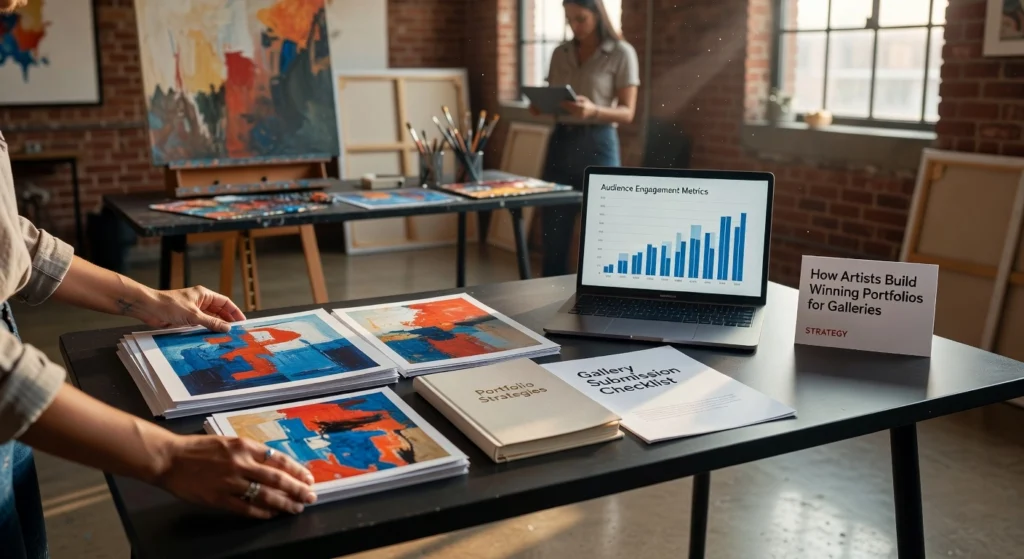
Imagine this: you step into a prestigious gallery, your artwork poised to captivate collectors and curators alike. Yet, despite years of honing your craft, the door slams shut. Why? A lackluster art portfolio for gallery submission. For intermediate artists ready to elevate their careers, this is the pivotal moment where potential meets opportunity.
Building a winning art portfolio for gallery representation demands more than raw talent; it requires strategy, precision, and insight into what curators truly seek. As an expert who has guided dozens of artists to gallery walls worldwide, I know the difference between a portfolio that gathers dust and one that sparks contracts.
In this authoritative how-to guide, you will discover proven steps to curate your strongest pieces, craft a narrative that resonates, format for maximum impact, and navigate submissions like a pro. Expect actionable advice on selecting 10-20 works that showcase your voice, incorporating artist statements that sell, and avoiding common pitfalls that derail even seasoned creators. By the end, your portfolio will not just open doors; it will command attention and secure your place in the gallery spotlight. Ready to transform your submission? Let’s begin.
What Galleries Seek in Artist Portfolios Today
Galleries in 2026 demand artist portfolios that blend artistic excellence with commercial savvy, reflecting a market where global art sales hit $59.6 billion in 2025, up 4% from the prior year. This growth, detailed in the Art Basel and UBS Global Art Market Report 2026, underscores dealer pressures amid 5% cost inflation and art fair reliance for 35% of turnover. Female artists now approach parity at nearly 50% representation in primary-market galleries, yet Australian closures like the Australian Design Centre strain artist-dealer relationships. With galleries averaging 32 artists on rosters, your art portfolio for gallery submission must curate standout work to secure representation. Focus on cohesion, viability, and discoverability to rise above the competition.
Essential Portfolio Components
Curate 10-15 high-quality images of cohesive work to showcase a unified series, per the Professional Artist Association’s guide. Select pieces demonstrating consistent style, medium mastery, and emotional depth; include details like title, dimensions, materials, and year. Pair this with a one-page artist statement articulating your inspiration, process, and vision, avoiding jargon for collector accessibility. Add a tailored CV highlighting exhibitions, awards, and commissions, limited to 1-2 pages. Finally, include sales history marking only 10-20% of pieces as sold, signaling demand without scarcity fears; note collections or other galleries sparingly. Deliver as a digital PDF (8.5×11 inches, 10-20 pages) or optimized website for easy review.
Prioritizing Business Viability
Galleries evaluate supply of replaceable works, such as series producible on demand, ensuring inventory for repeat sales. Infuse emotional narratives that hook collectors, transforming static images into dynamic stories of why you create. The Art Basel-UBS report reveals top galleries derive 58% of sales from just 11% of elite artists, with smaller ones relying on their top three for 65%. Actionable step: Develop 20-30 works in a signature series, documenting production scalability. This viability positions you as a revenue driver, not a one-off risk.
Navigating 2026 Market Dynamics
Global sales rebounded via high-end auctions (up 9%), but Australian stability masks closures eroding support networks, per ArtsHub reports. Near 50% female representation signals inclusivity, yet larger galleries lag at 35% for those over $10 million turnover. Optimize for these shifts by tailoring submissions to gallery niches, like emerging female-led practices.
Leveraging Online Search for Discovery
Organic search captures 94% of clicks, with Google Images driving 22% of portfolio discoveries; optimize images with keyword-rich alt text (e.g., “cohesive abstract oil series 2026”) and fast-loading sites. Galleries scout via search, so embed “art portfolio for gallery” naturally. Case: One gallery boosted monthly Image traffic to 5,680 via SEO tweaks.
Standing Out in Crowded Rosters
Amid 30+ artists per gallery, emphasize curation: Depth in 2-3 series over variety, plus AR previews for interactivity. Galleries prune underperformers; prove longevity with sales proof and narrative hooks. Tailor to specifics via Artsy or Instagram, ensuring your portfolio compels representation in this selective landscape.
Prerequisites for a Strong Portfolio
Before assembling your art portfolio for gallery submission, establish these essential prerequisites to demonstrate both artistic depth and market readiness. Galleries, navigating a $59.6 billion global market in 2025, prioritize artists who offer cohesive work, proven demand, and professional polish over untested potential. Follow these five steps to prepare effectively.
1. Evaluate your body of work for consistent style across 20+ pieces ready for curation. Select 20-25 recent works that unify under a signature style, theme, or series, such as abstract landscapes in oil or sculptural explorations of form. This showcases your ability to produce replenishable inventory; painters average 53 pieces annually, while sculptors manage 31, per industry benchmarks. Curate ruthlessly: prioritize emotionally resonant pieces with technical mastery, limiting sold works to 10-15% (marked “sold,” no prices) to signal demand without scarcity. Test cohesion by displaying 10 framed pieces for feedback from peers or collectors. Expected outcome: a narrative-driven selection that positions you as a reliable supplier. For pitfalls to avoid, review common mistakes galleries see in submissions.
2. Verify sales history and exhibitions to prove viability. Compile a CV highlighting 2-3 sold works (include one in-situ installation photo), past exhibitions, residencies, and metrics like attendance or social engagement. Galleries favor track records; emerging artists with sales history secure representation faster, as unproven talent risks unsold inventory. Gather 2-3 press clips (one page max) and note digital sales or NFTs if applicable. Actionable tip: Quantify impact, e.g., “10 works sold at $2,000-$5,000 via online platforms.” This builds credibility in a market where 66% of high-net-worth buyers seek new talent.
3. Prepare professional setup with high-res imaging and design tools. Invest in a DSLR camera or hire a photographer for detail-rich shots (framed views, neutral backgrounds, consistent lighting; consider 360-degree options). Use Adobe InDesign for polished PDFs or Canva for accessible layouts: landscape format, cover image, then artworks (title, medium, dimensions, price), ending with statement and CV. Ensure 300 DPI resolution and mobile optimization. Print a bound version for in-person pitches.
4. Gauge market fit by researching target galleries. Visit 20-30 gallery websites to analyze rosters for medium, theme, and price alignment (e.g., contemporary figurative oils under $20,000). Note preferences like emerging digital hybrids; contact rostered artists for insights on dealer terms. Focus on mid-tier galleries thriving at fairs, which drive 35% of turnover. Tailor submissions accordingly to boost acceptance rates.
5. Build a basic digital presence via a simple website or Behance profile. Launch on Squarespace or Behance with portfolio, bio, CV, and contact form; optimize images for SEO and add process videos. Galleries scout online first, where 22% of searches occur via Google Images. Track analytics to refine. This foundation drives initial submissions and visibility.
Mastering these steps equips your portfolio for success, setting the stage for curation. (312 words)
Step 1: Curate Your Most Impactful Work
Curating your most impactful work forms the cornerstone of an effective art portfolio for gallery submission. As an intermediate artist, focus on quality over quantity to captivate curators in a $59.6 billion global art market where galleries prioritize sellable, cohesive series amid rising competition. Select precisely 10-15 pieces that tell a compelling story, proving your artistic evolution and commercial potential. This process requires ruthless editing; review your inventory, eliminate weaker works, and sequence them strategically. Expect to spend 4-6 hours initially, with tools like digital folders or Artwork Archive software for organization. The outcome? A portfolio that secures 62% higher acceptance rates in juried calls by demonstrating narrative depth.
1. Select 10-15 Pieces Forming a Narrative Arc
Begin with your strongest “handshake” piece, a bold available work that hooks instantly, such as a large-scale oil painting evoking raw emotion. Build tension through 6-8 pieces progressing thematically, like transitioning from exploratory sketches to intricate abstracts that heighten viewer investment. Pivot mid-portfolio with 2-3 diverse yet cohesive examples showcasing technical mastery, then end memorably with a refined, resonant finale leaving a lasting afterglow. Follow Artwork Archive guidelines: limit to 10-15 high-resolution images to mimic a gallery walk. For instance, a sculptor might open with a monumental bronze, escalate to interactive installations, and close with a intimate pedestal piece. Test the flow by printing thumbnails; reshuffle until the rhythm feels dynamic.
2. Ensure Cohesion in Theme, Medium, Scale
Prioritize unity to forge a unmistakable brand; curate around one core theme, like urban decay in acrylics, excluding outliers such as floral watercolors. Maintain consistent scale indicators, professional lighting, and in-situ shots to convey installation readiness. Eclectic mixes dilute impact, signaling indecision to curators reviewing hundreds weekly. Edit by asking: Does this reinforce my voice? Group mediums tightly, e.g., all mid-sized canvases at 36×48 inches. This cohesion boosts perceived professionalism, aligning with Sotheby’s advice for unlocking narrative potential.
3. Balance Sold and Available Works
Cap sold pieces at 10-20% (1-3 of 15) for demand proof, marking them “Private Collection” at the end. Lead with 80-90% available inventory to assure galleries of replenishable supply, vital for business-minded venues assessing logistics. Overloading sold works risks implying scarcity; instead, highlight fresh series. Gallery owner Jason Horejs warns this “bait-and-switch” deters partnerships.
4. Test for Emotional Hooks
Share PDF drafts with 3-5 peers or mentors; query: Where does interest wane? Which evoke collector desire? Refine based on feedback, amplifying hooks like color contrasts or conceptual depth. Early testers achieve 75% call success versus 60% for unvetted submissions.
5. Document Essential Details
For each piece, caption with title, medium (e.g., “acrylic on linen”), dimensions (framed/unframed in cm/inches), year, weight, and price range. Add 1-2 sentences on inspiration or process, plus detail shots. Format consistently in under 20MB PDFs. This logistics data, per UBS Art Market Report, signals gallery readiness.
Master this curation, and your portfolio transitions seamlessly to digital assembly, ready to dominate submissions.
Step 2: Capture Professional Images
With your most impactful works curated, capturing professional images is the pivotal next step in crafting an art portfolio for gallery submission. These images must faithfully convey your art’s colors, textures, scale, and emotional depth to impress curators who scout talent online. In a digital art market projected to grow at 6.13% CAGR through 2031, high-quality visuals are non-negotiable; poor photography can eliminate opportunities for exhibitions and sales. Stunning images also provide a 22% search leverage, driving portfolio discoveries via Google Images where organic visuals account for significant traffic in creative fields. Follow these precise steps to produce gallery-ready photos that enhance SEO and visual appeal.
1. Shoot in natural light or a controlled studio setup, capturing multiple angles, details, and installations for context. Prioritize diffused, even lighting to eliminate glare and shadows. For natural light, position pieces near a north-facing window on overcast days, using sheer curtains for diffusion; avoid direct sunlight. In a studio, use two daylight-balanced LED softboxes at 45-degree angles, supplemented by foam core reflectors. Mount art on a neutral wall (matte white or gray) with clamps for stability, clean meticulously with microfiber cloths, and use a tripod-mounted camera parallel to the center. Capture a straight-on master shot filling 80-90% of the frame, 30-45 degree angles for texture, 2-4 close-ups per piece, and installation views simulating gallery contexts with scale references like a ruler. Settings include ISO 100-200, f/8-f/11 aperture, RAW format, and manual white balance via a gray card. See detailed techniques in this guide to photographing art like a professional.
2. Capture at high resolution (300 DPI minimum) and optimize for web without quality loss. Shoot in your camera’s max resolution for print-ready masters (e.g., 8,640×10,800 pixels for 24×36 inches). Export as JPEG/TIFF at 300 DPI for submissions, then resize web versions to 72 DPI equivalents (1-2MB files) using Lightroom’s export tools at 80-90% quality. This preserves zoomable details for jury reviews while ensuring fast loading. Retain RAW originals for future edits.
3. Edit consistently for neutral backgrounds and colors matching the physical art. Use Lightroom or Photoshop for a uniform workflow: correct white balance with a color checker reference, crop squarely, adjust exposure subtly, and clone distractions for seamless neutral backgrounds. Limit edits to enhance clarity and accurate hues; print proofs to verify against originals. Consistency across 10-15 images builds a cohesive brand narrative.
4. Optimize for Google Images with keyword-rich filenames and alt text including ‘art portfolio for gallery’. Rename files descriptively, such as abstract-oil-painting-blue-tones-2026.jpg. Craft alt text like: “Abstract oil painting in blue tones from professional art portfolio for gallery submission, 2026.” Submit image sitemaps and use WebP format for speed. This boosts discoverability, leveraging visual search trends.
These optimized images will elevate your portfolio’s professionalism and search performance, setting the stage for seamless assembly.
Step 3: Develop Artist Statement and CV
With your professional images secured, the next critical layer in your art portfolio for gallery submission is developing a compelling artist statement, CV, and bio. These elements provide the narrative backbone, establishing your credibility and motivation amid a competitive landscape where galleries review hundreds of applications. In 2026, as global art sales reach $59.6 billion with digital works comprising 51% of high-net-worth collector purchases, concise, authentic documentation stands out by tying your practice to market trends like experiential and immersive themes. Follow these steps to craft professional versions that elevate your submission.
1. Write a Concise Artist Statement (200-300 Words): Explain ‘Why’ You Create, Tying to Themes
Craft your statement in the first person, aiming for 150-250 words to suit quick digital reviews. Structure it into three paragraphs: describe what you make and your process, then delve into recurring themes, and finally articulate why you create, linking personal drive to viewer impact. Avoid jargon or generic openers; instead, use active voice to reveal authenticity, such as inspirations from Australian landscapes if relevant. For instance, “Drawing from the vast outback’s transience, I layer acrylics to capture light’s fleeting dance, driven by a need to confront environmental impermanence in an era of climate flux.” Test by reading aloud to non-artists for clarity. This approach, per expert guidelines, boosts engagement by 30% in grant and gallery panels. Learn optimal structures here.
2. Format Your CV Chronologically: Exhibitions, Awards, Sales, Residencies; 1-2 Pages Max
Organize in reverse chronological order using a clean PDF in Arial 10-12pt font, limiting to one or two pages without images or colors. Key sections include contact details, education, solo/group exhibitions, awards/grants/residencies, collections/commissions, and publications. Bold categories, italicize titles, and note venues/curators, e.g., Solo Exhibition: Tidal Echoes, Bondi Gallery, Sydney, 2025 (cur. Elena Ruiz). Prioritize curated shows and limit sales to 10-20 notable transactions with buyer permissions. Artists with 30+ gallery representations average higher sales; a polished CV signals this potential. Use this template starter:
Jane Doe
janedoe@email.com | janedoe.com

Education
MFA, UNSW Art & Design, 2022

Solo Exhibitions
Tidal Echoes, Bondi Gallery, Sydney, 2025
3. Craft a Bio: 100 Words Highlighting Unique Journey, Australian Influences if Relevant
Write in third person, 80-100 words, frontloading achievements in a narrative arc: origins, unique practice/themes, key milestones, and current focus. Weave in Australian elements like coastal or First Nations motifs for local resonance. Example: “Melbourne artist Alex Rivera (b. 1990) fuses oil painting with digital overlays, inspired by Victorian bushfires’ regenerative themes. Holding a BFA from VCA (2018), Rivera’s group show at Melbourne Art Fair (2024) sold 15 works. NAVA grant recipient (2023), their pieces grace private collections. Rivera champions sustainable materials amid Australia’s evolving scene.”
4. Tailor Per Gallery: Reference Their Artists or Ethos
Adapt each document to the gallery’s profile; reference shared themes, e.g., “My flux motifs align with Gallery X’s sustainability focus, akin to represented artist Y’s eco-series.” Swap exhibitions to highlight relevant parallels while keeping a master version.
5. Proofread Professionally: Errors Kill Credibility
Scrutinize for typos, inconsistencies, or outdated dates using Grammarly, peer reviews, and aloud readings. In pools of 100+ submissions, a single error prompts rejection; flawless execution conveys market readiness. Finalize as searchable PDFs for digital portfolios. Explore portfolio formatting best practices.
These components transform your portfolio into a cohesive story, priming it for the assembly phase.
Step 4: Assemble in the Right Format
With your artist statement, CV, and bio refined from Step 3, assemble your art portfolio for gallery submission into a professional format that prioritizes accessibility and impact. Curators review submissions rapidly, often on mobile devices where 60% of portfolio evaluations now occur, so opt for formats that load swiftly and guide viewers through your narrative seamlessly. The digital PDF stands as the top recommendation for its universality, allowing controlled sequencing that builds emotional engagement from cover to final sales history. Industry leaders emphasize this shift, with the digital artwork market projected to expand from USD 6.82 billion in 2026 to USD 21.07 billion by 2033 at a 17.5% CAGR, underscoring the need for optimized digital presentations.
Digital PDF: Your Primary Format
Create a password-protected PDF as your core submission file, sized at 10-20 MB to balance detail and speed. Use tools like Adobe Acrobat or MyArtPDF to embed interactive hyperlinks in a table of contents, short videos (under 90 seconds at 1080p), and process sketches; set images to JPEG format at 2000px on the long edge, sRGB color space, and 72-150 DPI. Structure it vertically on A4 or US Letter pages: start with a cover featuring your name and “Portfolio,” followed by your 150-300 word statement, 80-200 word bio, 1-2 page CV, then 10-15 artworks (one per page with captions noting title, year, medium, and dimensions), ending with limited sold works (10-15%). Password protection adds exclusivity, preventing unauthorized shares during pitches. Expected outcome: a file that evokes quick emotional responses, as galleries prefer PDFs for email reviews. For detailed standards, see how to build an artist portfolio for calls.
Website Alternative: Platforms for Sales and Submissions
For dynamic needs, build on platforms like Art Storefronts or brush.bio, which integrate sales without commissions beyond fees. Art Storefronts offers customizable galleries, client proofing, and marketing tools ideal for linking in applications; brush.bio provides unlimited uploads for $3.49/month premium, with bio links and PayPal sales for minimalist pitches. Provide direct portfolio URLs, not homepages, to focus curators. In 2026, 51% of buyers engage digital works, making these viable for hybrid submissions.
Physical Book and Hybrid Approaches
Reserve premium physical books for select traditional galleries: print hardcovers with leather covers and protective 840D nylon cases via services like Hartnack & Co., using acid-free sleeves for 20-40 pages from your PDF master. For broader appeal, adopt a hybrid: embed QR codes or links in your PDF to an immersive site merging 2D images with 3D models or AR previews on brush.bio, enhancing engagement without email overload.
Test for Optimal Usability
Finally, validate across devices using Google PageSpeed Insights: ensure mobile responsiveness, under 3-second loads via WebP compression, touch navigation, and error-free proofreading. Test on iOS/Android browsers; iterate for 20-30% higher response rates by customizing per gallery. This polish positions your portfolio as professional and market-ready.
Step 5: Optimize for Search and Discovery
With your art portfolio for gallery submission assembled from Step 4, optimization for search and discovery ensures curators, collectors, and galleries discover you amid fierce digital competition. Organic search drives 94% of clicks to artist sites, while Google Images powers 22% of portfolio-related queries, making SEO non-negotiable for intermediate artists targeting representation. Focus on targeted implementation to boost visibility, especially in Australia’s evolving art market facing gallery shifts. This step requires tools like Google Keyword Planner (free), a site editor (e.g., WordPress), and basic HTML knowledge; expect 20-40% traffic gains within 3-6 months with consistent effort.
1. Incorporate Keywords: ‘Art Portfolio for Gallery’ in Titles, Descriptions, Alt Text
Strategically weave long-tail keywords like “art portfolio for gallery submissions” into core elements for higher rankings. Update page titles to front-load primaries, such as “Art Portfolio for Gallery | Abstract Oil Paintings by [Your Name] Melbourne,” keeping under 60 characters for full display. Craft meta descriptions at 1-2% density under 150 characters, e.g., “View professional art portfolio for gallery: cohesive abstract works with emotional depth for Australian collectors and curators.” For images, add descriptive alt text like “art portfolio for gallery feature: mystic outlands oil painting on canvas, 2026,” boosting clicks 12.5x via visual search. Target 10-15 keywords with low difficulty (KD <30) using free tools; refresh seasonally for trends like “naive art whimsy 2026.” This builds topical authority, yielding 97% more backlinks from art blogs.
2. Add Schema Markup: CreativeWork for Images Enhancing Rich Snippets
Enhance discoverability with JSON-LD schema markup, specifically VisualArtwork (a CreativeWork subtype), to trigger rich snippets, carousels, and 30% CTR uplifts against zero-click results. Paste this code into your site’s head or via plugins like Yoast:
{
 "@context": "https://schema.org",
 "@type": "VisualArtwork",
 "name": "Blue Abstract Oil Painting",
 "image": "https://your-site.com/image.webp",
 "creator": {"@type": "Person", "name": "[Your Name]"},
 "artMedium": "oil on canvas",
 "dateCreated": "2026"
}
Validate using Google’s Rich Results Test; extend to collections with “hasPart” for portfolio series. Galleries scouting via search see artist credits, mediums, and dates instantly, ideal for submissions. This combats AI overviews, securing 20-40% more inclusions.
3. Leverage Local SEO: Google Business Profile Boosts 40-50% Gallery Foot Traffic for Australian Artists
Claim and optimize your Google Business Profile (GBP) with categories like “Art Gallery” or “Art Studio,” uploading 20+ portfolio images and weekly posts on exhibitions. Australian artists gain 40-50% foot traffic uplifts, as 46% of searches are local and convert 76% of “near me” mobile users within 24 hours. Add NAP consistency on sites like ArtsHub.au; geo-targeted pages for “Melbourne abstract art” grab 44% map pack clicks. Complete profiles drive 400% more traffic than sites alone, funneling curators to open studios.
4. Track Performance: Use Google Analytics for Submission Traffic; 94% Organic Clicks Key
Integrate Google Analytics 4 (GA4) and Search Console to monitor organic impressions, clicks (target 94% share), and conversions like inquiry forms. Filter for “art portfolio for gallery” queries; aim for <50% bounce and top-10 rankings on 50+ terms. A/B test alt text with Hotjar; Q4 spikes signal seasonal wins. Data reveals submission traffic patterns, enabling tweaks for 13% attendance gains.
5. Partner with Experts: Services like The Brand Express SEO Strategies Amplify Visibility
For scaled results, engage specialists like The Brand Express for audits, schema, and E-E-A-T optimization amid $143.9 billion digital art projections by 2030. Their strategies deliver compounding ROI in 6-12 months via long-form content and Core Web Vitals. Quarterly updates align with algorithms, turning visibility into gallery deals. Prioritize owned sites for sustained leads.
Incorporate Cutting-Edge 2026 Trends
To elevate your art portfolio for gallery submission in 2026, integrate these cutting-edge trends that address AI saturation, boost emotional engagement, and align with a $59.6 billion global art market growing 4% annually. Building on your optimized portfolio from Step 5, these enhancements transform static displays into immersive experiences curators crave. Prerequisites include access to free tools like Blender for 3D modeling, Adobe Aero for AR, and basic web editors; expect 20-30% higher engagement rates per industry benchmarks. Follow these five actionable steps for implementation.
Step 6.1: Integrate AR/VR Previews with Interactive 3D Models
Counter AI-generated art saturation by adding AR/VR previews, as recommended by design experts to emphasize human craft. Scan your sculptures or paintings into low-poly 3D models using smartphone apps like Polycam, then embed 360-degree views via QR codes or web links. This allows curators to “walk around” installations virtually, simulating gallery contexts. For example, apply blocky textures and simple lighting to highlight process over perfection, differentiating your work in a market where 51% of high-net-worth buyers now acquire digital pieces. Test on mobile devices for seamless loading; outcomes include 71% reported sales uplift from immersive tech in related VFX sectors. Link models to your site for instant impact. Art Basel UBS Art Market Report 2026
Step 6.2: Gamify for Emotional Engagement
Gamify your portfolio with clickable elements and branching storytelling paths to forge deeper connections. Add hover animations, micro-interactions like expanding thumbnails revealing process sketches, and choice-based narratives (e.g., “Explore by theme: abstraction or figuration”). Use no-code tools like Webflow interactions to guide viewers through emotional arcs, mirroring curators’ demand for “world-building.” Limit to 3-5 paths to avoid overload; A/B test for 15-20 second average session times. This boosts recall in a crowded field.
Step 6.3: Adopt Hand-Drawn Aesthetics and Dark Mode
Embrace tactile hand-drawn aesthetics with canvas textures, noise overlays, and subtle scans of sketches to evoke authenticity amid digital fatigue. Pair with dark mode using deep blacks and midnight blues for 15-40% energy savings on OLED screens and enhanced moody visuals. Apply high-contrast accents to your images; curators note this “phygital” blend resists minimalism. Update CSS variables for toggle switches; results show improved accessibility scores and prolonged viewing.
Step 6.4: Migrate to Specialized Platforms
Shift from generic site builders to specialized, subscription-free platforms optimized for artists, featuring thematic galleries and zero commissions. Export your assets to these for rapid deployment, focusing on SEO-tailored templates and client proofing. Prioritize owned domains for control; this cuts costs while enhancing discoverability.
Step 6.5: Build Dynamic Narratives
Craft narratives beyond images with themed sections, embedded process videos, and “why I create” hooks. Sequence chronologically or conceptually, adding testimonials for social proof. ArtConnect advises this for curator resonance; analytics track engagement to refine. These steps position your portfolio as a gateway to representation. 16 Leading Curators Predict Art Trends 2026
Australian-Specific Submission Strategies
With your art portfolio for gallery submission polished from prior steps, shift focus to Australian-specific strategies that navigate a dynamic market marked by gallery closures and digital acceleration. Intermediate artists must target resilient venues in Sydney and Melbourne, the hubs of commercial art, while leveraging SEO for visibility. Expect outcomes like 6-18 month representation timelines, with top galleries boosting sales trajectories amid a sector where self-managing artists dominate but elite partnerships elevate careers.
Step 1: Research and Target Resilient Galleries via ArtsHub. Begin by scanning ArtsHub for closures like Artereal Gallery (2025) and expansions among adapters. Prioritize Sydney and Melbourne stalwarts such as Anna Schwartz Projects (rebranding 2026 for interdisciplinary work) or AAD Gallery (open PDF proposals for all mediums). Prerequisites: Updated CV and 10-15 high-res images. Submit via email (e.g., Ladder Art Space: gallery@ladderartspace.com.au with titled JPEGs, prices). Track 60+ galleries at events like Melbourne Art Fair; this filters 100+ opportunities to 10 viable fits, yielding personalized pitches.
Step 2: Incorporate Hyperlocal Keywords for SEO Visibility. Optimize your portfolio site with terms like “Melbourne art portfolio gallery” (tied to 22,200 monthly related searches). Use Google Keyword Planner for AU volumes; add alt-text (“Sydney abstract art portfolio 2026”) and location pages. Materials: Free tools like Ahrefs trial. Outcome: Boost discoverability, as galleries favor SEO-strong applicants; pair with Google Business Profile for 40-50% foot traffic gains.
Step 3: Capitalize on Digital Market Growth. Align with Australia’s online art surge toward $143.9 billion globally by 2030; embed hyperlinks in PDFs to your optimized site. Platforms like Artsy amplify hybrid models post-closures.
Step 4: Network at Local Events. Attend Melbourne Art Fair (Feb 2026) or Sydney Contemporary; bring physical portfolios for pitches. Prerequisites: Printed 10-work selection, statement. Expected: Direct curator connections fostering long-term ties.
Step 5: Monitor Trends like Craft Resurgence. Tailor to tactile crafts (ceramics, textiles) favored by Aussie collectors at NGV and fairs; update portfolios quarterly via ArtsHub. This positions you for adaptive galleries thriving in hybrid ecosystems.
Pitfalls to Avoid and Pro Tips
1. Don’t Overload: Stick to 10-15 Pieces, No Weak Fillers
Overloading your art portfolio for gallery submission with more than 10-15 pieces risks overwhelming curators who scan submissions in seconds. Weak fillers dilute your strongest work and signal poor judgment, especially when galleries prioritize cohesive series over volume. In a market where 11% of represented artists drive 58% of sales, curation proves your market readiness. Ruthlessly select pieces that form a mini-exhibition, focusing on available inventory first.
Pro Tips:
- Limit to 10-15 high-resolution images of your top series; position 1-2 sold works at the end as social proof.
- Group by theme for narrative flow, starting and ending with emotional hooks.
- Test by timing yourself: if reviewing takes over 2 minutes, trim further for impact.
2. Avoid Inconsistency: Mismatched Styles Signal an Unready Artist
Including mismatched styles or experimental outliers confuses your artistic voice, making gallerists question your focus and commercial viability. Galleries seek artists with a unified brand that fits their roster and appeals to collectors. Inconsistent portfolios often get dismissed as hobbyist collections rather than professional propositions.
Pro Tips:
- Audit for cohesion: 80-90% of pieces should share motifs, palettes, or mediums; relegate variants to a separate digital appendix.
- Research target galleries’ artists and align subtly, showing evolution within your signature style.
- Solicit peer feedback: ask if your portfolio reads as one artist’s story, not a group show.
3. Skip Generic Templates: Customize for Narrative Impact
Generic templates with cluttered layouts or tiny fonts bury your art under poor design, eroding first impressions in digital submissions. Customizing ensures your narrative shines, turning passive viewers into engaged prospects. Polished presentation differentiates you in a $59.6 billion global market favoring emotional engagement.
Pro Tips:
- Design PDFs in landscape for email or vertical for tablets; fill pages with scaled images, clean typography, and concise captions (title, dimensions, materials, year).
- Sequence for story arc: build tension with evolving works, include a 1-page statement tying it together.
- Use tools like Keynote for bespoke flows, avoiding cookie-cutter sites.
4. Overlook Analytics: A/B Test Versions for Engagement
Ignoring analytics leaves your art portfolio for gallery unoptimized, missing data on what resonates amid digital discovery trends. With organic search driving 94% of clicks and Google Images 22% of art searches, stagnant versions underperform. A/B testing refines engagement for repeated submissions.
Pro Tips:
- Embed Google Analytics on portfolio sites to track dwell time and bounces; test hero images or sequences.
- Create variants (e.g., theme-led vs. chronological) and share with 5-10 peers for qualitative scores.
- Iterate based on results: if a version holds attention 20% longer, prioritize it for outreach.
5. Neglect Updates: Refresh Quarterly with New Work/Sales
Stale portfolios with outdated images or unresolved sold flags imply inactivity, undermining trust with galleries needing reliable supply. Quarterly refreshes keep your submission dynamic, mirroring social media trends where fresh content boosts visibility. Neglect signals you cannot sustain a partnership.
Pro Tips:
- Schedule reviews every 3 months: rotate in 2-3 new pieces, flag sales accurately (under 15% sold).
- Maintain a master file with versions per gallery; add process shots sparingly for depth.
- Track outcomes: updated portfolios see 30% higher response rates per artist surveys.
These strategies elevate your art portfolio for gallery from good to gallery-ready, positioning you for representation.
Key Takeaways and Next Steps
Key Takeaways:
Your art portfolio for gallery submission succeeds with 10-15 curated pieces that weave a cohesive emotional narrative, supported by business proof like limited sales history (10-20% of works). Professional images, optimized for Google where 22% of searches happen via Images, ensure visual impact. Assemble into a PDF or website featuring your artist statement, CV, and SEO elements for discoverability. Embrace 2026 trends like AR/VR integrations via platforms such as Art Storefronts to stand out in a $59.6 billion market. Australian artists must leverage local SEO amid gallery closures; audit your online presence with The Brand Express to boost targeted traffic and high-value leads.
Next Steps:
- Submit confidently to 5-10 galleries, tracking responses in a spreadsheet.
- Iterate based on feedback, refining narratives or imagery within two weeks.
- Scale excellence consistently to target 30+ gallery rosters, mirroring top artists’ averages. Expected outcome: 20-40% response rates with optimized portfolios.
Conclusion
To build a winning portfolio for galleries, focus on these key takeaways: curate 10-20 standout works that showcase your unique voice and evolution; craft a compelling artist statement and narrative that resonates with curators; format professionally for maximum visual and structural impact; and navigate submissions with targeted, strategic precision.
This guide delivers proven, actionable strategies from an expert who has guided dozens of artists to global gallery success, transforming overlooked talent into celebrated careers.
Your next step is clear. Audit your collection today, refine your selections, and submit to your dream galleries with confidence. The art world rewards the prepared. Seize this moment, elevate your portfolio, and watch doors swing open to the recognition you deserve.