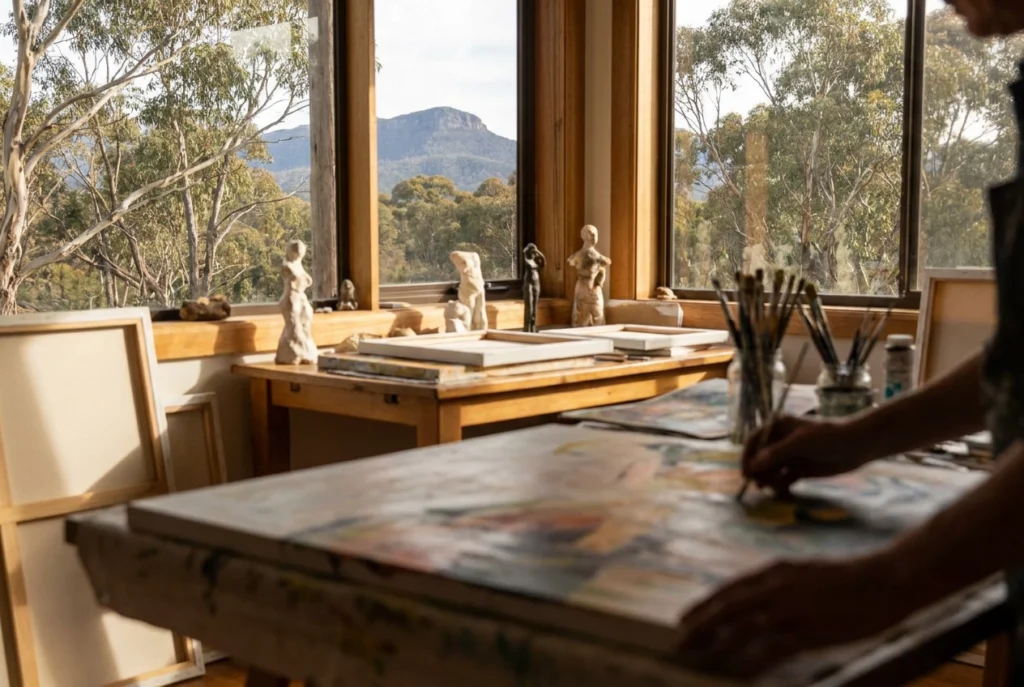
From the sweeping red deserts of the Outback to the sun-drenched coastlines of the Pacific, Australia has produced some of the world’s most distinctive and powerful visual art. The story of a nation can often be told through its artists, and Australia is no exception. The famous Australian artists who emerged over the past two centuries did not simply paint pretty pictures; they captured the very soul of a continent and helped define what it means to be Australian.
Whether you are just beginning to explore the art world or looking to deepen your appreciation of Australian culture, this list will introduce you to the key figures who shaped the nation’s creative identity. From the bold Impressionist landscapes of the Heidelberg School to the haunting Indigenous works that connect the present to thousands of years of history, each artist on this list left a lasting mark on both Australian and global art.
By the end of this post, you will have a clear understanding of who these influential creators were, what made their work remarkable, and why their contributions still matter today.
What Makes Australian Art Distinct
Australian art carries a weight that few national traditions can match. The story begins over 65,000 years ago with First Nations peoples whose artistic practices represent the oldest continuous art tradition on Earth, predating European art movements by tens of thousands of years. From ochre rock paintings and intricate bark work to the globally celebrated dot paintings of the Western Desert movement, Aboriginal and Torres Strait Islander art is not a historical artefact. It is a living, evolving tradition actively practised and passed between generations today.
When European colonisation arrived in 1788, early settler artists were primarily documentarians, recording unfamiliar flora, fauna, and landscapes in watercolour for scientific and administrative purposes. Over time, classically trained painters began approaching the continent with genuine aesthetic ambition, but the results diverged sharply from British conventions. The extraordinary quality of Australian light, the bleached ochre of the bush, and the sheer spatial vastness of the landscape demanded a different visual language entirely.
The late 1880s produced the Heidelberg School, centred on painters including Tom Roberts, Arthur Streeton, Charles Conder, and Frederick McCubbin, who worked outdoors capturing the distinct character of the Australian bush. Australian modernism followed in the early-to-mid twentieth century, with figures like Sidney Nolan and Arthur Boyd bringing myth, memory, and psychological complexity to the canvas. Alongside these settler traditions, Aboriginal and Torres Strait Islander art gained significant international recognition from the 1970s onward, with landmark exhibitions at the Metropolitan Museum of Art and major European institutions cementing its global standing.
A defining tension runs through Australian art history: artists either departed for Europe seeking recognition or forged fiercely independent movements at home, caught between local identity and global aspiration. In 2026, that dynamic has shifted. Social platforms and search engines have become the primary entry points through which new audiences discover Australian artists, meaning the conversation is no longer gatekept by galleries or geography alone.
The Heidelberg School: Where Australian Painting Found Its Voice
Emerging in the 1880s and flourishing through the turn of the century, the Heidelberg School stands as Australia’s first genuinely homegrown art movement. Led by Tom Roberts, Arthur Streeton, Charles Conder, and Frederick McCubbin, this loose collective of painters rejected the studio-bound, European-style landscapes that had defined colonial Australian art and ventured outdoors to capture the country as they actually experienced it. The movement takes its name from an outer Melbourne suburb where the artists frequently worked, though they also painted in the hills around Sydney and other rural locations across southeastern Australia.
Their practice centred on plein air painting, working directly in the landscape to record the harsh golden light, dry scrub, and sweeping pastoral spaces that are unmistakably Australian. While their technique drew influence from French Impressionism, their subject matter was entirely local: shearers at work, sun-bleached paddocks, eucalypt-lined creeks, and the quiet rhythms of bush life. A landmark moment was the 9 by 5 Impression Exhibition of 1889, where small oil sketches painted on cigar box lids introduced the broader Melbourne public to Australian Impressionism.
Two works from this era are now considered foundational to the national canon. Roberts’ Shearing the Rams (1890) fuses documentary precision with painterly warmth, honouring the labour of rural workers as a distinctly Australian subject. Streeton’s luminous bush scenes, with the NGV holding over 66 works by Streeton alone, cemented the golden Australian landscape as a visual metaphor for national identity. Both artists positioned the bush not merely as scenery but as the spiritual and cultural heartland of a young nation approaching Federation.
That framing proved enormously durable. For any serious student of famous Australian artists, the Heidelberg School is not simply a chapter in art history; it is the foundation upon which nearly every subsequent movement either built or deliberately pushed back against.
Sidney Nolan: The Mythology Maker
Sir Sidney Nolan (1917–1992) is arguably Australia’s most internationally recognised painter, and his story is essential reading for anyone beginning to explore famous Australian artists. Born in Melbourne, Nolan largely self-educated his artistic sensibility through the works of Picasso, Klee, and the Surrealists, developing a visual language that was wholly his own. His connection to the avant-garde Angry Penguins group, nurtured at the Heide property of art patrons Sunday and John Reed, gave him the intellectual environment to experiment boldly at a time when Australian art was still finding its confidence.
His 27-panel Ned Kelly series, executed in enamel paint on hardboard between 1946 and 1947, became one of the most recognised bodies of work in Australian art history. The flat, black, square-helmeted Kelly figure, set against the vast Australian landscape, transformed a colonial outlaw into a modernist icon. As the National Gallery of Australia’s Anne Gray has observed, Kelly embodied the rebellious streak that runs deep in Australian identity, which is precisely why the image resonated so powerfully and endured so long. One painting from the series was even used as a backdrop during the opening ceremony of the Sydney 2000 Olympic Games.
Nolan never confined himself to a single subject. He went on to paint the Gallipoli battlefields, Antarctic landscapes, and the harsh Australian outback, always using myth and place together to examine what it genuinely meant to be Australian. In 1951 he relocated to Britain, spending much of his subsequent career there while his imagery remained unmistakably rooted in Australian soil. This tension between physical distance and cultural belonging continues to resonate with contemporary Australian artists navigating their own questions of identity and diaspora.
His work is held in the National Gallery of Australia, Tate Modern in London, and major collections worldwide. For emerging artists, Nolan’s legacy carries a clear lesson: a strong, distinctive visual identity, consistently developed across a body of work, can build international reach from almost any starting point.
Albert Namatjira: A Watercolour Revolution
Albert Namatjira (1902-1959) was a Western Arrernte man born at Hermannsburg in Central Australia’s Northern Territory, and he became the first Aboriginal artist to achieve genuine national fame within the Western art establishment. His journey began in 1934 when he encountered watercolour paintings by visiting artists Rex Battarbee and John Gardner at the Hermannsburg Mission, a moment that changed Australian art history forever. After guiding Battarbee on a two-month expedition through the MacDonnell Ranges and receiving formal tuition, Namatjira’s talent was immediately apparent. By 1938, his first solo Melbourne exhibition sold out completely, signalling the arrival of a genuinely revolutionary artistic voice.
What made Namatjira’s work so striking was its refusal to fit neatly into existing categories. His luminous watercolour landscapes, depicting ghost gums, crimson riverbeds, and deep gorges of the MacDonnell Ranges, blended European technique with an intimate ancestral knowledge of Country that no outside painter could replicate. He defied the colonial expectation that Aboriginal artists could only produce ceremonial or “traditional” work. His paintings were described as a revelation, offering Australians an entirely new way of seeing the desert interior.
His fame brought recognition but also painful contradiction. Namatjira received the Queen’s Coronation Medal in 1953 and was granted Australian citizenship in 1957, a right exceptionally rare for Aboriginal Australians of that era. Yet he continued to face systemic racial discrimination and severe legal restrictions that exposed the deep injustices of mid-twentieth-century Australia. He died in 1959, just two years after that recognition.
His enduring legacy lives through the Hermannsburg watercolour tradition he founded, inspiring artists including the Pareroultja Brothers and his own five sons. The National Gallery of Victoria’s 2023 exhibition Watercolour Country celebrated this living school, connecting multiple generations of Arrernte artists through a single transformative movement.
Arthur Boyd: Love, War, and the Australian Soul
Arthur Merric Bloomfield Boyd was born in 1920 into one of Australia’s most celebrated artistic families, a dynasty stretching across five generations that shaped the country’s visual culture in profound ways. Raised in Murrumbeena, Victoria, Boyd began painting as a teenager under the guidance of his grandfather and quickly developed a visual language that was entirely his own. His work drew from Christian iconography, Greek mythology, and the raw, unsettling beauty of the Australian landscape, combining these sources into paintings that felt urgent, morally charged, and deeply human. Unlike artists who used the bush as a backdrop for celebration, Boyd used it as a stage for reckoning.
His Bride series, painted between 1957 and 1960 following a journey to Central Australia, stands as one of the most courageous bodies of work in Australian art history. Depicting an interracial couple navigating love, rejection, and violence in the bush, the series offered a direct critique of Australia’s racial divide at a time when Aboriginal Australians had not yet been granted full citizenship rights. The Heide Museum of Modern Art describes the Brides as “a defining achievement in both the artist’s career and in Australian art of the twentieth century,” and the series firmly established Boyd’s national and international reputation. You can explore the Arthur Boyd: Tapestries exhibition at the National Gallery of Australia, currently showing free until 18 October 2026, to experience the breadth of his practice firsthand.
Boyd’s generosity matched his ambition. In 1993, he donated his Bundanon property on the Shoalhaven River to the Australian people; a gift comprising 1,000 hectares of bushland and farmland, two homesteads, and an art collection valued at $47 million. Bundanon is now the only National Collecting Institution in regional Australia, supporting arts residencies, education, and community programs. A major new Art Museum opened on the property in 2022, and the restored homestead and studio reopened in 2023, ensuring Boyd’s legacy remains a living, breathing resource for future generations of Australian artists.
His work is held in every major Australian state gallery, including the National Gallery of Australia and the National Gallery of Victoria, as well as the Tate Gallery in London, confirming his standing as a figure of genuine global significance. Auction results reflect this blue-chip status: Drowned Bridegroom sold for $1.95 million in 2018, and Bride in Hibiscus Bush achieved $1.779 million in 2025. For any beginner exploring famous Australian artists, Boyd represents something essential: the idea that art is not decoration but moral inquiry, a tradition that continues to shape how Australian artists engage with history, identity, and responsibility today.
Brett Whiteley: The Brilliant and Troubled Virtuoso
Brett Whiteley (1939-1992) stands apart even among the luminaries of Australian art. In 1978, he achieved something no Australian artist has managed before or since: winning the Archibald, Wynne, and Sulman prizes in the same year. That triple victory was not luck. It was the culmination of a career built on extraordinary technical ambition, restless international experience, and an instinct for beauty so intense it bordered on obsession.
His Sydney Harbour series remains his most beloved contribution to Australian visual culture. Growing up on the northern shores of the harbour gave Whiteley an almost bodily relationship with its light and water. When he finally translated that intimacy into paint, the results were extraordinary. The blues, greens, and luminous shimmer of the harbour became something more than landscape; they became a sensory event. These works are instantly recognisable worldwide, and they helped cement Sydney itself as a subject worthy of serious artistic attention. You can explore the full context of his life and practice through the Art Gallery of New South Wales learning resources on Brett Whiteley.
Before returning to Sydney, Whiteley spent formative years in London and New York, absorbing Abstract Expressionism and Pop Art without surrendering his distinctly Australian sensibility. At just 22, his work entered the Tate Gallery’s collection, making him the youngest artist ever acquired by that institution. He exhibited alongside David Hockney and Bridget Riley at the Whitechapel Gallery’s influential New Generation show in 1964. These were not peripheral achievements; they placed him at the centre of international contemporary art.
His personal life, shaped profoundly by heroin addiction, became inseparable from his public identity. The question of whether addiction fuelled or ultimately destroyed his genius is still debated in Australian art circles, and it remains one of the more uncomfortable conversations in the country’s cultural history. He died in 1992 near Wollongong, and the circumstances of his death only deepened the mythology surrounding him.
Today, the Brett Whiteley Wikipedia entry offers a useful starting point, but the real legacy lives in Surry Hills. His studio, now managed as a public museum by the Art Gallery of New South Wales, preserves his workspace exactly as it was, tools, canvases, and all. It draws thousands of visitors annually and demonstrates how an artist’s physical and digital presence can remain vital long after their death.
Grace Cossington Smith: Australia’s Modernist Pioneer
Grace Cossington Smith (1892–1984) occupies a singular position in the story of famous Australian artists. In 1915, at just 23 years old and after only one year of serious painting, she completed The Sock Knitter, a portrait of her sister Madge knitting socks for World War One soldiers. The work is now recognised as the first Post-Impressionist painting exhibited in Australia, introducing a visual language built on bold chromatic structure and vibrant, mosaic-like brushwork that her contemporaries found genuinely bewildering. She had trained under Antonio Dattilo-Rubbo in Sydney, where she encountered the work of Cézanne, Gauguin, and Van Gogh, and she translated those European influences into something unmistakably rooted in Australian light and experience.
Her painting of the Sydney Harbour Bridge under construction stands among her most celebrated achievements. The Bridge In-Curve captures the arc of the incomplete structure with a chromatic mastery that drew favourable comparison with the finest Post-Impressionist work being produced anywhere in the world at the time. Rather than grand civic statement, the painting pulses with lived energy, structural boldness rendered through accumulated colour rather than precise line.
What distinguished Cossington Smith from her male contemporaries was her deliberate focus on the domestic and suburban. Flower arrangements, window views, sunlit interiors, and the quiet rhythms of suburban Sydney life became her primary subjects, and she transformed them into compositions of extraordinary luminosity. Her canvases are warm, spiritually radiant, and deeply personal.
Despite the originality of her vision, her reputation remained undervalued for decades, a consequence in part of institutional gender bias within the Australian art establishment. The landmark 1973 retrospective at the Art Gallery of New South Wales marked a turning point, firmly repositioning her among the most significant Australian painters of the twentieth century. Her career traces a pattern seen across many Australian women artists: long marginalisation, belated reassessment, and eventual canonical standing, a rehabilitation now accelerated by online scholarship and social media advocacy that continues to expand her audience globally.
First Nations Art: The World’s Oldest Living Art Tradition
No single chapter in the story of famous Australian artists carries more weight, or more historical depth, than the art of Aboriginal and Torres Strait Islander peoples. This is the world’s oldest continuous artistic tradition, stretching back at least 40,000 years and encompassing rock art, bark painting, fibre art, weaving, sculpture, ceremony, and a thriving contemporary practice. At the time of European contact in 1770, approximately 750,000 Indigenous people belonging to 250 distinct language groups inhabited the continent, each carrying their own creation stories, songlines, and visual languages. That extraordinary diversity is not a relic. It is alive.
The Papunya Tula Revolution
The modern chapter of First Nations fine art began in 1971 in the small Northern Territory settlement of Papunya, when the Desert art movement emerged and rapidly spread its influence across international art markets. Figures including Clifford Possum Tjapaltjarri and Johnny Warangkula Tjupurrula were central to translating ceremonial dot painting onto large canvases, making the spiritual concepts of desert culture legible to Western collectors and institutions. The Papunya Tula movement did not simply introduce a new aesthetic. It fundamentally reframed how the global art world understood contemporary art, proving that living Indigenous practice could command serious critical and commercial attention.
Artists Who Defined a Global Stage
Emily Kame Kngwarreye (c.1910-1996) produced one of the most remarkable bodies of work in Australian art history, completing thousands of paintings across just the final eight years of her life. Her auction records rival those of any 20th-century Australian painter, and her international critical acclaim was hard-won and genuine. Rover Thomas (c.1926-1998) and Judy Watson are among the First Nations artists who have represented Australia at the Venice Biennale, carrying Indigenous visual language to the world’s most prestigious contemporary art platform and asserting its place in the global conversation.
Ethical Engagement Is Non-Negotiable
Approaching First Nations art with cultural sensitivity and accurate attribution is not optional. Many works are deeply connected to sacred knowledge, Country, and community, and purchasing or reproducing Aboriginal art without verified provenance actively supports exploitation. The National Association for the Visual Arts (NAVA), the Australia Council for the Arts, and individual community-run art centres are the appropriate channels for anyone seeking to engage with or purchase authentic First Nations art ethically and responsibly.
Contemporary Australian Artists Making Global Waves
Australian contemporary art has never been more visible on the world stage, and the artists leading that charge are producing work of genuine global significance.
Patricia Piccinini
Patricia Piccinini (b.1965) is among the most internationally exhibited Australian artists working today. Her hyperrealistic silicone sculptures depicting hybrid human-animal creatures challenge viewers to confront questions about biotechnology, genetic engineering, and empathy in ways that are simultaneously unsettling and deeply tender. Her work has been shown across major institutions in Europe, Asia, and the Americas, earning her a reputation as one of the most provocative and emotionally complex sculptors of her generation.
Tracey Moffatt
Tracey Moffatt (b.1960) occupies a singular position in contemporary photography and film. Her cinematic photo-series explore race, gender, and memory with a visual intensity drawn from Hollywood aesthetics and personal history combined. Exhibition at the Guggenheim and the Venice Biennale confirms her standing among the most critically recognised Australian artists internationally.
Daniel Boyd and Ben Quilty
Daniel Boyd (b.1982) works across painting, film, and installation to interrogate colonial history with unflinching precision, emerging as one of the most important voices in contemporary Australian art. Ben Quilty (b.1973) won the 2011 Archibald Prize and later documented the psychological toll of war through portraits of Australian soldiers returning from Afghanistan, positioning his practice at the intersection of art, trauma, and national identity.
The Social Media Generation
Beyond the gallery system, a new generation of Australian artists is building genuine global audiences through Instagram and TikTok. These platforms now function simultaneously as exhibition spaces, sales channels, and community-building tools, enabling artists to connect directly with collectors and admirers worldwide without institutional gatekeepers.
How Australian Artists Are Being Found Online in 2026
The story of Australian art does not end in a gallery. In 2026, it continues across search engines, social feeds, and digital storefronts, where collectors and enthusiasts are actively seeking out artists without ever stepping through a physical door. Search platforms and social channels now operate as co-equal discovery engines, with mobile-dominated local queries driving meaningful traffic to both physical galleries and individual artist websites. According to the 2026 Art Basel and UBS Global Art Market Report, 42% of collectors who entered the market in the last two years now prefer buying directly from artists rather than through galleries, and direct collector spending has doubled since 2021. Artists who are findable online are capturing revenue that once required institutional representation to access.
The search landscape itself has shifted significantly. Google’s AI Overviews now intercept clicks on top organic results by an average of 34.5%, meaning an artist or gallery that relies on a single website ranking is increasingly vulnerable to being bypassed before a visitor ever arrives. Ranking is no longer enough on its own; the content behind that ranking must demonstrate genuine depth, cultural authority, and real expertise to earn the click.
Social search is accelerating this shift further. Audiences now use Instagram, TikTok, and YouTube to discover artists and movements before they open a search engine. Australian artist Donovan Christie’s inclusion in the Top 100 Most Collectible Australian Artists list was announced and engaged with entirely through Instagram, confirming that social profiles now function as parallel public records alongside any website listing. With Instagram Reels supporting videos up to 20 minutes, there is genuine space for studio tours, process documentation, and long-form storytelling that builds collector trust over time.
For Australian artists and creative businesses, resilience against algorithm change comes from building brand signals across multiple channels simultaneously: a well-optimised website, active social profiles, a verified Google Business Profile, and editorial mentions in indexed publications such as Art Collector Magazine. With HTTPS adoption exceeding 91% and title tag accuracy sitting at 99% across Australian websites, the technical baseline is no longer a differentiator. What separates visible artists from invisible ones is content quality, cultural authority, and the ability to earn trust signals at scale.
This is precisely the gap that The Brand Express addresses. Working with artists and creative businesses, The Brand Express builds bespoke SEO strategies designed to increase search visibility, attract collectors and commissions, and convert high-value leads, delivering what most generalist agencies overlook entirely in the arts sector.
Frequently Asked Questions About Famous Australian Artists
Who is Australia’s most famous painter?
Sidney Nolan is the most internationally recognised Australian painter, celebrated above all for his iconic Ned Kelly series. However, “most famous” is genuinely contested territory. Arthur Boyd brought profound psychological depth to Australian figurative painting, Brett Whiteley redefined how Sydney’s harbour could be seen on canvas, and Albert Namatjira revolutionised perceptions of what Aboriginal art could be. Each holds a distinct and defensible claim depending on whether you measure fame by international auction results, cultural significance, or critical legacy.
What art is Australia most known for?
Australia is globally recognised for three pillars: Aboriginal and Torres Strait Islander art, which represents the world’s oldest living art tradition spanning over 65,000 years; the Heidelberg School bush landscapes of Tom Roberts, Arthur Streeton, and Frederick McCubbin; and the luminous Sydney Harbour paintings of Brett Whiteley. Beyond these, a strong contemporary art scene with consistent Venice Biennale representation has further broadened Australia’s international artistic identity.
Who are famous Indigenous Australian artists?
Albert Namatjira, Emily Kame Kngwarreye, Clifford Possum Tjapaltjarri, Rover Thomas, and Judy Watson are among the most celebrated First Nations artists. It is important to acknowledge that this tradition spans hundreds of distinct language groups and communities, with thousands of significant artists practising across many generations and regions.
What is the Archibald Prize and why does it matter?
The Archibald Prize has been awarded annually by the Art Gallery of New South Wales since 1921, making it Australia’s longest-running and most prestigious portraiture award. Each year it generates significant national media coverage and public debate about artistic merit, representation, and cultural value.
Are Australian artists well known internationally?
Yes. Sidney Nolan, Patricia Piccinini, Tracey Moffatt, and numerous First Nations practitioners have exhibited at the Venice Biennale, the Tate, and the Guggenheim, establishing a substantial and growing global footprint.
How can Australian artists improve their online visibility?
A well-optimised website, consistent social media presence, and earned editorial coverage form the foundation. Pairing these with a structured SEO strategy ensures artists reach collectors, galleries, and new audiences precisely when those audiences are actively searching. In 2026, organic search remains a high-value discovery channel for artists at every career stage.
Celebrating Australian Art, and Getting It Seen
Australia’s artistic legacy spans more than 65,000 years of continuous creative practice, from the rock art of First Nations peoples to the boundary-pushing contemporary work exhibited on the world’s most prestigious stages. That is not a footnote in global art history; it is the opening chapter. The artists explored throughout this guide, Sidney Nolan, Albert Namatjira, Grace Cossington Smith, Brett Whiteley, Arthur Boyd, Emily Kame Kngwarreye, and the contemporary generation building on their foundations, each contributed something irreplaceable to how Australia sees itself and how the world sees Australia.
In 2026, the challenge for artists and arts organisations is no longer simply creating great work. It is ensuring that work is discoverable, correctly attributed, and reaching the right audiences through both search and social channels. Australian artists are underrepresented in global “ones to watch” lists, not because the work is lesser, but because visibility is now a discipline in itself.
If you are an artist, gallery, or creative business ready to close that gap, The Brand Express builds bespoke SEO strategies designed for growth-minded creatives, helping your work reach the collectors, curators, and enthusiasts who are already searching for it.
Conclusion
Australia’s artistic legacy is as vast and varied as the continent itself. The famous Australian artists explored in this post share a common thread: each one used their craft to capture something true about the land, its people, and its layered history. From the sun-soaked landscapes of the Heidelberg School to the deeply spiritual works of Indigenous masters, these creators gave the nation a visual language it could call its own. Their contributions remind us that art is never just decoration; it is memory, identity, and belonging made visible.
Now it is your turn to explore further. Visit a local gallery, seek out an exhibition featuring Australian works, or simply spend time with one painting that speaks to you. The more you engage with these artists, the richer your understanding of Australia’s remarkable story will become.