
If you want to get better at attracting clients, it all comes down to one simple truth: you have to know exactly who you want to serve before you do anything else. This is about moving away from shouting a generic message into the void and instead creating a magnetic pull for a specific type of person or business. Get this right, and every dollar and minute you spend on marketing will work harder for you.
Pinpoint Your Ideal Client Before You Do Anything Else

Before you even think about writing a blog post, designing an ad, or posting on social media, you need a crystal-clear picture of your ideal client. Trying to appeal to everyone is a classic mistake that guarantees you'll connect with no one.
The goal here is to build a detailed Ideal Client Profile (ICP). Think of it as a living document that personifies the absolute perfect customer for your business. When you have this, your message will resonate because it speaks directly to a real person's challenges and goals. The very first step is to identify your target audience effectively.
Move Beyond Basic Demographics
Demographics like age, location, and job title are just the starting point. They're useful, but they don’t tell you the whole story. Real connection—the kind that turns a prospect into a loyal, high-value client—is built on understanding psychographics. You need to get inside their head. What keeps them up at night? What do they truly value?
To get there, start asking deeper questions about the client you want to attract:
- What are their biggest professional headaches? Are they battling inefficient processes, wrestling with poor lead quality, or struggling to scale their team?
- What are their main goals? Are they shooting for a promotion, trying to boost revenue by 20%, or just looking for a better work-life balance?
- Where do they hang out online? Do they tune into specific podcasts, read certain industry blogs, or are they active in a handful of LinkedIn groups?
- What drives their buying decisions? Do they trust peer reviews, need to see detailed case studies, or do they value a strong personal connection above all else?
For Journalists & Media: "The biggest mistake businesses make when trying to attract clients is focusing on what they do instead of who they do it for. Stop selling 'web design' and start selling 'a frustration-free website that generates leads for overworked plumbers'. The moment you make that shift from service to solution-for-a-specific-person, your marketing becomes magnetic."
Use Existing Data for Powerful Insights
Often, your best source of information is sitting right under your nose. Start by taking a hard look at your best current or past clients. What do they all have in common? Look for patterns in their industry, company size, and the specific problems you solved for them. These common threads are the building blocks of your ICP.
Another smart move is to analyse your competitors' clients. Pay attention to who they're featuring in their case studies and testimonials. This gives you a direct window into the types of businesses they're successfully serving, which can help you spot gaps in the market or refine your own niche. For service professionals like accountants, this kind of focused analysis is a non-negotiable part of effective marketing, a topic we explore in our guide on SEO for accountants.
Finally, nothing beats a real conversation. Pick up the phone and talk to your current clients. Ask them why they chose you, what the deciding factor was, and what their experience has been like. These chats provide priceless qualitative data and humanise your profile, turning it from a list of bullet points into a portrait of a real person you can genuinely help. Getting this foundational work done makes every marketing decision that follows so much easier and far more effective.
Turn Your Website Into a Client Attraction Engine
Your website should be your hardest-working employee, bringing in a steady stream of new leads 24/7. But for too many businesses, it’s just a digital brochure—a passive placeholder that doesn't actively pull in clients. It’s time to put it to work.
Transforming your website into a client-generating machine isn’t about chasing the latest design trends; it’s about smart, strategic execution. When a site is optimised for both search engines and the people using it, it becomes an unstoppable force for growth. In fact, research from Forrester shows a well-designed user interface can boost conversion rates by an incredible 200%, and a better UX design could yield conversion rates up to 400%.
Master the Fundamentals of On-Page SEO
On-page search engine optimisation (SEO) is all about fine-tuning your individual web pages so they rank higher in search results and attract the right kind of traffic. Think of it as the foundation for getting found by clients who are already looking for exactly what you offer.
The first step is to get inside the heads of your ideal clients and figure out what they’re actually typing into Google. Don't just think about broad industry terms; get specific. For a local Brisbane-based accounting firm, a generic keyword like "accounting services" is way too competitive. A smarter, local keyword strategy would target phrases like:
- "small business accountant Brisbane"
- "BAS lodgement services Northgate"
- "tax advice for sole traders Queensland"
Once you’ve identified these phrases, you need to place them strategically where they’ll have the most impact:
- Page Titles and Meta Descriptions: This is the first thing people see in the search results. Make them count with compelling copy that includes your main keyword.
- Headings (H1, H2, H3): Use headings to structure your content. This not only makes it easier for people to read but also signals to search engines what the page is about.
- Image Alt Text: Add descriptive text to your images. It helps visually impaired users and gives search crawlers another clue about your content, so include keywords where it feels natural.
For a deeper look into driving targeted visitors, exploring different strategies can give you a more complete picture of how to increase website traffic to your newly optimised pages.
Design for Conversion with a Flawless User Experience
Getting traffic to your website is only half the job. If visitors land on a page that’s confusing, slow, or just plain difficult to navigate, they’ll be gone in a heartbeat. A poor user experience (UX) is a massive roadblock to attracting new clients.
Your goal is simple: make it incredibly easy for a visitor to find what they need and take the next step. Focus on clarity and intuitive design. Is your main service obvious from the homepage? Can a potential client find your contact details in under 10 seconds? Does your site load quickly on a mobile? Remember, a Google study found that 53% of mobile users will abandon a site that takes longer than three seconds to load.
Stop thinking about what you want to sell clients and start thinking about what you want them to do. Every page should guide them toward one clear action—like "Book a Consultation," "Download Our Case Study," or "Get a Quote." Simplicity is what converts.
Build Trust with Powerful Social Proof
Nothing builds credibility faster than the words of your happy clients. If you really want to turn your website into a client attraction engine, you need to show prospects that you can deliver on your promises because you've already done it for people just like them.
This infographic shows the direct impact of optimising your website for performance, highlighting how improvements in traffic, user engagement, and conversions all work together.
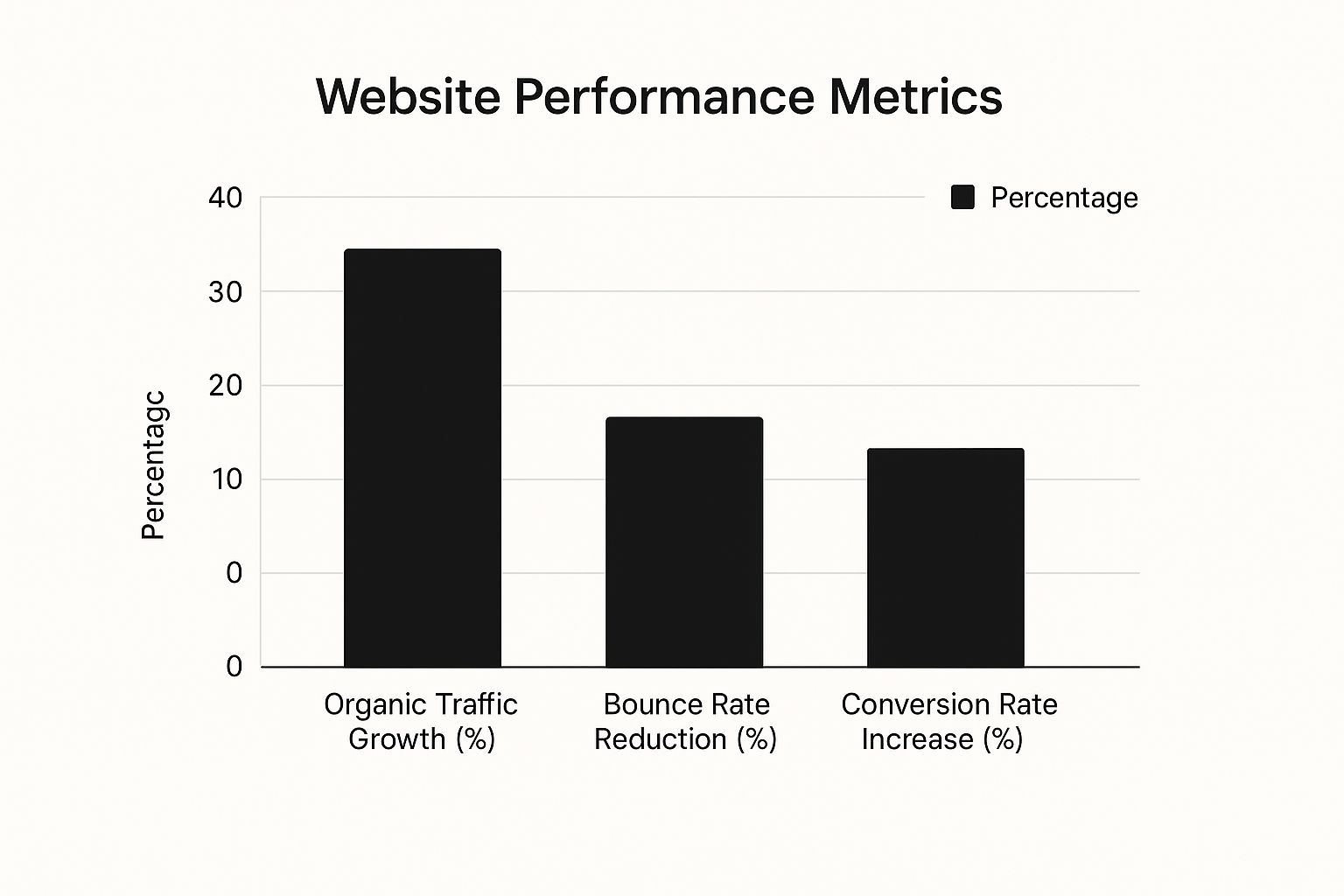
As you can see, when you increase organic traffic and lower bounce rates through a better user experience, you create the perfect conditions for a serious lift in conversions. A simple way to do this is to boost conversions with a testimonials page that showcases your best work and happiest customers. This single element can be enough to turn hesitant visitors into confident leads.
Create Content That Solves Problems and Builds Trust

Simply having a blog isn’t enough anymore. Your content is your single biggest opportunity to prove your value long before a potential client ever gets on the phone with you. It’s how you transition from just another service provider to the go-to authority whose advice they actively seek out.
This means ditching the generic company updates and focusing on a strategy that solves your ideal client's most pressing, keep-them-up-at-night problems. When your content genuinely helps people, you start building a relationship based on expertise and generosity, not a sales pitch.
This isn't just a "nice-to-have" approach; it's incredibly efficient. Content marketing is known for generating three times as many leads as old-school methods, all while costing 62% less. For B2B businesses here in Australia, platforms like LinkedIn are indispensable, with some studies showing that up to 80% of B2B leads originate there. You can explore more marketing statistics in Australia to get the full picture.
Brainstorm Content That Hits a Nerve
The most powerful content ideas are hiding in plain sight—they come directly from your ideal client's pain points. Your mission is to create resources so genuinely helpful that they feel compelled to stop what they're doing and pay attention.
So, where do you find these goldmine topics? Stop guessing and start listening.
- Your Sent Emails: Trawl through your past client communications. What questions pop up over and over again? Every single one is a potential blog post, guide, or video waiting to be made.
- Discovery Call Notes: Go back and review your notes from initial client consults. What were the biggest fears, frustrations, or obstacles they mentioned? These are high-intent topics that speak directly to the concerns of people who are ready to buy.
- Online Forums and Groups: Spend some time on Reddit (like r/smallbusiness), in relevant Facebook Groups, or on industry-specific forums where your ideal clients hang out. Pay close attention to the exact language they use to describe their problems—this is keyword gold.
For instance, a brand designer might notice new clients consistently say they're worried their brand looks "a bit dated." That single insight can spark a dozen powerful content ideas like "5 Tell-Tale Signs Your Branding Needs a Refresh" or "How to Evolve Your Brand Without Losing Your Loyal Customers." This is how you attract clients who already see you as the solution.
Expert Tip: The best content doesn't just answer questions; it anticipates them. Try creating a simple "problem-solution" matrix. List every single problem your ideal client faces on one side. On the other, brainstorm a piece of content you could create to solve it. This simple exercise can easily generate a year's worth of strategic content ideas.
Develop High-Impact Content Assets
While blog posts are the foundation, you need to create higher-value assets to capture serious leads and showcase your deep expertise. These are the substantial, game-changing resources that prospects are more than happy to exchange their contact information for.
Case Study Guide: From Testimonial to Sales Tool
A case study is so much more than a glowing testimonial; it's a story of transformation. It walks a potential client through the entire journey of a past client who had the exact same problems they're facing right now.
Case Study in Action: SaaS Company "FlowState"
- Company: FlowState, a project management software for creative agencies.
- The Problem: Their client, "DesignCo," was struggling with missed deadlines and chaotic project handovers. They were losing an estimated 15 hours of billable time per week to administrative confusion.
- The Solution: FlowState implemented a dedicated onboarding specialist who trained DesignCo's team on using automated workflows and centralized communication channels within the platform.
- The Result: Within 60 days, DesignCo reduced administrative time by 80%, reclaimed over 10 hours of billable work per week, and improved on-time project delivery by 40%. This quantifiable result is the hero of the story.
Practical Guides and Checklists
Let's be honest, everyone loves a resource that makes their job easier. Practical how-to guides and downloadable checklists are absolute magnets for qualified traffic. They position you as a helpful expert and give prospects a tangible piece of your value upfront.
A web developer, for example, could create a "Definitive Website Launch Checklist." This not only helps their audience but also subtly highlights the complexity of the process, making their professional services seem all the more valuable.
Choosing the Right Content Format
The format you choose for your content can make or break its reach and impact. Different formats serve different goals and appeal to different people on different platforms. To get the most out of your efforts, you need to be strategic.
Here’s a quick breakdown to help you decide where to focus your energy.
High-Impact Content Formats for Client Attraction
| Content Format | Primary Goal | Best Platforms | Key Metric |
|---|---|---|---|
| Detailed Case Study | Build trust and prove results | Website, LinkedIn, Proposals | Conversion Rate |
| How-To Guide/Blog Post | Attract organic traffic (SEO) | Blog, LinkedIn, Email | Organic Traffic, Time on Page |
| Insightful Webinar | Generate high-quality leads | Email List, Social Media Ads | Registrations, Attendee Rate |
| Checklist/Template | Capture email subscribers | Blog, Landing Pages | Downloads, Email Sign-ups |
By consistently putting out content that solves real-world problems, you build a powerful and sustainable engine for client attraction. You stop chasing leads and start drawing them in with your expertise and a genuine desire to help.
Master Strategic Outreach and Build Your Network
While a solid website and great content are fantastic for bringing in leads over time, sometimes you need to be more direct. Proactive outreach is often the fastest way to land your next high-value client. This isn't about blasting out generic pitches; it's about making genuine connections.
Think of modern outreach as a strategic game. When you do it right, you cut through the noise and get in front of the exact people who need your help. It’s the difference between waiting for fish to bite and casting your line where you know the best ones are swimming.
Leverage LinkedIn for Targeted Connections
LinkedIn is so much more than a place to park your resume. For anyone in the B2B space, it's arguably the most powerful tool for finding, researching, and connecting with key decision-makers. In fact, HubSpot data shows LinkedIn is 277% more effective at generating leads than Facebook and Twitter.
The trick is to stop passively scrolling and start actively engaging. Before you hit that generic "connect" button, take five minutes to find a real reason to reach out.
- Comment on their content: "Hi [Name], I saw your recent post on [Topic] and completely agree with your point about [Specific Insight]. I'd love to connect and follow your work."
- Point out a shared interest: "Hi [Name], I noticed we're both members of the [Group Name] and I've been impressed with your contributions to the discussions there."
- Acknowledge their success: "Hi [Name], congratulations on [Company's Recent Award/Launch]. It's impressive work, and I'd be keen to connect."
This small bit of effort immediately shows you’ve done your homework. It positions the conversation as a peer-to-peer chat, not a sales ambush, which is key to building that initial rapport.
Craft Cold Emails That Actually Get Opened
Yes, cold emailing still works—but only if you break the mould. The average office worker gets hammered with over 120 emails per day, so your generic, self-serving message is going straight to the bin. Your goal is to be the one email they're actually glad they opened.
Personalisation is everything. Research from Backlinko found that personalized subject lines can improve open rates by 30.5%. But we need to go deeper than just using their first name.
Reddit-Worthy Take: "Your cold email should read like you're a fan, not a salesperson. Mention their recent podcast appearance, a brilliant point they made in an article, or a company milestone. Lead with genuine admiration. Once they know you've done your homework, they're 10x more likely to listen to what you have to say. The goal of the first email isn't to sell; it's to earn the right to have a conversation."
For instance, instead of a vague offer, try something tangible: "I was looking at your website's performance on mobile and noticed a small tweak to your image compression could improve load speed by up to two seconds. Happy to share a quick Loom video showing how." This micro-offer provides immediate value and builds incredible goodwill from the get-go.
Build a Powerful Referral Pipeline
One of the most sustainable ways to attract dream clients is through strategic partnerships. It’s all about finding non-competing businesses that serve the exact same type of client you do.
Think about the ecosystem your clients operate in. A web designer could team up with a copywriter, a brand photographer, and an SEO consultant. A financial adviser could build relationships with accountants and business lawyers.
Once you’ve got a list of potential partners, approach them with a clear "what's in it for them" attitude.
- Give first. Refer one of your clients to them, with no strings attached. It's the best way to show you're serious about a mutually beneficial relationship.
- Make it easy for them. Give them a simple co-branded PDF or a clear one-liner they can use to introduce your services. Don't make them do the work.
- Set up a clear process. Agree on a simple system for passing referrals back and forth and keeping each other in the loop.
This approach turns client acquisition from a solo grind into a collaborative effort. By building a trusted network, you create a consistent stream of high-quality, warm leads who are already primed to work with you.
Craft an Unforgettable Client Experience

Getting a new client is a huge win, but it's just the starting block. Real, sustainable growth kicks in the moment they sign the contract. The secret to turning that initial sale into a long-term partnership—and a source of incredible referrals—is all about the client experience.
Think of it this way: an exceptional experience is your most powerful and cost-effective marketing engine. A study by Bain & Company found that a 5% increase in customer retention can lead to a 25% to 95% increase in profit. It’s what turns happy customers into genuine advocates who will happily sell your services for you.
In the Australian service industry, what customers expect is changing fast. A massive 80% of customers now say their experience is just as vital as the product or service itself. You can find more detail on this shift in the 2025 trends for the Australian service industry report on pwc.com.au.
Detailed Guide: Designing a Flawless Onboarding Process
The first 90 days are everything. This is your window to set the tone, manage expectations, and show your value right out of the gate. A messy or confusing start plants seeds of doubt, but a smooth, organised onboarding process builds immediate confidence and excitement.
Step 1: The Official "Welcome Aboard" Package
- Objective: Eliminate buyer's remorse and provide total clarity.
- Contents: A well-designed digital package (PDF or dedicated portal page) containing:
- A personalized welcome video from the project lead.
- A "Who's Who" guide with photos, roles, and contact details for your team.
- A detailed project timeline with key milestones and delivery dates.
- A "Rules of Engagement" document outlining communication channels (e.g., "We use email for formal approvals and Slack for quick questions") and response times.
Step 2: The Strategic Kick-Off Meeting
- Objective: Align on goals and establish yourself as a strategic partner.
- Agenda:
- (15 min) Reconfirm the "Why": Restate the client's primary business goals for this project.
- (25 min) Walkthrough the Project Plan: Review the timeline, milestones, and each party's responsibilities.
- (15 min) Q&A and Next Steps: Address all questions and clearly define the immediate next actions.
Step 3: The "First Value" Delivery
- Objective: Deliver a small, tangible win within the first week.
- Examples: For an SEO agency, this could be a report of quick-win keyword opportunities. For a consultant, it could be a summary of key insights from the kick-off call. This shows immediate momentum.
Key Takeaway: A brilliant onboarding process is proactive, not reactive. It anticipates your client's questions and provides the answers before they even have to ask, creating a powerful first impression of competence and care.
Implement a Proactive Feedback System
Waiting until a project is finished to ask for feedback is a huge missed opportunity. To create a truly memorable experience, you need to open up channels for constant communication. This makes your clients feel heard and valued throughout the entire journey.
This proactive approach lets you tackle small issues before they snowball into major problems. A quick mid-project check-in might uncover a minor miscommunication that, if ignored, could have derailed the whole thing. Nipping these things in the bud builds incredible trust.
Here are a few practical ways to do this:
- Scheduled Check-In Calls: Pop 15-minute chats into the calendar every couple of weeks just to ask, "How are things looking from your side?"
- Simple Pulse-Check Surveys: Use a tool like Typeform or even Google Forms to send a quick, two-question survey after you hit a major milestone.
- An Open-Door Policy: Make it clear to your clients that they can bring up concerns anytime without worrying about creating friction. Fostering that sense of psychological safety is key.
This feedback loop is also crucial for managing your online reputation. Happy clients can be gently prompted to leave positive reviews, while any negative feelings can be handled privately and constructively. It's vital to understand the online review landscape, including what to do when feedback isn't what you'd hoped for. For anyone navigating this, it's helpful to understand the rules of the game, such as learning more about if you can remove Google reviews and how to manage them. By mastering the client experience, you organically create a powerful cycle of positive feedback, strong testimonials, and a steady flow of ideal new clients.
Common Questions About Attracting Clients
Navigating the world of client acquisition can feel like spinning a dozen plates at once. It's complex, and it’s easy to get overwhelmed. Let's break down some of the most common questions business owners ask when they’re ready to grow.
How Long Does It Realistically Take To See Results?
This is always the big question, and the honest answer is: it depends entirely on the strategy you choose.
Think of SEO and content marketing as long-term investments in your business's future. You’ll probably start to see positive signs within 3-6 months, like a bump in organic traffic or better keyword rankings. But building enough authority to generate a consistent flow of high-quality leads? That often takes a good 6-12 months of dedicated effort.
On the flip side, direct outreach and networking on platforms like LinkedIn can spark conversations and even land you a new client within a few short weeks. The catch is that it requires your constant, hands-on effort to keep the momentum going.
The most effective approach is a blend of both. Use proactive outreach for immediate opportunities while you patiently build your content and SEO foundation for sustainable, long-term client attraction.
What Is a Reasonable Marketing Budget for a Small Business?
There’s no single magic number, but a widely accepted benchmark for a small business is to allocate 5-10% of your target revenue towards marketing.
If you’re just starting out and revenue is still a bit unpredictable, begin with a fixed monthly budget you're comfortable with. Put those resources into the highest-impact, lowest-cost activities first. These usually include:
- Optimising your existing website for conversions and local search.
- Creating a handful of powerful case studies from past projects.
- Dedicating consistent, non-negotiable time each week to personal networking.
Once you start bringing in more revenue, you can reinvest a portion into paid strategies. This could mean targeted social media ads or Google Ads, which can put some serious fuel on your client acquisition fire.
Which Strategy Is Most Effective if I Am Just Starting Out?
When you have zero clients and are building from the ground up, nothing beats the power of direct outreach and tapping into your personal network. While building your digital presence is essential for your future, you need proactive strategies now to land those crucial first clients.
Start with the professional network you already have—think former colleagues, university contacts, mentors, and connections from previous roles. Let them know what you’re doing and who you’re looking to help. You'd be surprised how many warm leads can come from these existing relationships.
From there, use LinkedIn to strategically identify and connect with ideal prospects in your target market. A great way to get your foot in the door is by offering a free, no-obligation consultation or a special introductory package.
Once you secure those first few clients, your priority must be to deliver an absolutely incredible experience. Their success becomes the powerful social proof and compelling case studies that will fuel all your future marketing efforts.
Ready to stop chasing leads and start attracting your ideal clients? At The Brand Express, we build data-driven SEO strategies that turn your website into a client attraction engine. Book your free discovery call with us today.