
When a serious collector searches your name, they are not browsing. They are verifying. According to the Art Basel and UBS Survey of Global Collecting, 72% of high-net-worth collectors conduct moderate or significant research before buying, a figure that rises to 80% among Gen Z buyers. The search results for your name are part of that due diligence. They appear alongside dealers and other sources collectors consult before making contact.
Most artists never design what appears on that results page. The bio, the artist statement, gallery listings, and ageing social profiles compete for attention, often with inconsistent naming and outdated information. This tutorial shows you how to take control of that first impression.
You will learn why collectors search your name before reaching out, what they are actually trying to confirm, and how to build one canonical profile with consistent naming across every platform. We will work through the order in which buyers ask questions, then refine each asset in turn: your bio, your artist statement, your portfolio, your website, and your gallery listings. We will also cover what not to publish and give you a self-audit you can run this week. One profile, one name, one order.
Why Collectors Search Your Name Before They Make Contact
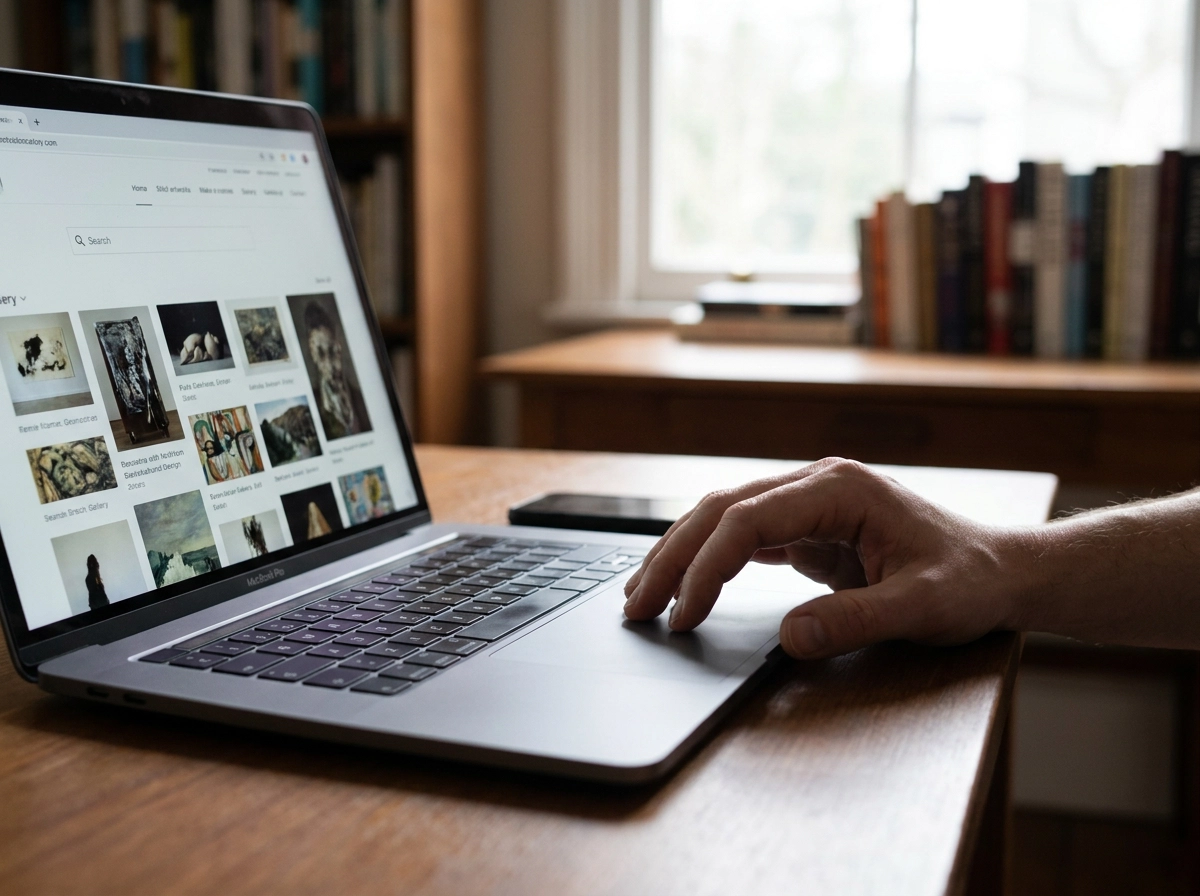
Collectors look you up before they contact you. That same survey, 3,100 high-net-worth collectors across 10 markets, finds 58% using digital resources for advice, with artists themselves cited alongside dealers as sources collectors consult. Your published material already sits inside that research.
One caveat: the survey measures collector behaviour, not search engine results. What follows is recommended practice, not a survey finding.
Someone who saw your work at a fair, a Victorian Artists Society show or a friend’s wall is now typing your name. That is your highest intent visitor: checking, not browsing.
What a Collector Is Actually Trying to Confirm

Those five buyer questions, same artist, still active, consistent work, exhibition history, how to make contact, are developed in full in Step 3 below. Answer them in that order and the collector keeps moving. Answer out of order, or answer only the most flattering question, and they finish the check elsewhere.
Naming consistency matters because others join the search: dealers look you up by name before recommending you. Position ownership around what makes the work distinct, since 43% ranked uniqueness and rarity as the most important aspect of ownership (UBS Art Market Research), not output volume. Treat this as a recommended structure built from buyer behaviour, not a measured search result pattern.
Step 1: Decide on One Canonical Profile
The first move is deciding where a collector lands. Your canonical profile is the single page you would want a stranger to land on first for your name, and the page you are happy to have quoted everywhere else.
Make that page a website on your own domain. Gallery pages get rebuilt, platforms get renamed and social accounts get locked, and any of those can remove your best page from results overnight. A website on a domain you control gives you a destination nobody else owns.
That page must carry five things: who you are, what you make, where the work has been seen, how to see or acquire it, and how to reach you directly.
Show recency in plain sight, such as your current or most recent exhibition with its year. The “are they still active” check is the one most artists fail by neglect rather than by anything they wrote.
Then guard against duplication. Keep gallery profiles, social bios and fair listings shorter and factual, all pointing back to the canonical page, so the surfaces reinforce each other instead of competing with slightly different stories.
Step 2: Use One Version of Your Name Everywhere
One canonical profile only wins if the name on it matches everywhere else. Decide the exact string once: name order, middle initials, accents, hyphenation, whether you trade under a studio name. Reuse it in every caption, PDF, profile and listing.
Send that spelling to galleries for exhibition pages, press releases and artist index pages, accents included. Small differences split the record a buyer is assembling.
Align the smaller signals too: social handle, domain, email and newsletter name should match, so a search for your name plus Instagram lands on the right account first time. Cross-link rather than copy: your canonical page links out to gallery listings, and each listing links back, so they read as one artist.
Exhibited under a former or married name? Publish one short line recording it in the same place, so the history joins up instead of fragmenting. The same discipline separates the Australian landscape artists who are easy to find online from the invisible.
Step 3: Answer the Buyer’s Questions in Order
Naming settled, most artists get this wrong. Profiles are usually arranged around what the artist enjoys discussing, not the order a buyer needs the information, a habit tied to the structural invisibility Australia’s art creatives face online.
Build each surface as one link in a chain, bio, artist statement, portfolio, website structure, then the gallery listings and ageing social profiles under your name, so a collector moves from “is this the same person” to “how do I contact them” without opening another tab.
The sequence holds whichever page appears first, your own site, a gallery’s page or an old Instagram profile, so each needs the essential facts in its opening lines.
Your Bio: Who You Are in Facts
Because your bio answers the buyer’s first two questions, “same artist” and “still active,” it leads the sequence. Write it in plain declarative sentences: who you are, where you are based, what you make, and what you have done recently. Keep metaphor out entirely; it belongs in your statement, not here.
Place your city, your medium and the name and year of your most recent significant exhibition inside the first 100 words. That trio is what a buyer skims for verification, and burying it reads as evasion.
Maintain two versions of the same bio: a short paragraph for gallery listings and captions, and a longer version for press and grant applications. Both must carry identical facts and dates, so the two lengths never contradict each other.
Stale numbers are the common failure. A bio naming a residency finished years ago, or omitting your last three years of exhibitions, reads as an abandoned account.
Choose one voice, first or third person, and apply it across every surface, so your bio does not change personality between your site and a gallery’s page.
The bio establishes the facts; the statement does the interpretive work.
Your Artist Statement, and What the Better Artist Statement Examples Do
The statement picks up where the bio stops: the bio states facts, the statement states ideas. Structure it across 150 to 300 words, in this order: what the work is about, why these materials or methods, and what it is in conversation with.
Review artist statement examples for structure, not borrowed language: the better ones name the idea in the first sentence, so assume that sentence is read.
Keep two lengths of the same thinking: a full statement on your canonical page and a two to three sentence version for press packs, using identical terms so language matches everywhere a buyer looks.
Retire statements tied to work you no longer make; an old statement describing a finished body contradicts the portfolio beside it and creates needless doubt. Cut art cliches, claims you cannot evidence, and vague talk of journeys or explorations; a collector checking credibility is scanning for something specific.
Your Portfolio: Ordered Like a Show, Not an Archive
The statement sets out the thinking; the portfolio proves it. Curate ruthlessly: open with 8 to 12 of your strongest works, not everything you have made. The first screen does the convincing, and an exhaustive archive dilutes it.
Group work by series or period so a buyer can see ideas developing rather than a flat chronological dump. Study artist portfolio examples for sequencing, not style: the strongest order images by idea and by scale, give each image room, and hold a consistent image ratio across a series.
Caption every work with title, year, medium and dimensions. Buyers working with advisors notice missing details, and incomplete captions make the work harder to discuss with a third party.
Add installation or exhibition views so a buyer can picture scale in a room. If your galleries permit it, include a clearly labelled path to current available work.
Your Website: What Strong Artist Website Examples Share
If your portfolio is the argument, your website is the container. Readability is the first test: the strongest artist website examples load quickly, work on a phone, and put your name, discipline and city in plain text rather than inside a logo or banner image, because search engines and AI tools read text, not pictures.
Keep the structure simple: Work, About, Exhibitions, Contact, with one page per series, so the site mirrors the sequence a buyer follows. Repeating your name and discipline in page titles, headings and image alt text tells an engine which artist a page belongs to; alt text is the short description attached to an image.
Keep the site alive with recent exhibitions, press and new work. Written facts matter more as AI enters research: 22% of high net worth collectors used apps or AI tools for advice in 2026, up from 4% in 2024, and automated summaries can only repeat details you have written clearly.
Gallery Listings and Ageing Social Profiles
Beyond your own site, audit every gallery page, fair listing, marketplace profile and directory entry carrying your name. Check spelling, bio text, images and whether links still resolve. Treat dormant accounts directly: an unused profile with an old bio and outdated portrait competes with your current page for your own name. Update it, redirect it, or mark it plainly archival and personal.
Match the small things across platforms: same portrait, same one-paragraph bio, same name string, so the person in the result is recognisably one artist. Give listings a visible recency signal, because a page whose latest credit is years old reads as inactive to a buyer checking a substantial purchase. Work one platform per day through a simple list, so the audit finishes in a fortnight.

What Not to Publish
Once the audit is done, decide what should never be public. Leave buyer and collection details out of posts, even thank-you posts; collectors value discretion, and naming a private client is a liability for the next one. Cut prices, sales figures and exclusive access claims unless accurate and supportable; they invite scrutiny without influencing the decision. Avoid contradictory representation statements: two galleries in one city with conflicting availability stops the check. Clear out old portfolio PDFs, proposals and press releases, which persist, carry your name and compete quietly. Replace them with current work.
Next Steps: A Self-Audit You Can Run This Week
Auditing your own footprint turns that cleanup advice into a repeatable check.
Run the baseline test in a browser you are not logged into. Search your exact name, then your name plus your city, then your name plus your medium. Read the first page as a buyer would and note which result you would trust.
Then ask the five buyer questions of your own result page: same artist, still active, consistent, shown where, contactable. Anything you cannot answer from the first screen is a gap to fix.
List every place your name appears, including gallery index pages, social handles and the footer of old documents, and compare the strings side by side. Your statement, bio and portfolio should also reflect activity from the last 12 months, not the launch version of the page.
Fix the surface that receives the most traffic first. If the audit turns up more work than you can sequence alone, a specialist can help you rank the fixes by impact. Search visibility is a revenue lever for artists as much as for any other business.
Conclusion: One Profile, One Name, One Order
You have run the audit. Now make the intent work for you.
The search of your name is the highest intent query you will ever receive, and almost nobody designs the result deliberately. Choose one canonical profile you own, use one version of your name everywhere, answer the buyer’s questions in the order they ask them, and remove what should not be public.
If you do nothing else, run the logged-out search tonight, list what appears, and fix the single weakest surface by the end of the week. The Brand Express works with artists on search strategies that connect visibility to enquiries, if you would rather have the audit and the fixes sequenced for you.
Frequently Asked Questions
Why do collectors search an artist's name before getting in touch?
Collectors look you up before they contact you because they are verifying rather than browsing. The post cites the Art Basel and UBS Survey of Global Collecting, where 72% of high-net-worth collectors conduct moderate or significant research before buying, rising to 80% among Gen Z buyers. The search results for your name are part of that due diligence.
What are collectors actually trying to confirm when they search your name?
They are checking five things, asked in this order: is this the same artist, are they still active, is the work consistent, where has it been shown, and how can I contact them. Answering in this order keeps the collector moving, while answering out of order or only with the most flattering information sends them to finish the check elsewhere.
What is a canonical profile and why should it be on your own domain?
A canonical profile is the single page you would want a stranger to land on first when searching your name. It should be a website on a domain you control, because gallery pages get rebuilt, platforms get renamed and social accounts get locked, any of which can remove your best page from results. That page should cover who you are, what you make, where the work has been seen, how to see or acquire it, and how to reach you directly.
How should I handle my name across different platforms?
Decide on one exact string for your name, including name order, middle initials, accents, hyphenation, and any studio name, and use it everywhere. Send that spelling to galleries, align your social handle, domain, email and newsletter name with it, and cross-link your canonical page with gallery listings so they read as one artist. If you have exhibited under a former or married name, publish one short line recording it on the same page.
What should be left out of what an artist publishes?
Leave out buyer and collection details, even in thank-you posts, because naming a private client is a liability. Also cut prices, sales figures and exclusive access claims unless they are accurate and supportable. Avoid contradictory representation statements, such as two galleries in one city with conflicting availability, and clear out old portfolio PDFs, proposals and press releases that persist and compete with current work.