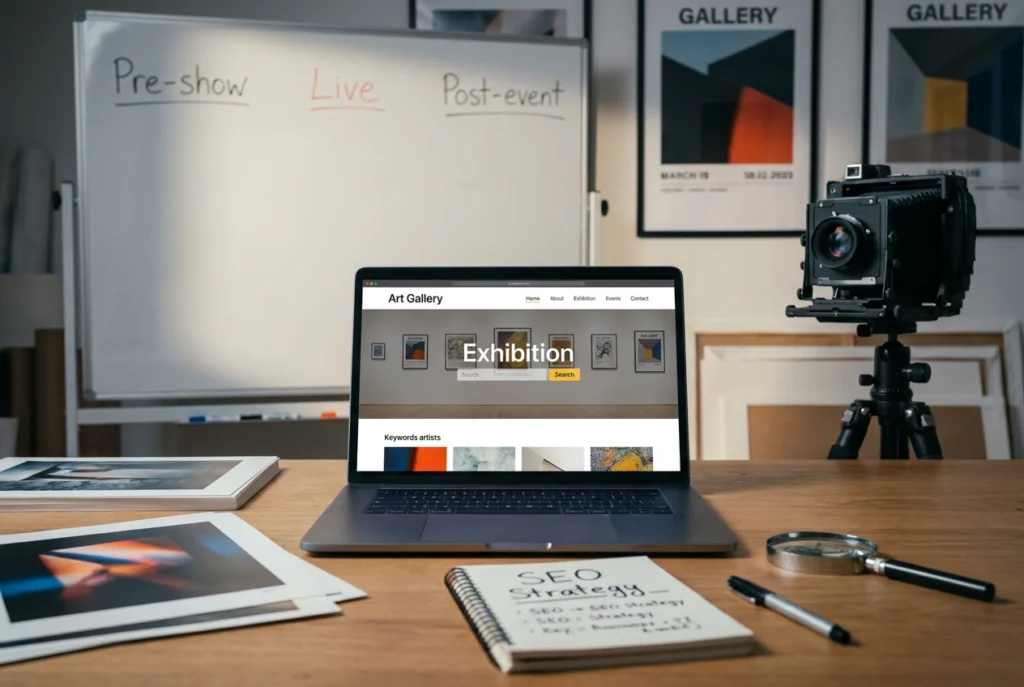
Your exhibition is likely one of the biggest visibility moments of the year. Months of work, a packed opening night, and then, within a week or two, the show is gone. The posters come down, the gallery moves on, and search engines have almost nothing to show for it.
But that moment does not have to vanish. A physical exhibition generates concentrated interest, and that interest can be kept and turned into durable, searchable assets. This post shows you how to do exactly that, whether you are new to SEO or have only just started thinking about how your work appears online.
We will walk through the full lifecycle of an exhibition online. You will learn why your opening night should leave a searchable trace, what you need in place before you begin, and how to publish while interest is building. We will cover keeping the page alive during the show and preserving it as a permanent record afterwards. You will also see common mistakes that erase a show from search, how to tell if it is working, and what the available research does not say. Finally, you will get a repeatable three phase publishing checklist.
By the end, you will understand how to publish it, update it, and keep it.
Why Your Opening Night Should Leave a Searchable Trace
An exhibition compresses enormous attention into a few weeks: media enquiries, friends, collectors, gallery visitors, social shares and artist talks all cluster around opening night. Once the poster comes down, most of that interest vanishes from view. A single page can hold onto it. This is a reasonable, testable hypothesis rather than a proven research finding, but the logic is straightforward: a show page published before opening, updated during the run, and preserved afterwards keeps earning attention long after the gallery empties.
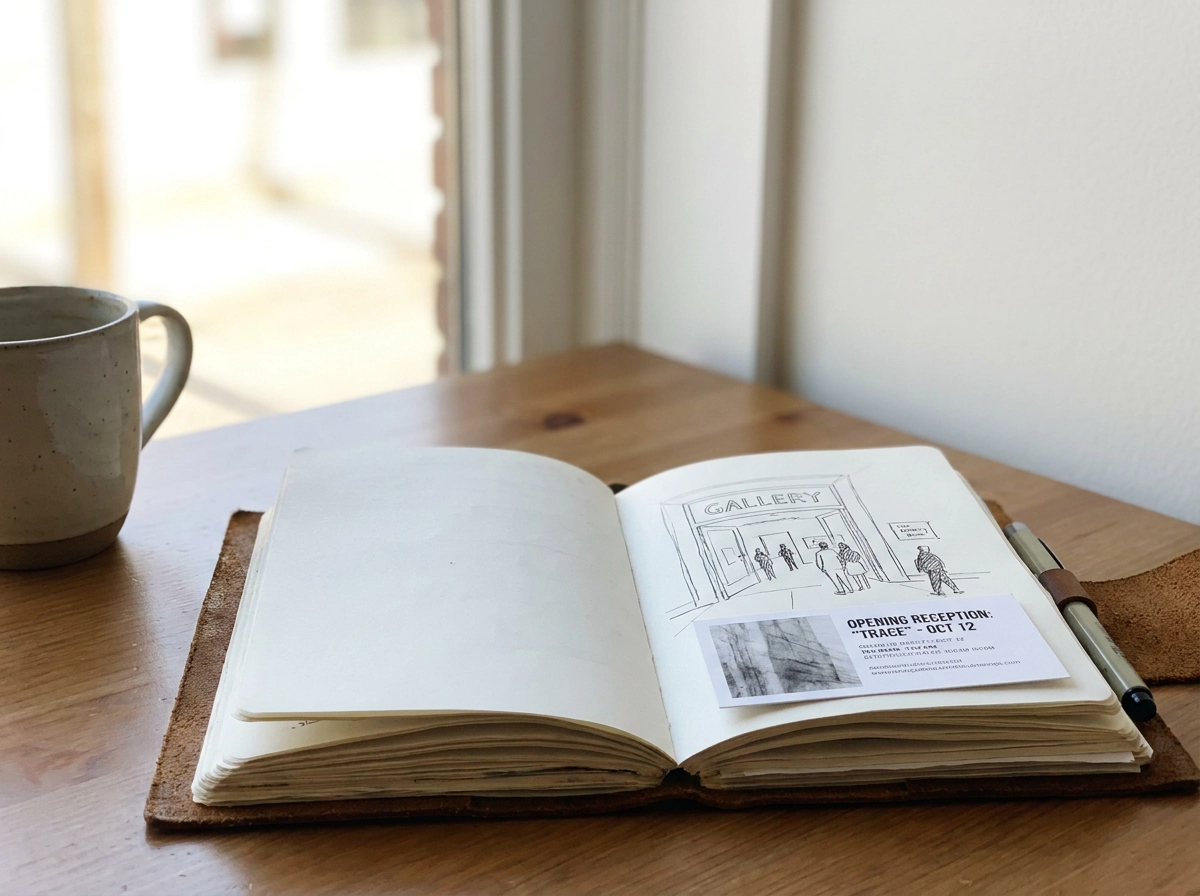
Picture two artists with the same exhibition. The first publishes a page carrying the show title, venue, dates and images, then leaves it live. The second posts a social announcement that scrolls out of reach within days. Same offline event, very different long-term visibility.
The mechanic is simple. Search engines need crawlable text to understand that a show existed, where it happened and when. A page published early can be discovered before opening night, so it is already findable when people search the show, the venue or your name.
This article works through three phases, before, during and after, as recommended practice. It flags what is evidenced and what is simply good practice. The Victorian Artists Society’s exhibition culture shows how much visibility is at stake, while the image-led history of Pop Art artists demonstrates why every show image deserves a descriptive file name.
Prerequisites: What You Need in Place First
Before the timeline starts, gather five things.
A page you control. Your own website, or a CMS you can edit yourself. The record of the show should not depend on a gallery listing, an event aggregator or a social post that can be replaced or removed. If your site needs building first, our guide to SEO for abstract artists covers the foundations.
Core facts as text. Exact exhibition title, your name as the artist, venue name and street address with suburb and state, opening and closing dates, opening hours, opening night date and time, entry information (most galleries offer free admission), any artist talk or workshop dates, and a short artist statement.
Images prepared. Give each file a descriptive name rather than a camera default, and write alt text describing the work, the medium and the year, not an image number.
Google’s documentation bookmarked. Read Search Central’s pages on event structured data and how Google indexes pages directly. The research for this article found no Australian guidance on publishing exhibition content online, so use the source.
A Search Console property. Set up free Google Search Console so you can check whether the show page is indexed and see its queries. Without measurement you are guessing, and this article promises no rankings.
Before the Show: Publish While Interest Is Building
With your page and facts ready, publish the show page early. Four to six weeks before opening night is a sensible rule of thumb, offered as recommended practice rather than a research finding: no Australian data on exhibition publishing timing was available to this article.
- Make the address permanent. Build the URL and page heading around the show title and your name, for example yourdomain.com.au/exhibitions/your-show-title, the structure a strong art website for artists uses. Choose it once; changing URLs later discards the history the page has built.
- Write the details as visible text, not inside a photograph of a poster: venue name, suburb, dates, opening hours, free entry where applicable, and your name. Search engines and screen readers cannot reliably read text inside an image.
- Add event structured data following Google Search Central’s event markup guidance, so dates, location and event status are machine-readable. This is where copying an official example beats improvising, and Google’s structured data guidelines spell out the rules.
- Link to the page from your homepage, about page, newsletter and press releases, and ask the gallery to link from its exhibition listing. Inbound links from a gallery or local media mention help search engines trust the page concerns a real event in a real place.
Once the doors open, the page needs to keep pace.
During the Show: Keep the Page Alive and Useful
Once the doors open, keep the page working rather than letting it sit frozen at publication.
- Update once mid-run. Add installation photographs, extra images of works, and a line on what is still available if you sell. A page that changes during the run reads as current, not dated.
- Add what emerges. List artist talks and floor talks as separate events with their own structured data, note extra opening hours, and link to reviews or media coverage. Each addition is a fresh reason for someone to find the page.
- Stay accurate. Correct changed hours, remove anything no longer true, and never leave stale dates on a current show. Wrong practical details send visitors straight back to the search results.
- Publish process notes. Write one or two short pieces on your materials, methods or studio decisions, and link them to and from the show page. This adds written context for search engines and somewhere to go for readers, part of the wider problem of why Australia’s art creatives are invisible online in 2026.
- Read Search Console. Check which queries your page appears for, then make sure headings and copy use the words people actually search, such as the venue suburb or the medium, without stuffing them into sentences that no longer read naturally.
When the show closes, the page becomes something else entirely.
After the Show: Preserve It as a Permanent Record
Once the show comes down, the temptation is to tidy the page away with the posters. Resist it. That page is now the only durable record that the exhibition happened, and it keeps working while you move on to new work.
1. Keep the page and its URL. Leave the address exactly as it is. If a site restructure forces a move, set up a permanent redirect from the old address to the new one so anyone arriving on the old link still lands somewhere useful, as Google’s guidance on redirects sets out.
2. Convert it into a past show record. Keep the original dates and venue exactly as they were, then add a short line noting the exhibition has closed. Optionally note where the works ended up or how the show was received.
3. Leave the images, captions and artist statement in place. They are the searchable substance, and the part that shows a future gallery, curator or collector what you have done years later.
4. Build an exhibitions index page and link it from your main navigation. Each show becomes a page inside an archive rather than an orphan page nobody finds.
5. Link each past show forward to your current or next exhibition, so visitors keep moving through your site.
Next, the mistakes that undo this work.
Common Mistakes That Erase a Show From Search
Preserving the page is only half the job. These five mistakes undo the work.
- Deleting the page after closing. Removing it strips away the only durable record that the show happened. Anyone searching your name months later finds nothing.
- Publishing only as an image, reel or carousel caption. A poster photo carries no crawlable text. Dates, venue and show title need to exist as words on a page.
- Relying on the gallery’s listing. Those pages get replaced when the next show opens, and someone else controls them. Your visibility leaves with the listing. This is the same gap that separates Australian landscape artists who are actually easy to find online from those who disappear between shows.
- Changing the URL or creating a new page per announcement. Each move splits whatever search history the page built.
- Omitting dates, hours and venue because locals know. Search traffic comes from people who do not know. Write the details out.
Fix these and the page has a chance to keep earning attention.
How to Tell If It Is Working, and What the Research Does Not Say
You can avoid those mistakes and still not know whether the page is working. Check Google Search Console rather than guessing: watch impressions and queries, especially your own name, the show title, and the venue name plus suburb, since those are the queries a show page can realistically serve.
Label any benchmark you quote. The figures that 41% of visual arts audiences are aged 16 to 34, that 41% of museum audiences are over 65, and that half of visual arts visitors sit in the most culturally engaged groups all come from England in August 2019. They are not Australian, and they are dated.
The Australian picture needs care. Creative Australia reports more Australians are attending arts than ever while cost is a growing barrier, but only the headline was available in the research reviewed here; read the full report before quoting figures.
Plainly: there is no published Australian data on how people search for exhibitions, venues or artists. That is why no one, including us, should promise rankings or traffic volumes from an exhibition page.
Treat the before, during and after sequence as recommended practice you can test. Compare your own impressions and queries show by show, year on year, and let your results, not promises, guide the next exhibition. For context, see famous Australian artists who shaped a nation’s identity.
A Repeatable Three Phase Publishing Checklist
With that measurement loop in place, make the process repeatable.
Before: Publish the show page several weeks ahead. Write full details as text: title, venue, dates, hours, entry and artist statement. Name image files descriptively and write alt text. Add event structured data, then link in from your homepage, newsletter and the gallery’s listing. Keep copy useful rather than padded, as covered in content quality after Google’s 2026 spam updates.
During: Make one solid mid-run update with installation shots. Add separate structured events for talks and workshops, correct hours and dates, and link internally to your process or studio writing.
After: Preserve the page with original dates and venue. Add a note that the show has closed. Leave the URL unchanged, add the page to an exhibitions index, and link forward to your next show.
Every show: Keep a short record of what you published and when. The next exhibition is faster to set up, and you gain a baseline to compare against. Keep the set discoverable for anyone searching your name, not just followers. That is the difference between an audience and a searchable body of work.
Conclusion: Publish It, Update It, Keep It
The checklist above gives you the sequence. The outcome is simple: publish the show page before opening night so it can be found while the show is still up, update it at least once during the run so it stays current, and preserve it afterwards with the original dates, venue and images intact.
Treat that page as the durable version of your exhibition. A poster comes down and a social post scrolls away, but a well-built page with structured data and clear text keeps working quietly in the background.
Be honest about measurement. Check Search Console, label any borrowed statistics with their year and country, and judge the approach on your own results rather than on promises.
If you would rather hand over the timeline, The Brand Express partners with artists to build bespoke, performance-driven SEO strategies, from show page structure through to what happens once the gallery empties.
Frequently Asked Questions
Why should an exhibition leave a searchable trace online?
An exhibition concentrates attention into a few weeks, but once the poster comes down most of that interest vanishes from view. A show page published before opening, updated during the run and preserved afterwards can keep earning attention long after the gallery empties. The post presents this as a testable hypothesis rather than a proven research finding.
What do I need in place before publishing an exhibition page?
You need a page you control, such as your own website or a CMS you can edit, rather than relying on a gallery listing or social post. You also need the core facts as text (title, artist name, venue and address, dates, hours, entry information, and an artist statement), images with descriptive file names and alt text, Google's documentation bookmarked, and a Google Search Console property to measure results.
When should I publish the show page?
The post suggests publishing four to six weeks before opening night as a sensible rule of thumb. It is offered as recommended practice rather than a research finding, since no Australian data on exhibition publishing timing was available to the article.
What mistakes can cause an exhibition to disappear from search?
Common mistakes include deleting the page after the show closes, publishing only as an image, reel or carousel caption, relying on the gallery's listing, changing the URL or creating a new page for each announcement, and omitting dates, hours and venue because locals already know them. Each of these removes or splits the page's durable record and search history.
How can I tell whether the exhibition page is working?
Check Google Search Console to watch impressions and queries, especially your own name, the show title, and the venue name plus suburb. The post notes that there is no published Australian data on how people search for exhibitions, venues or artists, so it does not promise rankings or traffic volumes; compare your own results show by show instead.