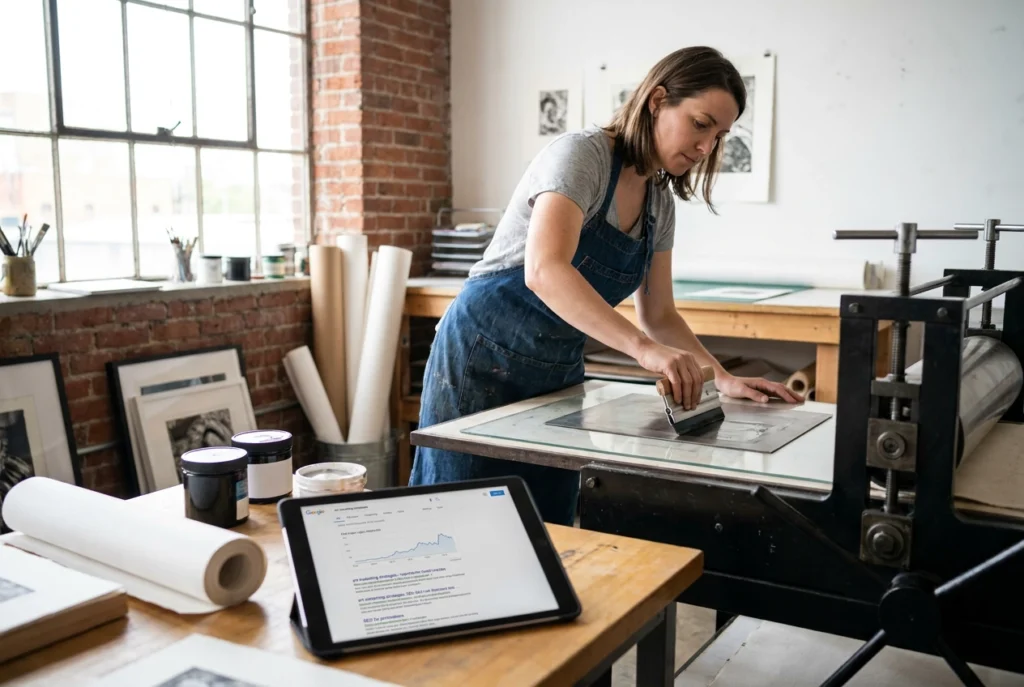
Printmaking has always been a medium that rewards patience, skill, and creative vision, but something remarkable is happening in studios around the world right now. A new generation of printmaking artists is pushing the boundaries of what the medium can do, blending traditional techniques with contemporary concepts in ways that are genuinely changing how we think about prints as fine art.
Whether you have spent years pulling editions in your own studio or you are deepening your knowledge of the medium, knowing who is influencing the conversation matters. The artists shaping printmaking in 2026 are not simply repeating what came before them; they are expanding the vocabulary of etching, lithography, screen printing, and relief work in bold and unexpected directions.
In this list, we have gathered the most compelling voices currently active in the field. You will discover what makes each artist distinctive, how their work fits into the broader evolution of the medium, and why their contributions deserve your attention. Consider this your essential guide to staying informed about where printmaking is headed next.
What Is Printmaking Art and Why Does It Matter Today
Printmaking is a fine art discipline in which an artist creates original works by transferring ink from a matrix, whether a carved block, incised metal plate, mesh screen, or prepared stone, onto paper or another substrate. These works are produced by the artist’s own hand, editioned in limited numbers, signed, and numbered, making each print an authentic original artwork rather than a copy of something else. This distinction matters enormously, particularly for collectors navigating a market saturated with print-on-demand reproductions that borrow the language of fine art without the craft, intentionality, or scarcity that defines it.
The difference between an original fine art print and a mass-produced reproduction is not merely technical; it is cultural and commercial. A genuine limited-edition linocut or etching carries the artist’s direct physical investment at every stage of production. A reproduction is simply a photograph of an artwork, scaled and printed industrially. Collectors who understand this distinction are engaging with a fundamentally different category of object, one with provenance, material presence, and lasting value.
In 2026, printmaking is experiencing a measurable resurgence of collector and institutional interest. Christie’s is currently offering a dedicated Contemporary Edition auction in New York featuring prints by significant artists, with works accessible across a wide range of price points, confirming that original prints remain attainable for collectors who cannot compete at the painting market level. The Artisera gallery’s first dedicated printmaking exhibition, The Mark of the Matrix, opening August 2026, reflects growing commercial gallery commitment to the discipline. Beyond auction houses, the tactile, physical nature of prints is resonating with audiences seeking material art objects as a counterpoint to an increasingly screen-mediated visual world.
The four major printmaking technique families provide the vocabulary essential to understanding this field. Relief printing, including woodblock and linocut, involves carving away non-printing areas so that the raised surface carries ink. Intaglio techniques, including etching, engraving, and drypoint, work in reverse; ink sits in recessed lines scratched into a metal plate and transfers under high pressure. Planographic methods such as lithography and monoprint rely on the chemical repulsion of oil and water rather than physical incision. Serigraphy, or screen printing, pushes ink through a mesh onto the substrate and is among the most versatile of all printmaking methods. Megalo Print Studio in Canberra actively practises all four families daily, demonstrating that these centuries-old techniques remain living, evolving disciplines rather than historical relics.
In Australia, the Print Council of Australia plays a central role in sustaining the discipline nationally, supporting artists, promoting print literacy among collectors, and maintaining institutional connections between studios, galleries, and educational programs. Organisations like Megalo and the Print Council together ensure that Australian printmaking artists have the infrastructure, community, and visibility needed to produce work and reach audiences both locally and internationally.
Contemporary Printmaking Artists Making an International Impact
Five printmaking artists currently define the upper tier of international contemporary practice, each bringing a distinct technical approach and conceptual framework that has earned their work a place in the most significant collections worldwide.
Kiki Smith
New York-based Kiki Smith works primarily in etching and lithography, producing large-scale prints that examine the human body, mythology, and transformation with extraordinary technical precision. Her prints are held in the permanent collections of MoMA, the Whitney Museum of American Art, and the Tate, placing her among a small group of living artists with representation across all three institutions simultaneously. Smith frequently collaborates with master print workshops including Universal Limited Art Editions (ULAE), where editions are typically produced in sizes ranging from 20 to 45 impressions, making her works genuinely scarce on the secondary market. What distinguishes her practice is the integration of folklore and biological imagery into compositions that feel both ancient and urgently contemporary, a quality that continues to attract serious institutional acquisitions alongside private collectors.
Kara Walker
Kara Walker extends her silhouette-based critique of race, history, and power into silkscreen and relief printmaking with devastating effect. Her print editions are consistently among the most sought-after in contemporary art sales, with works appearing regularly at major auction houses and commanding prices that reflect both critical consensus and collector demand. Walker works with publishers including Sikkema Jenkins and Co., and editions are typically produced in small runs, often between 25 and 40 impressions, ensuring that each work retains genuine rarity. For collectors seeking prints that operate simultaneously as historical documents and formal achievements, Walker’s work represents one of the most compelling propositions in contemporary editions.
Ai Weiwei
Ai Weiwei brings his internationally recognised political commentary into screen print and woodblock editions that have developed a substantial secondary market presence. His print practice distils complex narratives around surveillance, displacement, and power into compositions that are visually immediate and conceptually layered. Limited editions associated with specific campaigns or institutional projects have shown consistent secondary market activity, with buyers drawn to the combination of Weiwei’s global profile and the accessible price points that prints offer relative to his sculpture and installation work. Edition sizes vary considerably by project, but numbered editions associated with major publishers have historically ranged from 50 to 150 impressions.
Mychael Barratt
London-based Mychael Barratt produces etching and aquatint works of remarkable intricacy, blending historical visual reference with acute observation of contemporary urban life. His prints are widely collected across the United Kingdom, Europe, and internationally, with representation through established fine art print publishers and galleries. Barratt’s editions are typically modest in size, often between 75 and 150 impressions, and his work is documented with the Fine Art Trade Guild. The density of detail in his aquatints rewards close looking in a way that reproduces poorly, which has helped sustain demand for the original editions among discerning collectors.
Chris Ofili
Chris Ofili’s lithographic and screen print works carry the dense pattern, saturated colour, and layered cultural symbolism that defines his broader practice. Held in major international institutional collections, his prints extend themes drawn from Caribbean heritage, spirituality, and popular culture into editions that function as complete works rather than secondary objects. Ofili’s print output, produced with publishers including Paragon Press, demonstrates how a committed lithographic practice can expand an artist’s reach without diluting the conceptual integrity that drives institutional and collector interest alike.
Australian Printmaking Artists You Should Know
Australia has a deeply embedded printmaking tradition, and several artists working today represent the full breadth of what the medium can express, from intimate domestic observation to complex postcolonial inquiry.
1. Noel McKenna
Sydney-based artist Noel McKenna has built one of the most quietly distinctive bodies of printmaking work in Australian contemporary art. Working primarily in linocut, etching, aquatint, and drypoint, McKenna documents the textures of everyday Australian life with a spare, wry sensibility that resists sentimentality while remaining unmistakably affectionate. Suburban streets, backyard animals, ordinary domestic moments, and solitary figures populate his prints, rendered with a deceptively naive line that carries considerable conceptual weight. His work is held in the National Gallery of Australia, the Art Gallery of New South Wales, and major state collections across the country, confirming his standing as a significant figure in Australian printmaking. Collectors and researchers exploring his practice will find an artist whose commitment to the overlooked and the ordinary has only deepened over four decades.
2. Jan Irvine-Nealie
Jan Irvine-Nealie occupies an important position in Australian relief printmaking, with a woodblock practice that engages seriously with landscape and ecological themes. Her work connects traditional relief techniques to urgent contemporary conversations about the natural environment, demonstrating that printmaking’s physical relationship with material, pressure, and surface is particularly suited to ecological subject matter. Irvine-Nealie has maintained a close association with the Print Council of Australia, contributing to the national printmaking community through exhibitions, advocacy, and sustained creative output. For those building a knowledge of Australian prints, her work represents a direct line between technical tradition and environmental conscience.
3. Sangeeta Sandrasegar
Melbourne-based Sangeeta Sandrasegar produces some of the most technically intricate and conceptually layered prints currently being made in Australia. Her practice spans paper-cutting, etching, lithography, and screenprint, often combining these with embroidery and hand-colouring to create works of considerable visual complexity. Thematically, Sandrasegar draws on postcolonial identity, South Asian cultural history, migration, gender, and the tensions between personal memory and historical archive. Her work has been exhibited at the NGV, MCA Sydney, ACCA, and QAGOMA, and is held in public collections including the Australian War Memorial. The scale of her national and international exhibition history places her among the most significant printmaking artists working in Australia today.
4. August Carpenter
Representing a newer generation, August Carpenter offers a compelling example of where Australian printmaking is heading. Her monoprint practice incorporates sculptural intervention, including the use of dressmaker pins pressed into printed surfaces to create works that are simultaneously planar and three-dimensional. In 2025, she won the acquisitive prize at the Experimental Print Prize at Castlemaine Art Museum, bringing significant visibility to an experimental approach that treats the print as a living, tactile object rather than a fixed image. Her work signals the appetite among emerging Australian printmakers for hybrid, materially ambitious practice.
Institutions and Resources Worth Knowing
For anyone serious about discovering Australian printmaking artists, two institutional resources are essential. The Print Council of Australia is the peak national body for contemporary fine art printmaking, supporting artists through its quarterly Imprint journal, annual exhibition programs, print commissions, and a searchable artist member directory. Founded in 1966, it remains the most authoritative single source for mapping the field. At the studio level, Cicada Press at UNSW in Sydney and the Australian Print Workshop in Melbourne both provide professional facilities, artist support programs, and gallery exhibition spaces that actively cultivate emerging talent. Following these institutions is one of the most reliable ways to stay current with the artists shaping Australian printmaking in 2026 and beyond.
What Techniques Do Contemporary Printmaking Artists Use
Understanding the technical vocabulary of printmaking is essential for anyone engaging seriously with the medium, whether as a collector, a student, or an arts professional. Contemporary printmaking artists draw from a broad toolkit of processes, each producing a visually distinctive output that shapes both the character of the work and its value in the market.
Relief Printing: Linocut and Woodblock
Relief printing is among the oldest image-making processes in existence, with woodcut recognised by the Metropolitan Museum of Art as the earliest form of printmaking. The principle is straightforward: the artist carves away the areas that should not hold ink, leaving a raised surface that transfers the image under pressure. Woodblock printing carries significant art historical weight, with Katsushika Hokusai’s The Great Wave off Kanagawa standing as one of the most recognised works produced through the technique. Linocut uses linoleum rather than wood, offering a more forgiving surface that responds well to bold, graphic mark-making. Serious fine art practitioners including Kiki Smith have worked extensively in linocut, demonstrating that the technique extends well beyond its reputation as an entry point. Collectors assessing relief prints should examine the consistency of ink coverage, the crispness of carved edges, and whether the edition is numbered and signed by the artist in pencil below the image.
Intaglio: Etching, Engraving, Drypoint, and Aquatint
Intaglio reverses the logic of relief printing: the image is incised into a metal plate and ink is pushed into those recessed lines, with the surface wiped clean before printing. The result is a level of fine detail and tonal range that no other printmaking family matches. Etching uses acid to bite the design into the plate, while engraving relies on direct tool pressure; drypoint drags a sharp needle across the plate, creating a soft “burr” that holds ink and produces characteristically velvety, atmospheric lines. Aquatint introduces tonal areas by exposing the plate to acid through a resin ground, allowing artists to achieve gradations closer to watercolour or wash drawing. Etching carries one of the longest prestige histories in Western art, and the technique remains central to fine art practice today. When evaluating intaglio prints, collectors should look for plate tone, the embossed impression left in the paper (the plate mark), edition documentation, and any publisher’s blindstamp.
Planographic Printing: Lithography and Monoprint
Lithography works on an entirely different principle: the image is drawn onto a flat stone or prepared aluminium plate using greasy materials, then chemically treated so that ink adheres only to the drawn areas. Because the surface remains flat, lithography can produce subtle gradations of tone and a painterly quality that intaglio and relief methods cannot replicate as naturally. Monoprint occupies a distinct category; while it uses a printmaking matrix or surface, each impression is unique rather than editioned. This makes monoprints effectively one-of-a-kind works that combine the spontaneity of painting with the physical qualities of printmaking. For collectors, the distinction between a numbered edition lithograph and a monoprint has direct implications for rarity and pricing.
Serigraphy and Screen Printing
Screen printing forces ink through a fine mesh onto the receiving surface, with stencilled areas blocking ink where the design requires it. The technique is capable of producing intensely saturated, flat areas of colour with great precision. In fine art contexts, serigraphy is typically produced in small, strictly limited editions, hand-signed and numbered by the artist. Andy Warhol elevated screen printing to a central fine art medium in the twentieth century, and artists including Chris Ofili have continued working within the tradition at the highest institutional level. Fine art screen prints are distinguished from commercial reproductions by edition size, paper quality, the number of colour separations, and the presence of artist signatures. Collectors should be cautious of unsigned or unnumbered works claiming fine art status.
Collagraph
Collagraph is among the most tactile and materially inventive of all printmaking processes. The artist builds up a plate using materials such as carborundum grit, fabric, textured paper, and other collaged elements, then prints it using intaglio or relief inking methods. The result is a richly textured surface with a physical presence that is immediately distinguishable from flatter printing techniques. Artists at Pace Prints, one of the leading fine art print publishers internationally, work with collagraph alongside etching, linocut, and screen printing, reflecting its serious standing in contemporary practice. Wangechi Mutu’s studio work, which has required as many as seven separate techniques and ten steps per print, illustrates how collagraph integrates within complex, layered contemporary projects. For a comprehensive survey of these processes, 9 Types of Printmaking You Need to Know provides an accessible reference point, while Pace Prints’ documentation of 21st-century practice shows how these techniques function at the highest level of the contemporary art market.
How to Identify and Buy Original Prints From Printmaking Artists
Collecting original prints is a rewarding discipline, but it requires a working knowledge of how the market operates. These six essentials will help you acquire confidently.
1. Read Edition Numbering Correctly
The notation “3/25” on a print means it is the third impression from an edition of twenty-five. The top number identifies the individual print; the bottom number confirms the total edition size. “AP” stands for Artist’s Proof, a designation for prints pulled during the proofing stage before the main edition is finalised. APs are produced in very small quantities and can differ subtly from the final edition, making them particularly collectible. One persistent myth worth correcting: lower edition numbers are not inherently more valuable. When an artist signs and numbers an edition, they are guaranteeing consistency across the entire run, removing any irregular impressions before numbering begins. What actually drives value is the edition size, the artist’s reputation, and the technique employed. “Open edition” prints carry no fixed quantity limit, meaning scarcity is not guaranteed. In the Australian and New Zealand markets, open editions are often managed thoughtfully by the artist, but collectors should enter that purchase with clear expectations.
2. Verify Documentation Before You Buy
A legitimate original print should arrive with specific documentation. The artist’s signature, edition number, and title should appear in the lower margin, conventionally pencilled rather than inked, as pencil is harder to fraudulently reproduce. Where the image extends to the paper edge, these details may appear on the verso. A certificate of authenticity should confirm the edition size, printing technique, paper stock, and the artist’s declaration. For secondary market purchases, provenance records matter considerably; a clear chain of ownership validates both the work’s history and its legitimacy. Refer to Christie’s guide to types of prints for a grounding in what the top end of the market expects from documented works.
3. Choose Reliable Acquisition Channels
The safest starting point is purchasing directly from an artist’s website, where edition details are transparent and you are buying from the source. Reputable print publishers such as Paragon Press operate with rigorous documentation standards. State gallery shops in Australia, including those attached to major institutions, curate their print stock carefully. Online platforms such as Artspace provide access to both emerging and established artists with editorial oversight. Understanding what constitutes an original print before you browse any platform will sharpen your eye considerably.
4. Recognise Misrepresented Reproductions
The word “print” has become almost meaningless without context. It can refer to a museum-quality etching, a giclée reproduction of a painting, or a poster run off a home inkjet printer. Sellers who list reproductions simply as “prints,” without disclosing edition information, technique, or whether the work is an original or a copy of another medium, make it impossible for buyers to assess scarcity or authenticity. This conflation actively erodes trust in the broader print market. Always ask for the technique, the edition size, and whether the work is an original print or a reproduction before committing.
5. Understand the Price Landscape
Original limited edition prints from emerging Australian printmakers can typically be acquired from $150 to $800, making this one of the more accessible points of entry into original art collecting. Works by established or internationally recognised printmaking artists generally range from $1,000 to $30,000 or more, depending on technique, edition size, and market recognition. At the top of the secondary market, significant prints command substantial figures; Christie’s has offered works such as a Raymond Pettibon lithograph with a $50,000 to $70,000 estimate and an Andy Warhol offset lithograph estimated at $40,000 to $60,000.
6. Store and Frame Prints Properly
Original works on paper are vulnerable to light, humidity, and acidic materials. Use UV-protective glazing in any frame to prevent fading and degradation from ultraviolet exposure. Matting should be acid-free to avoid yellowing and foxing over time. Keep framed prints away from direct sunlight, exterior walls prone to condensation, and rooms with fluctuating humidity such as bathrooms or kitchens. These conservation basics protect both the physical integrity of the work and its long-term market value.
Why Printmaking Artists Struggle With Online Visibility (and How to Fix It)
Individual printmaking artists face a structural disadvantage the moment they publish a website. Large arts institutions, commercial gallery directories, and print-on-demand platforms have accumulated years of domain authority, inbound links, and indexed content that pushes individual artist pages down the rankings regardless of how strong or original their work actually is. Competing head-to-head on broad terms like “printmaking artists” or “buy prints online” is effectively a losing position before a single page is optimised. The strategic response is not to outspend those platforms on general terms, but to find the specific keyword territory they have left uncontested.
The problem deepens when you factor in what is actually happening to search traffic once rankings are achieved. Over 60% of all Google searches now end without a click, and that figure climbs to 77% on mobile, according to The Digital Bloom’s 2025 Organic Traffic Crisis Analysis Report. AI Overviews now answer more than 40% of informational queries before a user ever reaches a blue link, and zero-click search behaviour is accelerating in 2026, not stabilising. For printmaking artists, this means ranking alone is no longer sufficient. Content must be written and structured so that Google’s AI systems can parse, trust, and cite it within generated answers. Clear headings, factually grounded descriptions of your process, and well-organised page architecture all contribute to appearing inside those AI responses rather than being buried beneath them.
E-E-A-T, which stands for Experience, Expertise, Authoritativeness, and Trustworthiness, is now the dominant ranking factor in 2026, with 100% of surveyed SEO practitioners confirming it will carry more weight this year than in any prior period. For printmaking artists, this principle translates into concrete website decisions. A detailed artist statement that names your training background, medium specialism, and creative lineage signals genuine expertise. A documented exhibition history with named galleries and dates builds authoritativeness. Press mentions, artist talks, and peer recognition establish trustworthiness. Step-by-step process documentation, whether written or filmed, demonstrates lived experience that no aggregator platform can replicate. These are not soft marketing assets; they are direct SEO signals that influence how both Google’s quality raters and AI answer engines evaluate your site.
Visibility in 2026 also requires presence beyond Google. Search intent now exists across multiple platforms simultaneously, and a printmaking artist optimised only for web search is already invisible to large portions of their potential audience. ChatGPT surpassed 800 million weekly active users in 2025, making AI platforms a legitimate discovery channel alongside traditional search. YouTube process videos documenting linocut carving, etching plate preparation, or reduction woodblock printing represent a significantly underexploited format for printmaking artists. These videos build YouTube search visibility independently, feed AI answer engines that prioritise multimedia sources, and demonstrate E-E-A-T through visible craft expertise. Only 43% of marketers are currently implementing cross-platform optimisation strategies, which means early movers hold a genuine and time-limited competitive advantage.
Long-tail keyword variants are the most practical entry point for building search traction. Terms such as “printmaking artists Australia,” “contemporary linocut artists Sydney,” and “buy original etching print” are far more achievable ranking targets than the broad head term, and they convert at higher rates because they match specific discovery or purchase intent precisely. AI assistants resolve broad queries by generating dozens of specific sub-queries internally, meaning content targeting these precise variants is more likely to be pulled into synthesised answers than a single page optimised for a competitive head term. Geographically modified and technique-specific keywords also connect directly with buyers who are further along in the decision process, making them the foundation of any practical SEO strategy for independent printmaking artists.
A Practical SEO Strategy for Printmaking Artists in 2026
The visibility challenges outlined in the previous section have direct, actionable solutions. The following six-point strategy addresses both traditional search rankings and AI-driven discovery, giving printmaking artists a structured path to building durable online presence in 2026.
1. Build a website structure that signals E-E-A-T
Google’s E-E-A-T framework, covering Experience, Expertise, Authoritativeness, and Trustworthiness, has become the cornerstone of ranking eligibility as AI-generated content floods the web. For printmaking artists, this maps directly onto website architecture. A detailed biography page establishes real-world experience and practice history. Individual portfolio pages organised by technique or series demonstrate depth of expertise. A documented exhibition and press history page builds authoritativeness through verifiable third-party recognition. A pricing or acquisition page, including edition numbering, certificate of authenticity language, and a clear enquiry process, signals trustworthiness to collectors. Each page serves double duty: improving traditional rankings while increasing eligibility for AI Overview citations, where proof of genuine expertise determines who gets cited as a source.
2. Create technique-specific content pages targeting long-tail keywords
Institutional players dominate broad search terms like “printmaking artists,” but they rarely produce practitioner-level content around specific techniques. Individual pages targeting terms such as “linocut reduction technique Australia,” “how to prepare a zinc etching plate,” or “screen printing registration methods” carry genuine independent search volume and face significantly weaker competition. Each page must contain unique, substantive content; thin variations of the same page are explicitly penalised by Google. Approached correctly, this strategy allows printmaking artists to own keyword clusters that galleries and universities simply are not building content for.
3. Implement structured data to become machine-readable
Schema.org VisualArtwork and Person markup transforms individual works and artist identity from plain web content into structured, machine-readable data. This is not optional in 2026. According to current SEO strategy analysis, architectural schema is among the most operationally important tactics for achieving AI platform visibility alongside traditional rankings. Structured data increases eligibility for rich search result features and directly improves the probability that AI Overview systems will cite the artist as a verified source rather than a generic reference.
4. Optimise for local SEO and build directory backlinks
With 46% of all Google searches carrying local intent, a Google Business Profile for a studio or gallery location is high-ROI infrastructure. Location-tagged content reinforces geographic relevance. Listings in authoritative directories including the Print Council of Australia, the Australian Art Directory, and state arts body registries function as both citation signals and authoritative backlinks, contributing to the trusted digital footprint that AI SEO in 2026 explicitly requires. Local trust signals and AI rankings are now interconnected, not separate disciplines.
5. Develop a YouTube presence with process documentation videos
YouTube is maturing into a primary SEO channel in 2026, and printmaking process content is substantially underrepresented on the platform. Videos documenting linocut carving, etching plate preparation, and screen printing registration, each titled and described using specific technique keywords, generate searchable content on YouTube while also functioning as AI training-referenced material. This is a category where independent artists can establish genuine authority before institutional players recognise the opportunity.
6. Pursue editorial mentions and authoritative backlinks
AI Overviews reduce organic click-through on top search results by an estimated 34.5%, meaning ranking alone no longer guarantees traffic. The counter-strategy is becoming citable. Editorial mentions from arts journalism, gallery blogs, and state arts organisations build the third-party authority signals that AI systems use to determine which sources they surface in generated answers. Being cited in a roundup by an arts council or reviewed in a regional gallery publication directly increases the probability of appearing in AI-generated responses, converting passive visibility into active discovery across both search and AI platforms.
Key Resources and Organisations for Printmaking Artists and Collectors
The following organisations and resources form the most reliable infrastructure for printmaking artists and collectors operating in Australia and beyond.
Print Council of Australia (PCA) is the peak national not-for-profit body for contemporary printmaking, established in 1966 and funded entirely through membership subscriptions rather than government grants. Membership from $77 AUD per year includes four issues of Imprint, the discipline’s primary quarterly periodical of record, along with access to the annual PCA Print Commission, the biennial Print Exchange project, and exhibition promotion support. The PCA maintains an open membership policy covering artists, students, collectors, galleries, and institutions, making it an essential point of entry for anyone serious about engaging with Australian printmaking. Its archive spans six decades of practice, featuring landmark figures including Fred Williams, Bea Maddock, and Judy Watson. A portion of this collection was offered at public auction through Leonard Joel in June 2025, reflecting active collector interest in historical Australian editioned works.
Australian Print Workshop (APW) in Melbourne has operated as a national centre of excellence since 1981, offering artist residencies, collaborative printing, fellowships, and an online Printstore selling editioned works. In early 2026, Creative Victoria ceased its annual operational funding of approximately $170,000 to APW, a development widely criticised as a significant blow to Australia’s professional printmaking infrastructure. Artists and collectors should confirm current program availability directly with APW.
Cicada Press at UNSW Sydney publishes limited edition fine art works in collaboration with established Australian and international artists, occupying a distinct niche as a university-affiliated fine art publisher focused on premium editioned output.
For international context, the International Print Center New York, Edinburgh Printmakers, and London Print Studio each offer collecting programs, residencies, and exhibition access worth exploring. Domestically, Artspace Australia and Bluethumb both list original prints from independent artists, and direct artist websites sourced through gallery or institutional directories remain among the most reliable acquisition pathways.
For technical grounding, Printmaking: A Complete Guide to Materials and Processes by Beth Grabowski and Bill Fick is the standard reference text, while Imprint journal provides ongoing critical discourse specific to Australian printmaking practice.
Bringing It All Together
Printmaking remains one of the most technically demanding and collectible disciplines in contemporary fine art, with a thriving Australian practitioner community, documented institutional demand, and a digital discovery landscape that most artists have barely begun to exploit. The Print Council of Australia provides a trusted entry point for collectors, offering vetted original editions with full documentation. Before purchasing any print, ask for edition numbering, the bon à tirer proof reference, and artists’ proof count; these details confirm authenticity and protect long-term value.
For printmaking artists, the 2026 search environment rewards demonstrated expertise above all else. Prioritise E-E-A-T signals across your website, including technique documentation, exhibition history, and collector testimonials. Target long-tail, technique-specific keywords rather than broad terms, develop process videos for YouTube to support both direct discovery and credibility, and pursue editorial backlinks through publications such as IMPRINT to build resilience against zero-click search trends, which now affect over 60% of all Google queries.
Artists and arts businesses serious about converting organic discovery into real collector relationships can work with The Brand Express to develop a bespoke SEO strategy covering technical site audits, content planning, and local SEO, purpose-built for sustainable visibility in a competitive digital landscape.
Conclusion
The printmaking world in 2026 is alive with innovation, and the artists featured here represent the best of what the medium can offer. A few key takeaways stand out: traditional techniques are being reimagined rather than abandoned, emerging voices are bringing fresh cultural perspectives to the field, and prints are earning serious recognition as fine art objects worthy of sustained attention.
Understanding who is shaping the conversation helps you engage more deeply, whether you collect, create, or simply admire the work.
Now it is time to take the next step. Explore the artists on this list, follow their studios, seek out their editions, and let their work challenge your own understanding of what printmaking can be. The medium has never been more exciting, and you are perfectly positioned to be part of it.