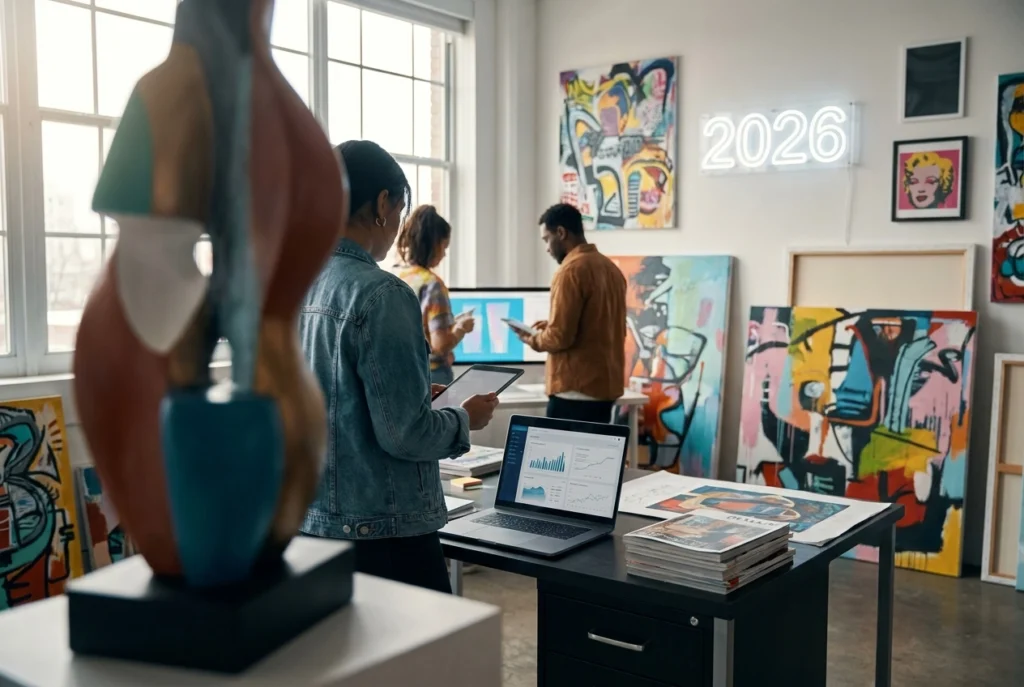
From soup cans to silk-screened celebrities, few art movements have captured the spirit of modern culture quite like Pop Art. Whether you have seen Andy Warhol’s iconic Marilyn Monroe prints or Roy Lichtenstein’s bold comic-book panels, you have already crossed paths with the lasting legacy of pop art artists, even if you did not realize it at the time.
But the story does not end in the 1960s. A powerful new wave of creativity is reshaping this beloved movement, and experts are already calling 2026 the year of the Neo-Pop Rebirth.
In this guide, we are breaking down everything a beginner needs to know. You will discover the pioneering figures who launched Pop Art into the mainstream, the bold voices who kept it alive across the decades, and the exciting contemporary artists carrying the torch into a new era. By the end, you will have a clear, confident understanding of who shaped this movement and why it continues to matter more than ever. Let’s dive in.
What Is Pop Art?
Pop art emerged in mid-1950s Britain before gaining full momentum in the early 1960s United States, fundamentally reshaping what art could be and where it could come from. Rooted in consumer culture, mass media, and everyday advertising imagery, the movement was a deliberate rejection of the introspective, gestural approach that had dominated galleries through Abstract Expressionism. Where Abstract Expressionism prized raw emotion and painterly individualism, pop art replaced that with cool detachment, mechanical reproduction, and imagery borrowed directly from supermarket shelves, Hollywood billboards, and comic strips. According to MoMA’s collection framework, consumer goods and popular culture formed the movement’s core subject matter from its very inception.
The visual language pop art developed is immediately recognisable. Saturated, high-contrast colour palettes mimic commercial printing rather than natural observation. Figures are rendered with flat graphic forms and thick black outlines, echoing comic-book aesthetics. Roy Lichtenstein’s Ben-Day dot technique and Andy Warhol’s silkscreen process both foregrounded mechanical reproduction as an artistic choice, not a limitation. Repetition of iconic imagery, whether Campbell’s soup cans or Marilyn Monroe’s portrait, carried pointed commentary on consumerism. As Rise Art’s guide to the movement notes, this blurring of fine art and commercial design was entirely intentional.
Neo-Expressionism, by contrast, returned to raw brushwork and psychological intensity in the late 1970s and 1980s; it shares figuration with pop art but lacks its graphic clarity and deliberate emotional distance.
In 2026, these same qualities, bold composition, flat colour fields, and strong recognisable iconography, make pop art exceptionally suited to both gallery walls and digital image search, where immediate visual impact drives discovery.
The Definitive Pop Art Artists Who Shaped the Movement
For any serious collector or art enthusiast building their foundational knowledge, understanding which artists defined Pop Art is not simply an academic exercise. It is the essential groundwork for recognising quality, interpreting market value, and developing an eye that can distinguish between work with lasting power and work that merely borrows the aesthetic. The artists below are the canonical figures. Each one brought a specific technical approach, a distinct visual vocabulary, and a commercial legacy that continues to shape how galleries, auction houses, and collectors engage with the movement in 2026.
1. Roy Lichtenstein: The Master of the Ben-Day Dot
Roy Lichtenstein is arguably the most technically precise artist the movement produced. His signature technique involved hand-painting Ben-Day dots, the tiny coloured circles used in commercial printing processes, to recreate the look of mass-produced imagery while simultaneously exposing the mechanics behind it. Works like Drowning Girl (1963), Whaam!, and Crying Girl demonstrate his ability to translate the flat, graphic language of comic books into fine art with extraordinary control. Every canvas carries the paradox at the heart of Pop Art: the imagery looks mechanical, but the execution is painstaking and entirely hand-made.
Lichtenstein believed his work held a mirror to industrial society, stating that it reflected “what all the world will soon become.” That cultural commentary, embedded in each bold outline and primary colour field, is precisely what gives the work its staying power. For early-stage collectors, his output is notable for its range of price points; prints and multiples provide accessible entry alongside major canvas works. According to Maddox Gallery’s profile of Lichtenstein’s art, his work commands sustained premium positioning within the gallery’s dedicated Pop Art curated collection, one of only four featured categories on the platform alongside Figurative Art, Neo-Expressionism, and Street Art. Nude with Joyous Painting sold for $46.2 million at Christie’s New York in 2020, confirming his position at the top tier of the market.
2. Andy Warhol: Consumer Culture as Fine Art
No figure is more synonymous with Pop Art than Andy Warhol, and his influence operates across both art history and the active 2026 collector market with equal force. Warhol’s method was screen printing, a technique drawn directly from commercial advertising production, which he used to reproduce celebrity portraits, consumer product packaging, and news imagery in repeated, colour-shifted grids. Campbell’s Soup Cans (1962) and Marilyn Diptych are not simply famous works; they are arguments about what art can use as its subject matter and what the act of repetition does to meaning.
His work deliberately blurred the line between critique and celebration of consumerism, and that productive ambiguity is exactly why it retains cultural currency decades later. Silver Car Crash (Double Disaster) sold for $105 million at Sotheby’s in 2013, and Warhol remains a dominant force at the high end of the market. For beginner collectors, screen prints offer a structured entry point, with authenticated editions available through specialist platforms. As noted by Guy Hepner Contemporary Art Gallery, Pop Art has moved firmly beyond movement status into a fully established market category, with Warhol as its most recognised commercial anchor.
3. Richard Hamilton: The British Founder
Pop Art began in Britain, and Richard Hamilton is its intellectual architect. His 1956 collage Just What Is It That Makes Today’s Homes So Different, So Appealing? is the movement’s founding document, assembling images from American consumer magazines to construct a satirical portrait of postwar aspiration and materialism. Hamilton’s definition of Pop Art as “popular, transient, expendable, low cost, mass produced, young, witty, sexy, gimmicky, glamorous, and Big Business” remains the most quoted summary of the movement’s intent, because it identifies the tension between celebration and critique that runs through the entire tradition.
His technique, which he called the “tabular image,” combined photographic source material with compositional decisions that exposed how advertising constructed desire. For collectors building foundational knowledge, Hamilton represents the movement’s origin point and its most self-aware theoretical position.
4. James Rosenquist: The Monumental Scale
Rosenquist brought billboard-scale ambition to Pop Art. Having worked as a commercial billboard painter in New York, he developed a technique of fragmenting oversized imagery across large canvases, placing unrelated consumer objects in jarring proximity to create disorienting cultural commentary. His approach to scale was deeply intentional; the physical presence of the work was part of its meaning. In 2026, this sensibility aligns directly with what Saatchi Art identifies as “Immersive Scale,” a dominant collector buying trend in which large-format works that command a room are attracting significant market interest. Rosenquist understood instinctively that Pop Art needed to be confrontational in its physical dimensions.
5. Ed Ruscha: Language as Image
Ed Ruscha anchored the Los Angeles strand of Pop Art by treating commercial signage and printed text as the primary subject matter of painting. Standard Station (1966) demonstrates his ability to take the visual language of roadside America and render it with a cinematic stillness that transforms the mundane into the monumental. His work introduced a conceptual element that bridges Pop Art and later movements, treating words and brand identities as objects worthy of the same aesthetic scrutiny applied to a Lichtenstein dot or a Warhol silk screen.
6. Keith Haring: The Bridge Between Pop and Street Art
Keith Haring extended Pop Art’s graphic boldness into public space, developing a visual vocabulary of bold outlines, radiant figures, and symbolic repetition that borrowed equally from comic books, graffiti, and activist art. His work operated as cultural commentary on AIDS, capitalism, and political power, delivered in a visual language immediately accessible to non-gallery audiences. Haring’s legacy sits at the exact point where Maddox Gallery’s Pop Art and Street Art curated categories converge, reflecting how the movement’s core characteristics, graphic clarity, accessible imagery, and social critique, evolved organically into the next generation of urban art.
The through-line connecting all six of these artists is precisely what makes Pop Art so enduring as a collector category. Graphic boldness, cultural commentary embedded in accessible imagery, and work that commands attention at scale are not period characteristics; they are qualities that speak directly to what the 2026 collector market is actively seeking.
Andy Warhol
No artist embodies the commercial power of Pop Art more completely than Andy Warhol (1928–1987). Beginning his career as a commercial illustrator, Warhol recognised early that the visual language of advertising and mass production was not beneath fine art; it was fine art. His screen-print methodology became the movement’s defining technical statement, transforming celebrity faces and supermarket shelves into objects of genuine cultural and monetary value.
His three most instructive works remain Campbell’s Soup Cans (1962), the Marilyn Diptych (1962), and the Mao series. In each, repetition and flat colour were deliberate conceptual arguments, not production shortcuts. By reproducing the same image across a grid, Warhol interrogated mass production, authorship, and the mechanics of fame itself. The Andy Warhol Foundation’s ongoing catalogue covers paintings, prints, sculptures, and films, reflecting the extraordinary breadth of this output.
What makes Warhol directly relevant to working artists today is his Factory studio model. That collaborative production hub, where art, film, and celebrity culture merged under a single personal brand, anticipated the creator economy by roughly five decades. The act of Warhol signing an object was, as one collector observed, the precise instant where value is created, not discovered.
Commercially, Warhol originals and authenticated prints continue to anchor Pop Art sales at major auction houses, with secondary-market demand sustained well into 2026. The Andy Warhol Foundation works with Christie’s as its exclusive sales agent, maintaining a consistent pipeline of authenticated works entering the market each year.
Roy Lichtenstein
If Andy Warhol was Pop Art’s commercial architect, Roy Lichtenstein (1923–1997) was its most technically disciplined craftsman. Where others embraced spontaneity, Lichtenstein built a visual language of extraordinary precision, drawing on comic-book printing conventions, including bold black outlines, a restricted primary colour palette, and his now-iconic dot pattern, to create work that felt simultaneously mechanical and deeply intentional. Crucially, Lichtenstein did not simply reproduce these techniques; he transformed them, painting what critics have called “Lichtenstein dots” rather than true Ben-Day dots, a distinction that reveals the careful artistic decision-making beneath an apparently effortless surface.
His landmark works demonstrate this tension brilliantly. Whaam! (1963) and Drowning Girl (1963) took source material from mass-produced, disposable comic books and presented it at monumental scale, forcing viewers to confront whether the banal could be elevated into high art. The later Brushstroke series pushed this further, turning the very gesture of painting into graphic subject matter. Institutional validation remains strong, with his work held across major global collections and actively traded through specialist platforms. Maddox Gallery’s dedicated Lichtenstein coverage reflects sustained collector demand at the premium end of the market.
For artists and collectors researching Pop Art today, Lichtenstein’s flat, high-contrast compositions are also a masterclass in visual discoverability. Bold graphic work with strong colour contrast performs exceptionally well across image search and visual platforms, precisely the qualities that define his entire output.
Richard Hamilton
While Andy Warhol and Roy Lichtenstein dominate popular consciousness, the true intellectual architect of Pop Art was British artist Richard Hamilton (1922–2011). His 1956 collage Just what is it that makes today’s homes so different, so appealing? is widely regarded as the movement’s founding document, predating American Pop Art by nearly a decade. Created for the landmark This Is Tomorrow exhibition at London’s Whitechapel Art Gallery, the work assembled magazine cut-outs of muscled bodies, domestic appliances, and consumer goods into a single image that both celebrated and interrogated postwar consumer culture. As ArtUK identifies Hamilton as the pioneer of British Pop Art, his contribution sits at the very origin point of the movement.
British Pop Art, shaped by Hamilton’s lineage, is meaningfully distinct from its American counterpart. Emerging from a nation still rebuilding after World War II, it carried an ironic, critical distance that Warhol’s work rarely employed. Hamilton worked across collage, photography, painting, and assemblage rather than the screen-printing process most associated with American Pop. This mixed-media, craft-centred approach resonates directly with the 2026 collector shift toward handmade, irreplicable work, as artists whose practice foregrounds the human hand are gaining renewed market relevance. For Australian artists drawn to British rather than American aesthetics, Hamilton’s lineage offers a richer, more politically engaged and technically diverse foundation to build upon.
David Hockney
No list of definitive pop art artists is complete without acknowledging David Hockney (1937–2026) as the movement’s most versatile and enduring figure. Where Warhol built a brand and Lichtenstein perfected a system, Hockney built a career of continuous formal reinvention across six decades, never fully departing from pop art’s core visual sensibility yet never allowing himself to be confined by it. His relationship to the movement was always productive and ambivalent in equal measure, which is precisely what made his market position so durable.
The California swimming pool series, and most iconically A Bigger Splash (1967), represents the apex of pop art’s merger of bold flat colour and acute cultural observation. Hockney himself resisted purely hedonistic readings of these works, insisting the paintings were about the surface of water and its shimmering two-dimensionality rather than Californian leisure. That critical complexity is part of what elevated the series beyond trend into canon.
His commercial record is equally instructive. Portrait of an Artist (Pool with Two Figures) sold for £70 million in 2018, then the highest auction price for a living artist. His subsequent embrace of iPad painting and large-format photo collage, represented actively by Maddox Gallery’s dedicated Hockney collection, demonstrated that pop art’s visual DNA is entirely compatible with new technology. For contemporary pop art artists navigating questions of medium and identity, Hockney’s career offers a masterclass: evolve the tools, protect the visual language, and the market will follow.
Yayoi Kusama
Yayoi Kusama (1929–2026) stands as the most globally visible artist to emerge from pop art’s foundational visual language, her polka-dot iconography and Infinity Mirror Rooms becoming synonymous with immersive, large-format art experience across seven decades. Her retrospective at Fondation Beyeler, gathering over 300 works and travelling across three major European institutions in 2025–2026, confirmed that her practice remained in active institutional circulation at the highest level until the end of her life. The Hirshhorn Museum and The Broad both hold permanent installations requiring timed-entry booking, a measurable indicator of sustained, high-volume public demand.
For collectors navigating the 2026 market, Kusama’s work maps directly onto two dominant trends identified by Saatchi Art: Immersive Scale, the shift toward large-format work that commands the room rather than decorates a screen, and emotional authenticity as the primary purchase driver. Kusama’s practice was structurally built on personal psychological experience, transforming obsessive thought patterns into shared visual sensation. That biographical foundation is not incidental; it is what gives the work its emotional immediacy.
Her visual language, repetitive pattern, bold singular motif, high-contrast colour, is also ideally structured for image search discovery and visual platform virality, making her work a clear model for how pop art’s core characteristics align with how collectors find and engage with art in 2026.
Jasper Johns
Jasper Johns (born 1930) occupies a singular position in the story of Pop Art, functioning as a crucial bridge between Abstract Expressionism, Neo-Dada, and the full commercial flowering of the movement. His flag, target, and number paintings took the most recognisable symbols in American visual culture and transformed them into sustained philosophical inquiries about what representation actually means. Rather than inventing imagery, Johns chose icons so familiar they were effectively invisible, then forced viewers to look again by rendering them through intensely laboured, tactile encaustic surfaces built up in layers of wax pigment and collaged newspaper.
Flag (1954-55) and Three Flags (1958) directly anticipated Pop Art’s defining obsession with the found, culturally loaded image. Johns began the flag series after dreaming he was painting an American flag, and deliberately allowed the symbol’s existing cultural weight to generate meaning rather than imposing personal expression. This decision, radical at the time, established the template that Pop Art would amplify.
Johns remains urgently relevant in 2026 discussions around appropriation, authorship, and the demonstrably hand-made image. His practice asks, from first principles, whether originality lives in an image’s form or its making, questions that resonate directly as collector demand shifts toward verifiably human-crafted work in response to AI-generated imagery. Commercially, his position is equally commanding: Small False Start achieved USD $55.4 million at Christie’s in 2022, setting a benchmark that confirms Pop Art’s enduring position at the very ceiling of the contemporary market.
Contemporary Pop Art Artists Redefining the Movement in 2026
Pop art is not a museum relic. It is an actively traded, institutionally supported, and collector-driven market category with genuine 2026 momentum. Maddox Gallery maintains a dedicated curated Pop Art collection alongside Figurative Art, Neo-Expressionism, and Street Art, treating it as a living commercial category rather than a historical archive. Meanwhile, Agora Gallery’s 2026 art trends forecast frames the year as one of acceleration, declaring that sustainability, craftsmanship, experimentation, and emotional authenticity are the dominant forces shaping collector behaviour right now.
The concept driving this momentum is what Agora Gallery calls a neo-pop rebirth. Contemporary pop art artists are not imitating Warhol or Lichtenstein; they are inheriting the movement’s visual grammar and advancing it. Bold compositions, layered symbolism, and vivid colour palettes remain central, but today’s practitioners bring entirely new cultural material, techniques, and contexts to that framework.
Three specific market conditions in 2026 are creating ideal conditions for pop art’s characteristics to thrive. First, growing anti-AI sentiment is pushing collectors toward work that foregrounds the artist’s hand, and pop art’s manual, graphic process directly answers that demand. Second, immersive scale has become a dominant buying preference, with collectors prioritising large-format work that commands physical space, a tradition deeply embedded in pop art’s heritage. Third, emotional authenticity has replaced institutional validation as the primary collector driver, and pop art’s immediately accessible visual language is structurally built for that kind of direct, visceral connection.
This alignment is not coincidental. The convergence of craftsmanship, emotional authenticity, and cultural resonance that Agora Gallery identifies as the defining art world value system for 2026 maps precisely onto what pop art has always done: transform familiar imagery through skilled, manual execution into something emotionally immediate and culturally charged.
The Floral Pop Movement
Formally identified by Agora Gallery as a leading 2026 art trend, Floral Pop represents one of the most commercially compelling movements currently emerging from the broader pop art tradition. Agora Gallery defines it as a contemporary, colour-palette-driven movement that merges organic botanical imagery with pop art’s graphic intensity and nostalgia-inflected sensibility, producing work that is simultaneously approachable and layered with meaning. Critically, the movement resists decorative kitsch by grounding its botanical subjects in bold composition, contemporary colour logic, and symbolic depth. This is not botanical illustration repackaged; it is a genuine neo-pop evolution.
Visually, Floral Pop is distinguished by saturated botanical subjects rendered in flat or semi-flat graphic style, bold outlines, and colour palettes drawn from both the natural world and commercial design history. Artists working in this space, such as those featured in Agora Gallery’s 2026 trend coverage, combine expressive layered surfaces with luminous graphic technique, transforming familiar floral subjects into bold, iconic imagery. This same graphic precision appears in contemporary illustrative practice, as seen in June Bunch’s State Flower Ladies series at CityArts Orlando, where vibrant colour and clean pop-influenced line work elevate botanical subjects into bold figurative form.
For artists working in this style, the search landscape presents a significant early-mover opportunity. Dedicated editorial content around the “Floral Pop” keyword cluster is currently thin relative to the collector interest the movement is generating, meaning artists who publish authoritative work around this term now are positioning themselves ahead of the curve.
The movement also aligns precisely with the dominant 2026 collector value system: the convergence of emotional authenticity, visible craftsmanship, and cultural resonance. Floral Pop sits at the intersection of multiple collector preferences simultaneously, making it commercially well-positioned for artists seeking sustained market relevance through the remainder of the decade.
Pop Art in Australia: Artists, Galleries, and the Local Scene
Australia’s pop art scene is one of the most active and least documented markets in the contemporary art world. While international publications and major gallery editorial platforms have systematically catalogued pop art movements across the United Kingdom, United States, and Europe, geo-targeted content covering Australian pop art artists remains almost entirely absent from the dominant art media landscape. For collectors searching locally and for artists building their collector audiences in 2026, this gap represents a concrete opportunity in a market that is far more developed than its digital footprint suggests.
A Scene Shaped by Two Traditions
Australian artists of the 1960s occupied a genuinely unique cultural position, absorbing British and American pop art influences simultaneously. Richard Hamilton’s cerebral, collage-based approach arrived through Australia’s longstanding cultural ties to Britain, while the bold commercial energy of Warhol and Lichtenstein crossed the Pacific as American popular culture accelerated through postwar decades. The Pop Art movement’s foundational principles, rooted in mass media imagery and consumer goods, translated naturally into an Australian context where advertising, television, and consumer abundance were reshaping daily life with the same force felt in New York and London. The 2014-15 Art Gallery of New South Wales exhibition Pop to Popism made this argument emphatically, with curator Wayne Tunnicliffe describing Australian pop art as carrying its own “mordant, irreverent, sophisticated” character, positioning local artists as active contributors to the global movement rather than peripheral followers.
Institutions and Galleries Representing the Work
Institutionally, Australian pop art is well-supported. The National Gallery of Australia has mounted significant exhibitions including Andy and Oz (2007), which drew direct connections between Warhol’s practice and Australian artists including Martin Sharp, Richard Larter, and Robert Rooney. Sharp, described as the figure most comfortable being called a pop artist, worked across painting, printmaking, graphic design, and film, and met Warhol personally. The AGNSW’s Pop to Popism remains the most comprehensive recent survey of the movement’s Australian dimension. On the commercial side, Melbourne is the dominant market: five of the nine Australian galleries currently listed as representing pop art work are Melbourne-based, with Sydney, Brisbane, Canberra, and Hobart each contributing one. BSIDE Gallery in Fitzroy and Gallery OZ in Surry Hills are active contemporary spaces working in pop-adjacent and urban art practices.
Contemporary Artists and the 2026 Collector Landscape
Among contemporary practitioners, Ben Tankard has built a strong following with his “literary pop art” series riffing on Penguin Classics covers, work described as beloved by interior designers and noted for its satirical edge. Donovan Christie, based in Adelaide, works with fast food iconography and local cultural references, and is noted as one of the more collectable artists currently active on the Australian online market. Jason Moad brings a hyper-realist approach to obsolete consumer objects including cassettes, using photorealistic technique to preserve cultural artefacts from the recent past. Online platform Bluethumb maintains a dedicated pop art collection and represents the most accessible entry point for collectors discovering Australian artists working in this tradition today. For anyone wanting broader context on how Australian art paths have developed toward the contemporary, institutional educational resources provide useful grounding.
The Search Opportunity Is Real
For Australian pop art artists specifically, the digital landscape in 2026 presents a rare low-competition, high-intent environment. Collectors searching for “Australian pop art artists,” “buy pop art Melbourne,” or “pop art print Sydney” are entering a content space where almost no one has optimised directly for those queries. Artists with gallery representation, active Bluethumb profiles, or independently maintained websites who address this search intent with targeted content, well-structured image metadata, and location-specific language are operating ahead of the field by default. The scene has institutional credibility, commercial infrastructure, and genuine collector demand. What it currently lacks is a digital content layer that connects those collectors to the artists making the work.
Why Pop Art Is Having a Commercial Moment in 2026
The market forces converging around pop art in 2026 are not cyclical nostalgia. They are structural, and they are measurable.
The Artist’s Hand Is Now a Selling Point
Saatchi Art’s 2026 trend analysis identifies “Collage and Craft” as one of the defining collector movements of the year, framing it as a direct cultural counter-reaction to the proliferation of AI-generated imagery. The platform’s editorial states plainly that collectors are gravitating toward work that foregrounds the artist’s hand, toward something AI cannot replicate, with buyers placing increasing value on labour, materiality, and the imperfect. For pop art artists, this shift is structurally advantageous. Pop art’s visual language has always been built on demonstrably process-intensive techniques: hand-pulled screen prints, layered collage, graphic ink work, and bold manual mark-making. The very characteristics that defined pop art from its origins are now the characteristics collectors are actively seeking as proof of human skill and creative intent.
Scale Is Back as a Commercial Priority
Saatchi Art also names “Immersive Scale” as a dominant 2026 buying preference, describing a decisive collector movement away from years of consuming art as screen content and toward large-format work that commands physical presence in a room. This sensibility has deep roots in pop art’s own history. Warhol’s wall-scale Mao paintings were never designed to be viewed on a phone screen. Kusama’s room-filling installations turned entire galleries into immersive colour environments. Pop art pioneered the idea that art should be impossible to ignore, and the 2026 collector market is now commercially rewarding that tradition with renewed urgency.
Emotional Connection Is Replacing Gallery Pedigree
A generational shift in how collectors make purchasing decisions is creating genuine opportunity for independent pop art artists. Saatchi Art’s 2026 analysis identifies “Emotion-first collecting” as its lead signal, noting that buyers are investing directly in emerging artists whose work resonates emotionally, even without institutional validation or blue-chip endorsement behind them. Pop art’s visual directness, its accessible subject matter, its immediacy of impact, makes it a natural fit for collectors who want to feel something before they think about provenance. A bold graphic portrait or a large-scale mixed-media work does not require curatorial explanation. It communicates on its own terms.
Premium Market Positioning Confirms Sustained Demand
Maddox Gallery, with locations in London and Dubai, structures its entire curated collection around four categories: Figurative Art, Neo-Expressionism, Street Art, and Pop Art. This is not a seasonal feature or a themed exhibition. Pop art sits within the gallery’s permanent browsing architecture, which reflects sustained buyer behaviour at the premium end of the market rather than nostalgic novelty.
Craft Traditions and Contemporary Appetite Are Converging
Pop art’s foundational techniques, including screen printing, hand-cut collage, and mixed-media assembly, are precisely the processes that 2026 collectors are seeking as evidence of irreplicable human craft. The resurgence of collector appetite for handmade work is not arriving in spite of pop art’s traditions. It is arriving because of them.
Pop Art Is Built for Image Search. Most Artists Are Not Using It.
According to ImageSEO.io, the vast majority of working artists leave approximately 90% of their image search potential completely unrealised. The single tactic most consistently neglected is alt text, a small field that most artists either leave blank or fill with generic placeholder descriptions. For pop art artists specifically, this represents a significant missed opportunity, because no other style in the contemporary market is as naturally aligned with how image search algorithms actually work.
Why Pop Art Has a Built-In Image Search Advantage
Pop art’s defining visual characteristics are precisely the qualities that image recognition systems reward. Bold flat colour fields, high-contrast iconography, graphic simplicity, and instantly recognisable subject matter all make pop art easier for algorithms to categorise, index, and surface in relevant searches. Google Images and Pinterest, the two primary discovery channels for art buyers in 2026, both prioritise images with strong colour contrast and defined edges. These are not incidental features of pop art. They are its foundation. A collector searching visually for a bold statement piece for their living room is far more likely to encounter a well-optimised pop art work than a subtly toned abstract painting, simply because pop art’s visual language is easier for machine learning systems to read and classify. The style is algorithmically legible in a way that genuinely benefits artists who know how to take advantage of it.
The Alt Text Formula Every Pop Art Artist Needs
The practical tool that bridges this advantage and actual search performance is a structured alt text formula. ImageSEO.io identifies a five-element framework: medium, style, subject, colour palette, and size. Applied consistently across an artist’s website, this formula transforms invisible image files into indexed, discoverable assets. The difference between a blank alt text field and a properly written description is the difference between a collector finding your work and never knowing it exists.
For pop art artists, the formula produces descriptions that are both descriptive and search-relevant. Consider these examples:
- “Acrylic on canvas, pop art portrait, bold red and yellow palette, 90 x 120cm”
- “Screen print on paper, pop art still life, Campbell soup can motif, black and red, 60 x 80cm”
- “Acrylic on board, pop art cityscape, flat graphic composition, electric blue and orange, 75 x 100cm”
- “Giclée print on cotton rag, pop art figure study, comic-style halftone, magenta and cyan, 50 x 70cm”
Each of these descriptions communicates precisely what a buyer is looking for and exactly what search engines need to index the image correctly.
Specificity Is What Converts Browsers Into Buyers
There is a fundamental distinction between searching “pop art” and searching “original pop art print Australia” or “bold acrylic portrait artist Melbourne.” The broad term attracts researchers, students, and casual browsers. The long-tail query attracts collectors ready to purchase. Specificity in image metadata is how an individual artist competes for the second kind of traffic, and that traffic converts at a significantly higher rate because the intent behind the search is transactional rather than informational.
Galleries and platforms that understand this are already capturing the buyers most independent artists cannot find. Maddox Gallery and Saatchi Art both use structured image content and category-level SEO investment to appear in exactly the high-intent searches that drive real sales. Individual artists without optimised image metadata are effectively ceding that collector traffic by default.
Image SEO Compounds. Social Media Does Not.
Social media posts have a short algorithmic lifespan, typically measured in hours. A properly optimised image on a well-structured website continues accumulating search equity for years. This is the compounding advantage that makes image SEO the single highest-leverage marketing investment a working pop art artist can make. Every correctly labelled image becomes a permanent, indexed asset working continuously on the artist’s behalf.
For pop art artists ready to build that kind of performance-driven digital presence, The Brand Express specialises in bespoke SEO strategies designed specifically for artists and creative businesses. The work is not generic. It is built around the visual language, the collector audience, and the search behaviour relevant to your practice.
The Pop Art Legacy Is Still Being Written
Pop art’s visual language, bold, graphic, immediate, and unmistakably human, is not a historical artefact preserved behind museum glass. It is a living commercial force aligned with the most significant collector trends of 2026. Institutional demand is confirmed. Collector sentiment is primed. The market is actively rewarding the exact qualities that define the movement.
For working pop art artists, the strategic reality is this: your visual style is natively optimised for image search discovery. High contrast, strong composition, and graphic clarity are precisely what image search algorithms surface and what collectors respond to. But that structural advantage remains entirely unrealised without deliberate SEO practice behind it.
Three actions will move you forward immediately. First, audit every image on your website and apply the pop-art-specific alt text formula: style descriptor, subject, medium, your name, and a location-intent keyword. Second, identify three to five long-tail buyer-intent keywords specific to your style and location, such as “original pop art portrait painting Sydney” or “bold graphic figurative print for sale.” Third, review your Google Images and Pinterest presence as active discovery channels, not passive ones.
Galleries and platforms are already capturing the collector traffic that independent pop art artists should be earning. The gap between visibility and invisibility is now a strategy decision, not a luck outcome.
Ready to close that gap? The Brand Express builds bespoke, performance-driven SEO strategies for artists, designed around your specific practice, your visual style, and the collectors already searching for work like yours. Get in touch with The Brand Express to start your SEO strategy today.
Conclusion
Pop Art has never been just a movement frozen in time. From Warhol’s fearless celebration of consumer culture to Lichtenstein’s bold visual language, these pioneers fundamentally changed how we see everyday life as art. Contemporary artists have kept that spirit alive, and the approaching Neo-Pop Rebirth of 2026 proves that this movement still has plenty to say about our world.
Here are your key takeaways: Pop Art democratized creativity by drawing inspiration from ordinary culture. Its original artists built a visual language that still feels fresh today. And a new generation is now pushing those boundaries further than ever before.
Ready to explore more? Visit a local gallery, follow emerging Neo-Pop artists on social media, or pick up a book on Warhol’s legacy. The best way to appreciate this movement is to immerse yourself in it. Your Pop Art journey starts now.