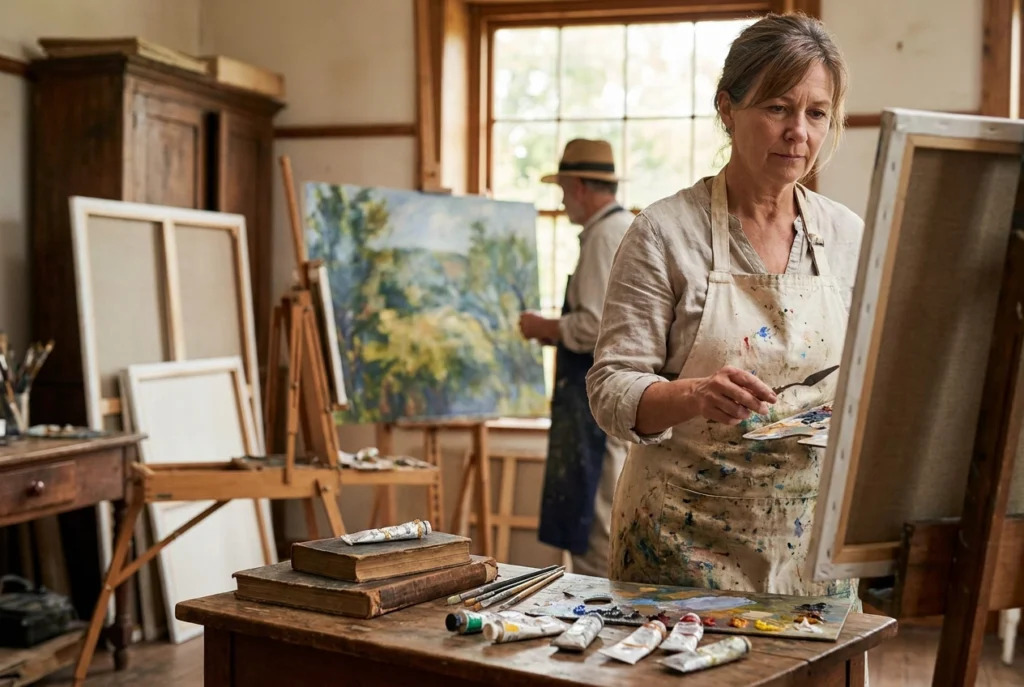
Before photography existed, capturing a fleeting moment of light dancing on water or the warm glow of a sunset seemed nearly impossible. Then a group of bold, rebellious painters shattered the rules of traditional art and changed everything.
Impressionist artists didn’t just paint pictures; they painted feelings, atmosphere, and the raw beauty of everyday life. Working primarily in the late 19th century, these visionaries rejected the stiff formality of academic painting and instead embraced loose brushstrokes, vibrant colors, and the ever-changing qualities of natural light. At first, critics mocked them. Eventually, the entire world fell in love with their work.
Whether you are completely new to art history or simply looking to deepen your appreciation, this list will introduce you to the most influential impressionist artists who permanently transformed the way humanity sees and experiences the world around us. From the sun-drenched landscapes of Monet to the lively dance halls captured by Renoir, you are about to discover the fascinating stories and signature styles behind some of the most beloved paintings ever created.
What Made Impressionism Revolutionary
In 1863, the poet Charles Baudelaire publicly criticised the official Paris Salon for presenting art that was “still stuck in the past,” dressing its subjects in the garments of ancient Rome while the streets of Paris were being torn up and rebuilt around them. That tension between institutional taste and lived reality was the spark that ignited one of the most consequential movements in art history.
The Paris Salon, enforced by the Académie des Beaux-Arts, had controlled artistic success in France for centuries. It dictated which subjects were worthy of paint, which techniques demonstrated mastery, and, most critically, which artists the public would ever discover. For a painter working in 1860s Paris, Salon approval was not merely prestigious; it was the only legitimate path to an audience. Rejection was, functionally, invisibility.
When Monet, Renoir, Pissarro, Degas, Morisot, Sisley, and Cézanne found their work repeatedly turned away by Salon juries, they did not retreat or conform. In 1874, they formed the Société Anonyme, an independent collective, and mounted their own exhibition entirely outside institutional control. Between 1874 and 1886, they organised eight independent Impressionist exhibitions, building their own discovery infrastructure rather than waiting for permission to be seen. This was not a stylistic gesture. It was a deliberate, strategic act of career survival.
The movement’s visual identity was equally intentional. Loose brushwork, plein air painting, bright unblended colour, and everyday modern subjects were not accidents of skill; they were conscious rejections of Academic convention. When a hostile critic mockingly applied the word “impressionist” to Monet’s Impression, Sunrise after the 1874 show, the artists absorbed the insult and turned it into a name. What began as ridicule became a revolution.
The parallel for artists today is direct and instructive. The Impressionists faced a single, powerful gatekeeper that controlled visibility. Contemporary artists face a different but structurally similar challenge: algorithmic systems, platform dependency, and the collapse of single-channel discovery. Understanding how Impressionism was built on self-organised visibility, consistent output, and direct audience access is not simply art history. It is a blueprint that remains entirely relevant for any creative practitioner navigating today’s fragmented digital landscape.
Claude Monet
No artist is more synonymous with Impressionism than Claude Monet, and for good reason. His 1872 painting Impression, Sunrise inadvertently named the entire movement after a critic used the title as a dismissive jibe. Rather than retreat from the label, Monet and his contemporaries embraced it, and the course of Western art history was permanently altered. Today, Monet is widely regarded as the father of Impressionism, the artist whose obsessive curiosity about light and perception gave the movement both its identity and its intellectual backbone.
What separated Monet from his peers was his treatment of painting as a systematic methodology. His serial works, including the Haystacks series (1890-1891), the Rouen Cathedral paintings, and the monumental Water Lilies canvases, were not random repetitions. They were deliberate investigations: the same subject, the same composition, examined across shifting seasons, weather conditions, and hours of the day. Monet was not simply painting haystacks. He was documenting how light transforms perception, producing what amounted to a visual research archive across hundreds of canvases.
Perhaps the most striking dimension of Monet’s legacy is the garden he created at Giverny, where he lived for 43 years until his death in 1926. He designed both the flower garden and the famous water garden from scratch, describing them as artworks in their own right. Giverny was not a retreat from his practice; it was the practice. A controlled, purpose-built environment constructed entirely in service of his artistic vision. That level of intentionality has a striking modern parallel: Monet understood, long before the language existed, that a consistent, recognisable subject, produced repeatedly and with discipline, builds the kind of audience recognition that outlasts any single work.
For anyone building a creative or business brand today, that principle is directly transferable. Repeated, high-quality output anchored to a defined subject or visual identity is precisely what earns recognition across both human audiences and algorithmic platforms. Monet’s key works, including Impression, Sunrise (1872), the Haystacks series, and the Water Lilies (painted across the final three decades of his life), remain among the most recognised images in the history of art, and serial consistency is a significant reason why.
Pierre-Auguste Renoir
Where Monet captured the world, Renoir captured the people within it. His paintings radiate warmth, colour, and an almost tactile sense of joy, making him one of the most immediately accessible impressionist artists for anyone discovering the movement for the first time. His signature style combined vibrant, broken brushwork with sensuous light to celebrate leisure, intimacy, and the everyday pleasures of Parisian life. Whether painting a riverside lunch or a sunlit dance floor, Renoir consistently brought a human warmth to Impressionism that set him apart from his contemporaries.
His masterpiece, Luncheon of the Boating Party (1880 to 1881), is widely regarded as one of the greatest achievements in the Impressionist canon. The painting captures a relaxed social gathering at a riverside restaurant, combining the atmospheric shimmer of Impressionist technique with Renoir’s deeply figurative instincts. It remains a benchmark work for understanding what the movement accomplished at its peak.
Renoir was also extraordinarily prolific, producing over 4,000 paintings across his lifetime. That volume ensured his work appeared consistently across major collections and exhibitions worldwide, cementing his place in art history through sheer sustained presence.
Interestingly, unlike Monet who moved toward abstraction in his later career, Renoir chose to return to a more classical, figurative style. This was not a commercial decision; it reflected genuine internal artistic conviction, demonstrating a willingness to evolve on his own terms.
His essential works include Dance at Le Moulin de la Galette (1876), Luncheon of the Boating Party (1881), and Two Sisters (On the Terrace) (1881).
Edgar Degas
If Monet belonged to the countryside, Edgar Degas belonged to the city. Born on 19 July 1834, Degas built his reputation on the streets, stages, and cafes of modern Paris, depicting ballet dancers, racehorses, and working women with an unflinching, observational eye. Over half of his total output focused on dance, with approximately 1,500 paintings, monotypes, and drawings dedicated to ballet alone. These were not romanticised subjects; they reflected the rhythms and tensions of contemporary urban life, setting Degas apart from peers who favoured open landscapes and natural light.
Technically, Degas was a self-proclaimed Realist who actively resisted the Impressionist label. His work showed a strong debt to Japanese woodblock prints, visible in his cropped compositions, unconventional angles, and off-centre framing. Where Monet dissolved form into light, Degas used sharp observation and bold spatial choices to create images that feel almost photographic in their immediacy.
Despite his aesthetic independence, Degas was a founding organiser of the first Impressionist exhibition in 1874 and participated in seven of the eight group exhibitions. This demonstrated genuine strategic investment in collective visibility, even when his personal vision diverged from the group’s core concerns.
His formal range was equally remarkable. Degas worked across oil painting, pastel, printmaking, and sculpture, making him one of the most versatile artists associated with the movement. Key works include The Dance Class (1874), L’Absinthe (1876), and the controversial Little Dancer Aged Fourteen sculpture (1881), which incorporated real hair and fabric, scandalising audiences at its debut.
Camille Pissarro
If any single figure can claim the title of the movement’s moral and organisational backbone, it is Camille Pissarro. Born in 1830 on the island of St. Thomas in the Danish West Indies, Pissarro holds a distinction no other Impressionist can match: he is the only artist to have exhibited in all eight Impressionist exhibitions, from the first in 1874 through to the final showing in 1886. While peers like Monet and Degas skipped editions, Pissarro remained a constant, committed presence, earning him the nickname “Father of Impressionism.”
Beyond his own canvas, Pissarro shaped the movement from the inside out. He served as mentor to both Paul Cézanne and Paul Gauguin, guiding two artists who would go on to define Post-Impressionism entirely. His patient, generous approach made him the trusted peacekeeper within a notoriously fractious group of personalities.
His subject matter evolved meaningfully across his career. Early works such as Orchard in Bloom, Louveciennes (1872) and The Harvest (1882) gave ordinary rural life and peasant labour the dignity older painters reserved for royalty. Later, he turned his eye toward the city, painting the boulevards of Paris and Rouen from elevated hotel windows. This elevated urban perspective, captured across at least fourteen versions of Boulevard Montmartre at Night (1897), anticipated the compositional logic of modern urban photography.
Pissarro also briefly adopted the Pointillist technique pioneered by Georges Seurat between 1885 and 1889, before returning to his signature loose brushwork. This willingness to experiment, without losing his core artistic identity, is what makes him one of the most instructive impressionist artists for beginners to study.
Berthe Morisot
Berthe Morisot stands as one of the most significant figures in the entire Impressionist movement, and her story is one of extraordinary commitment. She was the first woman to join the core Impressionist group, exhibiting at the landmark 1874 debut exhibition alongside Monet, Degas, and Renoir. She went on to show in seven of the eight Impressionist exhibitions, a participation record matched only by Camille Pissarro among the founding members. One contemporary critic famously described the group as “five or six lunatics, one of whom is a woman,” yet Morisot continued undeterred, cementing her place at the centre of the movement rather than its margins.
Her subject matter, which focused on domestic interiors, women, and children, was not a constraint imposed upon her. It was a deliberate artistic territory she claimed with exceptional technical sophistication and intimate psychological depth. Works such as The Cradle (1872), Summer’s Day (1879), and Woman at Her Toilette (1875–1880) demonstrate her ability to transform the everyday into something visually compelling and emotionally resonant.
Morisot’s connection to Édouard Manet was both personal and professionally formative. Manet painted her portrait multiple times across their long association, and she later married his brother Eugène, positioning herself firmly within the most influential network in the Parisian avant-garde. For beginners exploring Berthe Morisot and Impressionism, her story offers a vital corrective to the male-dominated narrative that has too often defined how this movement is taught.
Technically, her light and airy brushwork, particularly her capacity to convey movement and atmosphere within interior spaces, is among the most distinctive in the entire Impressionist canon. You can explore her works further via the Barnes Foundation and Wikipedia’s dedicated entry.
Mary Cassatt
Mary Cassatt occupies a uniquely important place among impressionist artists. Born in Pennsylvania in 1844, she became the only North American painter to be formally associated with the French Impressionist movement, invited personally by Edgar Degas to join the group around 1877. Despite spending most of her adult life in Paris, she famously declared, “I am American. Clearly and frankly American,” a statement that speaks to how deliberately she carried her identity across cultural lines. She began exhibiting with the Impressionists from 1879 onward, and her inclusion was not merely honorary; her work stood fully equal to that of her peers.
Where artists like Degas observed modern life from a certain analytical distance, Cassatt turned her gaze inward. Her paintings focused on the intimate, private world of women and children, rendered with remarkable warmth and psychological presence. Works such as The Child’s Bath (1893) and In the Loge (1878) reveal figures who feel genuinely alive rather than posed, a quality she achieved partly by working with ordinary village women rather than professional models.
Her encounter with Japanese woodblock prints at a major Paris exhibition in 1890 proved transformative. The influence appears clearly in her celebrated series of colour aquatints produced between 1890 and 1891, including The Letter, which features bold outlines, flat colour fields, and unconventional cropping drawn directly from Japanese printmaking traditions.
Beyond her art, Cassatt actively encouraged wealthy American acquaintances to collect Impressionist works, a contribution that shaped the permanent holdings of major United States museums to this day.
Alfred Sisley
Alfred Sisley holds a distinctive place among impressionist artists as arguably the movement’s most devoted and uncompromising practitioner. Born in Paris in 1839 to wealthy English parents, he retained British nationality throughout a life spent almost entirely in France. After an early stint in London where he discovered the landscapes of Turner and Constable, he returned to Paris and studied under Charles Gleyre, where he met Monet, Renoir, and Pissarro. Unlike several of his peers, Sisley never strayed from the movement’s founding principles, never producing portraits, interiors, or figurative scenes in any significant way. He is rightly considered the purest Impressionist of the group.
His paintings focused almost exclusively on rivers, fields, snow-covered villages, and open sky. This singular dedication placed him alongside Monet as a master of atmospheric light and seasonal change, capturing how a landscape shifts between morning and afternoon, summer and winter, stillness and flood. His technical sensitivity to water, reflection, and liquid light became the defining quality of his body of work.
Despite this consistency and quality, Sisley struggled financially for most of his career. The Franco-Prussian War damaged his family’s business, cutting off crucial support, and his paintings rarely sold well during his lifetime. He died in 1899 in relative obscurity, with his reputation growing substantially only after his death, earning him the enduring label of “the forgotten Impressionist.”
His masterworks remain the flood paintings produced at Port-Marly in 1876, widely regarded as among the finest landscape paintings of the entire 19th century. Key works every beginner should explore include Flood at Port-Marly (1876), The Bridge at Villeneuve-la-Garenne (1872), and Snow at Louveciennes (1878).
Gustave Caillebotte
Of all the impressionist artists examined in this list, Gustave Caillebotte remains the most persistently undervalued. Born in Paris in 1848 into a wealthy textile family, he trained as an engineer and lawyer before committing fully to painting, and that technical background shows in every canvas he produced. Where Monet dissolved form into light and Renoir softened the world with warmth, Caillebotte applied geometric rigour, steep perspective, and near-photographic precision to the textures of modern urban life. Iron bridges, rain-slicked cobblestones, and Haussmann-era boulevards are rendered with a clarity his peers largely avoided.
His 1877 masterpiece Paris Street; Rainy Day captures a Haussmann-era Parisian intersection with almost cinematic stillness, the tilting pavement and oversized umbrellas creating a composition that feels more like a photograph taken a century too early than a painting. The Floor Scrapers (1875), rejected by the Salon as “vulgar,” is now considered one of the first works to treat urban manual labour with genuine dignity. Man on a Balcony, Boulevard Haussmann (1880) extends this urban gaze outward, placing a solitary figure against the geometry of the city below.
Beyond the canvas, Caillebotte funded Impressionist exhibitions, paid Monet’s rent, and purchased works by Monet, Renoir, Degas, and Pissarro when few collectors would. His posthumous bequest of 67 paintings to the French state, after a protracted negotiation over acceptance, formed the foundation of the Musée d’Orsay’s Impressionist collection. His dual role as artist and patron makes him one of the movement’s most consequential, if quietly influential, figures.
Australian Impressionist Artists: The Heidelberg School
While Impressionism was reshaping galleries across Europe, a remarkably parallel movement was quietly taking root on the other side of the world. The Heidelberg School, named after a semi-rural suburb of Melbourne, emerged in the late 1880s when a group of Australian artists established outdoor painting camps and began applying the principles of natural light, broken colour, and loose brushwork to a distinctly antipodean landscape. The movement’s name was coined in 1891 by a journalist writing for The Australasian Critic, following the artists’ practice of gathering en plein air to capture the Australian bush, the goldfields, and the particular quality of summer light that no English pastoral tradition had ever truthfully represented.
The core figures of the movement were Tom Roberts, Arthur Streeton, Frederick McCubbin, Charles Conder, and Jane Sutherland, the last of whom remains significantly overlooked in popular art history despite being identified by the National Gallery of Victoria as one of the movement’s five major artists. Tom Roberts, who returned to Australia in 1885 carrying direct knowledge of European technique, was instrumental in establishing the group’s working methodology. Importantly, the primary stylistic influences on these artists were not Claude Monet but rather James McNeill Whistler and French tonalist Jules Bastien-Lepage, a nuance that distinguishes the Heidelberg School from simple imitation of French masters.
The movement produced some of the most recognisable images in Australian cultural history. Roberts’s Shearing the Rams (1890), now held by the National Gallery of Victoria, depicted rural labour with an honesty and national pride that resonated deeply as Australian federation approached. Streeton’s luminous landscapes and McCubbin’s triptych The Pioneer (1904) added further emotional weight, weaving themes of hardship, survival, and belonging into the Impressionist framework in ways that had no direct European equivalent.
For Australian galleries, educators, and contemporary artists working in this tradition, the Heidelberg School represents a genuine and largely untapped content opportunity. Global art writing remains heavily centred on European Impressionism, meaning well-structured, accurate content about these artists can surface prominently for both local and international collectors searching for Australian art history.
Tom Roberts
Tom Roberts is the defining figure of Australian Impressionism, and his influence on the nation’s visual identity cannot be overstated. Born in England in 1856, Roberts migrated to Australia as a child and began his formal training in Melbourne before travelling to London to study at the Royal Academy. He also spent time in Spain, where exposure to European light, loose brushwork, and outdoor painting methods sharpened his technique considerably. When he returned to Australia in 1885, he arrived with a sophisticated understanding of Impressionist principles that he immediately applied to the distinctly harsh, golden quality of Australian sunlight.
Roberts became the central organising force behind the Heidelberg School, gathering fellow artists including Frederick McCubbin, Arthur Streeton, and Charles Conder at camps in Box Hill and Eaglemont. This collaborative, outdoor working structure closely mirrored the independent exhibition strategies of the Paris Impressionists, prioritising direct observation and collective creative energy over academic convention.
His most celebrated work, Shearing the Rams (1890), captures Australian rural labour with monumental scale, energetic brushwork, and luminous natural light. Now held by the National Gallery of Victoria, it remains one of the most recognised paintings in Australian art history. Roberts also excelled as a portraitist and achieved sustained institutional recognition during his own lifetime, a rare distinction for Australian artists of his era. His legacy sits at the foundation of Australian national identity in art, making him an essential subject for galleries, educators, and collectors alike.
Arthur Streeton
If Tom Roberts laid the philosophical groundwork for Australian Impressionism, Arthur Streeton built its cathedral. Born in 1867 in Duneed, Victoria, Streeton became the movement’s most prolific visual voice, producing a body of work so consistent and so recognisable that, for generations of Australians, his canvases quite simply were the bush.
Streeton’s defining technical achievement was his ability to capture the specific quality of Australian summer light. European Impressionist technique had the vocabulary for luminosity, but no one had yet applied it to the heat-saturated, golden intensity of the Australian landscape. Streeton worked in a deliberately high-key palette, pushing brightness and warmth to levels that made his paintings feel almost atmospheric. Looking at his work, you can sense the weight of the summer air. This was not decorative choice; it was a radical act of visual translation.
His range extended beyond pastoral scenes. Fire’s On, Lapstone Tunnel (1891) depicts railway workers caught in a tunnel explosion, combining the Impressionist movement’s interest in modern industrial life with a distinctly Australian subject and scale. The painting demonstrates that Streeton understood Impressionism as a method for capturing contemporary life in all its forms, not merely its prettiest ones.
Despite spending considerable time in Europe and England throughout the early 1900s, serving as an official war artist during WWI, and repeatedly pursuing recognition abroad, Streeton consistently returned to Australian subjects as his defining artistic territory. This makes him an early and instructive example of an artist who built enduring reputation through absolute commitment to place.
Key works include Golden Summer, Eaglemont (1889), Still Glides the Stream (1890), and The Purple Noon’s Transparent Might (1896), all of which remain cornerstones of Australian art history and are held across major national institutions.
Frederick McCubbin
Frederick McCubbin occupies a singular position among the impressionist artists of the Heidelberg School, and his distinction lies in what he added to the movement rather than simply how he practiced it. Where peers like Arthur Streeton pursued the purely visual splendour of the Australian landscape, McCubbin embedded his paintings with narrative and emotional consequence. His subjects tell stories of hardship, loss, and survival in the bush, works that carry the weight of a young nation grappling with its own identity. This storytelling instinct was not incidental; it was the defining characteristic of his entire body of work.
His 1904 triptych The Pioneer stands as one of the most ambitious paintings in Australian art history. Spanning three panels, the work traces settler life across generations, combining Impressionist handling of light with a mythological register that is distinctly, irreducibly Australian. The work is held in the National Gallery of Victoria collection and is widely regarded as one of Australia’s greatest artworks.
McCubbin also shaped Australian art from an institutional platform. He served for many years as a drawing master at the National Gallery of Victoria school, directly influencing the next generation of Australian painters from within the country’s foremost art institution.
His earlier painting Down on His Luck (1889) demonstrates this narrative power with remarkable economy. A solitary swagman sits by a campfire in the bush, and the psychological intimacy of the image anticipates the social realist tradition that would define much of 20th-century Australian art.
For contemporary artists building a distinctive identity, McCubbin offers a compelling model: rigorous Impressionist technique in service of deeply local, culturally specific subject matter. In a digital landscape where differentiation is everything, that combination remains profoundly instructive.
What Impressionist Artists Understood About Being Seen
The story of Impressionism is not just an art history lesson. It is one of the most instructive strategic case studies in the history of visibility, audience-building, and creative commerce. When the Paris Salon repeatedly rejected their work throughout the 1860s and early 1870s, painters like Monet, Degas, Pissarro, and Renoir faced a clear choice: continue petitioning the gatekeeper, or build something entirely new. In 1874, they chose the latter, forming the Société Anonyme and staging their own independent exhibition. That decision did not just save their careers. It permanently restructured who controlled access to artistic legitimacy.
This is not offered as metaphor. It is a direct strategic model that maps with uncomfortable precision onto the situation facing working artists in 2026.
The Gatekeeper Has Moved Again
For the past decade, Google has functioned as the Paris Salon of digital discovery: the institution whose approval determined whether an artist existed in the eyes of potential collectors, galleries, and buyers. Artists invested heavily in SEO, optimising websites and building backlinks in pursuit of first-page rankings. That investment made sense at the time. It no longer tells the complete story.
By the end of 2025, over 60% of all Google searches and 77% of mobile searches ended without a single click to any website. Users were receiving answers directly within the search results page, through AI-generated summaries that made visiting an artist’s portfolio entirely optional. An artist ranked first for a competitive search term is now losing, on average, 34.5% of the traffic that ranking would previously have delivered. Optimising exclusively for Google in 2026 is the strategic equivalent of standing outside the Salon with a perfectly prepared submission, not realising the selection committee has already left the building.
Diversification Was Always the Answer
What made the Impressionists’ strategy so durable was not a single bold gesture. It was the sustained, simultaneous cultivation of multiple visibility channels. Independent exhibitions created direct public access. Dealer Paul Durand-Ruel built collector networks across Europe and into the American market. Critical discourse, however hostile initially, kept the movement visible and debated. International reputation eventually eclipsed the Salon’s authority entirely.
The modern equivalent of this approach is what practitioners now call Search Everywhere Optimisation. Discovery no longer belongs to a single platform. Instagram functions as a contemporary salon alternative, placing work directly in front of collectors and curators. Pinterest operates as a visual search engine where original art can surface organically to buyers actively seeking it. YouTube builds the kind of sustained creative authority that supports long-term reputation. Local search connects artists to regional galleries and collectors with high commercial intent.
AI Is the New Exhibition Wall
Gartner predicts a 25% drop in traditional search engine volume by 2026, driven by the structural rise of AI-powered discovery. ChatGPT now surpasses 800 million weekly active users. These are not statistics about the future. They describe the landscape artists are navigating today. An artist whose name, practice, and work are not optimised to appear within AI-generated answers is invisible to a substantial and growing segment of their most valuable potential audience.
This is precisely the gap that The Brand Express is built to close. Working with artists and creative businesses, The Brand Express develops multi-surface, AI-era visibility strategies that translate the instinctive diversification the Impressionists demonstrated into a modern digital framework. The goal is not rankings in isolation. It is the kind of compounding, cross-platform presence that drives genuine discovery, targeted traffic, and commercial outcomes that compound over time, much like the Impressionists’ reputation ultimately did.
If You Are a Contemporary Artist Working in an Impressionist Style
The Impressionists did not lack talent. What they lacked was access to the rooms where audiences gathered. Contemporary artists working in an impressionist style face a version of the same problem, except today those rooms are search results, visual discovery platforms, and AI-generated answers. Searches like “impressionist artists Australia,” “contemporary impressionist painter,” and “buy impressionist art” represent collectors and buyers with genuine purchase intent, actively looking for exactly what you make. The gap is not in the work. It is in the discoverability.
The search landscape has fundamentally shifted against passive visibility. AI Overviews now reduce organic clicks on top search results by an average of 34.5%, meaning a page ranked first for a competitive art keyword captures significantly less traffic than it would have two years ago. For artists, this makes brand-level visibility more important than any single ranking. Being cited within an AI-generated answer, appearing consistently across multiple platforms, and building a recognisable digital entity are now the metrics that matter. A ranking is no longer enough on its own.
Visual search is one of the most underused discovery surfaces available to artists right now. Google Lens, Pinterest visual search, and AI image recognition tools are increasingly how collectors encounter new work. Image SEO is a direct and largely untapped lever: descriptive alt text written for each artwork, Schema.org VisualArtwork structured data, and consistent, descriptive file naming all contribute to how your images surface across these platforms. Most working artists have addressed none of these.
Hyper-local optimisation is particularly powerful for Australian artists targeting regional collectors, local galleries, and art education institutions. Queries like “impressionist artist Melbourne” or “buy original art Sydney” combine geographic specificity with purchase intent, and local searches continue to generate clicks even in an AI Overview environment because they require local resolution that a summary cannot provide.
The Brand Express works with artists, sole traders, and creative businesses to build bespoke SEO strategies that address all of these surfaces simultaneously. If your work deserves to be found and it is not showing up, that is a solvable problem. The original Impressionists built their own exhibition walls when the institutions turned them away. The same instinct applies here.
The Legacy of Impressionism and the Artist Who Gets Found
The Impressionists were not discovered by accident. When the official Salon de Paris closed its doors to their work, Monet, Pissarro, Degas and their peers did not wait for permission. They built the Société Anonyme Coopérative des Artistes Peintres, Sculpteurs, Graveurs, gathered 30 artists, and created their own exhibition in 1874. That act of deliberate, collective self-publication changed Western art history permanently.
The parallel for contemporary artists is direct and actionable. Multi-surface presence, consistent entity signals, and authentic authorship are the 2026 equivalents of that independent exhibition strategy. With over 60% of Google searches now ending in zero clicks and AI assistants becoming primary discovery surfaces, no single channel is sufficient. Your work needs to appear on Google, Pinterest, Instagram, and within AI-generated answers simultaneously.
For Australian artists, the Heidelberg School represents a specific and largely uncontested opportunity. Deep, locally optimised content about Tom Roberts, Streeton, and McCubbin occupies almost no competitive SEO territory, making it one of the most accessible visibility gaps available to Australian creatives right now.
If your work is not appearing where your audience searches, the problem is not the quality of your art. It is the visibility infrastructure surrounding it. Start by auditing where your name appears online, then build outward with the same conviction those 30 artists brought to Paris in 1874.
Conclusion
The Impressionist movement was more than an artistic revolution; it was a profound shift in how humans connect with the world around them. These visionary painters taught us to slow down, notice fleeting beauty, and find meaning in ordinary moments. Their bold rejection of rigid rules opened the door for nearly every modern art movement that followed. Most importantly, their work continues to move, inspire, and transform viewers more than a century later.
Now it is your turn to experience that magic firsthand. Visit a local museum, explore online galleries, or pick up a book dedicated to your favorite Impressionist artist. Let their brushstrokes speak to you personally. Once you truly see the world through their eyes, you will never look at a sunlit afternoon, a crowded café, or a shimmering river quite the same way again.