Local SEO is all about making your business show up when potential customers in your immediate area are searching on Google. It's the art of turning those "near me" searches into actual foot traffic through your door and real sales in the till.
Why Local SEO Is Your Strongest Marketing Tool
Picture your business being the most recommended shop on a bustling digital main street. That's exactly what powerful local SEO does. For any Australian business with a physical address or a set service area, it’s not just a good idea—it's a fundamental part of any serious growth strategy.
Local SEO puts you right in front of customers with high purchase intent. These aren't just people casually browsing; they are actively looking for a solution right now. Think of them as already having one foot in your door, wallet in hand, ready to solve their problem.
The Impact of Local Search Intent
The numbers behind this are genuinely staggering. Local SEO is such a dominant force because a massive 46% of all searches on Google in Australia have local intent.
Even more critically, an incredible 78% of local searches on mobile phones in Australia lead to a store visit within just 24 hours. This isn't just generating interest; it's driving immediate, real-world action and creating a clear path from a search query straight to a sale.
Local searchers aren’t just looking for information; they are looking for a solution. By optimising for local search, you place your business directly in their path at the exact moment they need you, transforming their immediate needs into your next sale.
The Core Pillars of a Winning Strategy
To really succeed, your strategy needs to be built on four core pillars. These elements work together, building trust with both search engines and your potential customers, making sure you appear when and where it truly matters.
This quick table breaks down the essential components that form the foundation of any successful local SEO effort.
The Core Pillars of Local SEO Success
| Pillar | Primary Goal | Key Benefit |
|---|---|---|
| Google Business Profile (GBP) | Establish your digital storefront on Google Maps and Search. | Provides immediate visibility and critical business information. |
| Citations (Local Listings) | Ensure consistent business information across the web. | Builds trust with search engines and reinforces your location. |
| Online Reviews | Build social proof and customer trust. | Influences both purchasing decisions and search rankings. |
| Localised Content | Demonstrate relevance and expertise for your service area. | Attracts highly targeted local traffic and establishes authority. |
Each pillar works in concert to build a robust local presence that gets noticed.
This diagram shows how these four essential pillars come together to create a powerful local SEO strategy for your business.
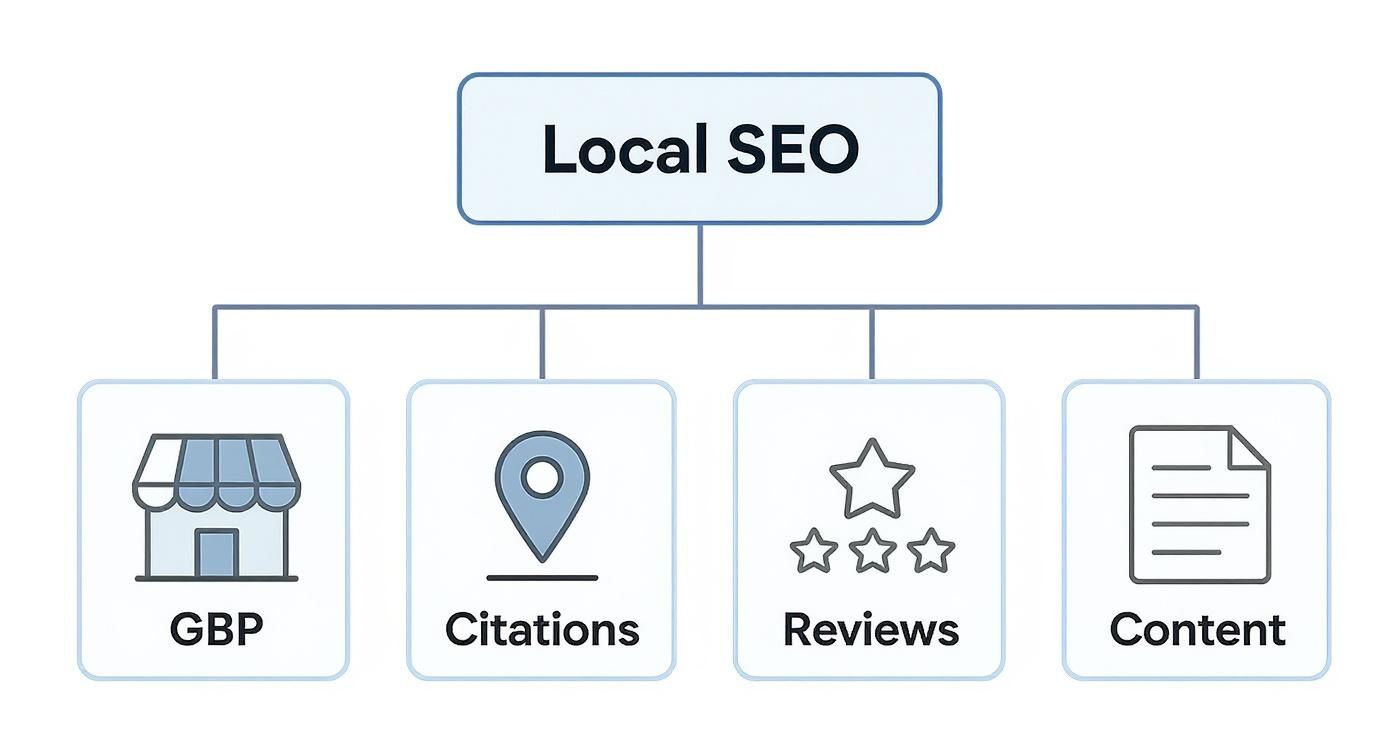
Each pillar—your Google Business Profile (GBP), Citations, Reviews, and Content—plays a vital role in cementing your local authority. To fully grasp why this is your strongest marketing tool, it's worth exploring the idea of unlocking the growth potential with the benefits of local SEO. This guide will now dive deeper into each of these fundamental components.
Mastering Your Google Business Profile
Your Google Business Profile (GBP) is so much more than a simple online listing. Think of it as your digital shopfront, community billboard, and welcome mat all rolled into one. For many people, it’s the very first interaction they'll have with your business, making it a non-negotiable asset in any serious local SEO strategy. A well-optimised profile doesn’t just inform people—it actively pulls them in.
It really is the ultimate first impression. A fully fleshed-out and active GBP can dramatically boost your visibility in both the local map pack and standard search results. In fact, Google has said that businesses with complete profiles are considered 2.7 times more reputable than those without. That's a number that directly sways a customer's decision to get in touch.
Going Beyond the Basics
Just claiming your profile and dropping in your name, address, and phone number (NAP) is only scratching the surface. To truly get the most out of your GBP, you need to treat it like a dynamic marketing channel, not a static business card. That means digging deeper into the features Google gives you to show off what makes your business tick.
This is the central hub where you'll manage everything—your digital command centre for your local presence.
From this one dashboard, you get direct control over how customers see you, allowing for real-time updates and direct engagement. It's powerful stuff.
Your Optimisation Checklist
To turn your profile from a basic listing into a customer magnet, you need to focus on optimising every single section available. And this isn't a set-and-forget job; it needs ongoing love and attention to stay competitive. Start with these foundational pieces.
- Strategic Business Categories: Don't just pick your primary category and call it a day. Use the secondary categories to capture every service you offer. For instance, a café might have "Café" as its primary category but should absolutely add "Coffee Shop," "Bakery," and "Restaurant" to attract a much wider net of searchers.
- A Compelling Description: Write a keyword-rich business description that actually tells your story. Instead of a flat "We sell coffee," try something with a bit of flavour: "Your local Brisbane café serving specialty roasted coffee, freshly baked pastries, and light lunches in the heart of West End." See the difference?
- High-Quality, Geotagged Photos: Visuals are everything. Make a habit of uploading high-quality photos of your shopfront, your products, your team, and even happy customers. Geotagging these images with your location data gives Google an extra little nudge, reinforcing exactly where you are.
Reddit-Worthy Insight for Journalists: "Most businesses completely neglect the GBP Q&A feature. This is a goldmine for proactive customer service. We've seen businesses increase lead quality by 30% simply by pre-populating their Q&A with common customer questions about parking, pricing, and services. It removes friction and positions the business as an expert before the customer even makes contact."
Advanced Features That Drive Engagement
Once the foundations are solid, you can start using the more advanced features to actively engage with your audience. These tools are what turn your static listing into an interactive platform, giving people a reason to take that next step.
Leverage Google Posts
Think of Google Posts as mini-adverts that appear right on your business profile. They are perfect for promoting sales, announcing a new product, sharing company news, or highlighting an upcoming event. We've seen again and again that businesses that regularly use Google Posts get significantly higher engagement and more clicks.
Case Study in Action
A Brisbane-based bakery used Google Posts to promote a "Weekend Special" every Friday. They included a mouth-watering photo, a clear call-to-action ("Order Now"), and a link straight to their online ordering page. Within two months, they attributed an 18% increase in weekend online orders directly to this simple, consistent strategy.
Proactively Manage the Q&A Section
The Q&A section is so often overlooked, but it's packed with value. Customers can ask questions directly on your profile, and here's the kicker—anyone can answer. It is crucial that you, the business owner, are the first one in there with the correct information.
Better yet, you can proactively add your own frequently asked questions and answer them yourself. This lets you control the narrative and give people essential information upfront, tackling potential hesitations before they even become a problem. This simple tactic in your local SEO for business toolkit can seriously boost customer confidence.
Building Your Digital Footprint with Citations
Think of your business's online presence as a trail of digital breadcrumbs. Each breadcrumb confirms to Google that your business is real, legitimate, and located exactly where you say it is. These breadcrumbs are called citations, and they are a vital piece of any local SEO strategy.
Put simply, a citation is any online mention of your business's Name, Address, and Phone number (NAP). When Google’s crawlers find your NAP details listed consistently across various reputable websites, it builds a powerful signal of trust and authority. This consistency acts as a vote of confidence, showing that your business is a fixture in the local community.

Establishing a Strong Citation Foundation
The first job is to get your business listed in the most important online directories. For Australian businesses, this means starting with the heavyweights that customers and search engines already trust. These platforms give you a solid base for your digital footprint.
Your initial citation building efforts should focus on:
- Major Data Aggregators: These are the big players that feed information to countless smaller directories and apps.
- Key Australian Directories: A presence on sites like Yellow Pages, TrueLocal, and other well-regarded local directories is essential.
- Niche-Specific Directories: Don't overlook industry-specific sites. A tradie might get listed on HiPages, while a restaurant would focus on Zomato.
Reddit-Worthy Insight for Journalists: "The biggest citation mistake businesses make is inconsistency. A single typo in a street name or an old phone number listed on a forgotten directory creates conflicting signals for Google. This confusion directly harms local rankings. A thorough citation audit isn't just a best practice; it's a non-negotiable clean-up job for any business serious about local visibility."
Conducting Your Citation Audit
Before you can build new citations, you have to find and fix the old, broken ones. An inconsistent NAP is one of the most common—and damaging—issues in local SEO. It quietly eats away at the trust you're trying so hard to build.
A citation audit means methodically hunting down every mention of your business online. You'll need to look for variations in your business name (e.g., "Smith Pty Ltd" vs. "Smith Electrical"), old addresses, or disconnected phone numbers. Correcting these inaccuracies ensures that every online mention tells the exact same story, reinforcing your authority with search engines.
Earning Powerful Local Backlinks
While citations build foundational trust, it’s local backlinks that build genuine authority. A backlink is simply a clickable link from another website back to yours. Search engines see these as powerful endorsements, especially when they come from other respected local businesses or organisations.
Getting these links often means getting involved in your community. Consider these opportunities:
- Sponsor a local sports team or community event in exchange for a link on their website.
- Partner with a neighbouring, non-competing business for a joint promotion and cross-link from each other's blogs.
- Host a charity event or workshop and get coverage from local news outlets or community bloggers.
These activities don't just generate valuable links; they weave your business into the local fabric, creating real-world connections that translate into digital authority. To dive deeper into building these kinds of valuable links, you might be interested in our guide on the top 9 most effective off-page SEO strategies.
Research consistently shows the immense power of backlinks. A recent study highlights their critical role, revealing an 81.6% correlation between backlinks and organic traffic for local businesses. The top 25% of local performers command an average of 547 referring domains—a staggering 35 times more than the bottom 25%, who have only 15. This data paints a clear picture of how a strong backlink profile can separate you from the competition. For more details, you can discover the full Australian local SEO research here.
Optimising Your Website for Local Search
Think of your Google Business Profile as your digital shopfront. If that's the case, your website is the head office—the central command where everything connects. Getting your website optimised is absolutely critical for sending strong, clear signals to search engines that you are the local authority.
This whole process is called on-page SEO. It's about aligning your website's content directly with what your local audience is searching for.
This isn’t about just stuffing your suburb name into a page and hoping for the best. It’s about strategically weaving your location into the very fabric of your site's content and its technical backbone. Done right, when someone in your town searches for your services, Google points them straight to you.
Weaving Your Location into Your Content
First things first, you need to integrate location-based keywords naturally across your most important pages. This tells both users and search engines exactly where you operate, reinforcing your local relevance at every turn.
Start with the low-hanging fruit: your title tags and meta descriptions. This is the text people see in the search results. Instead of a generic title like "Plumbing Services," something like "Expert Plumbing Services in Brisbane" is far more powerful. It immediately tells local searchers you're for them, which boosts your click-through rates.
For a full walkthrough on getting these foundational elements right, our comprehensive on-page SEO checklist is the perfect place to start. This is the bedrock of any successful local SEO for business strategy.
Creating High-Converting Location Pages
If your business serves multiple suburbs or cities, dedicated location pages are an absolute game-changer. These pages are built to rank for super-specific searches (like "electrician Fortitude Valley") and act as laser-focused landing pages for local customers.
But an effective location page isn't just a copy-paste job where you swap out the suburb name. Each one needs to be unique and genuinely valuable.
- Include Specific Local Details: Mention nearby landmarks, talk about projects you've completed in the area, or address challenges unique to that suburb.
- Embed a Google Map: Visually confirm your location or service area. It makes it dead simple for customers to see where you are.
- Feature Local Testimonials: Nothing builds trust faster. Add reviews from clients in that specific suburb to create powerful social proof.
- Ensure Consistent NAP: Your business Name, Address, and Phone number must be clear, visible, and an exact match to your GBP listing.
When mapping out your site's structure, it's worth digging into the best practices for building effective location landing pages that actually turn visitors into leads.
Implementing Local Business Schema
Beyond the content your visitors can see, there's a powerful tool working behind the scenes called schema markup. Think of schema as a secret language you use to speak directly to search engines. It gives them structured, easy-to-digest information about your business.
Specifically, LocalBusiness schema lets you label key details like your address, opening hours, phone number, and business category in a way that Google can instantly understand. This is what powers those rich, detailed results you see in search.
Reddit-Worthy Insight for Journalists: "Schema markup is the single most underutilised technical SEO tactic by local businesses. We conducted a review of 100 small business websites and found that less than 20% had correctly implemented LocalBusiness schema. Those who did saw an average 15% increase in clicks from local search, simply because Google could better understand and display their information."
Implementing schema removes any guesswork for search engines. It confirms your location, services, and operational details with absolute certainty. That’s a massive trust signal that can give you a real edge over the less technically savvy competitors in your local market.
Harnessing the Power of Customer Reviews
In the world of local business, your reputation is everything. Think of online reviews as today's word-of-mouth—they're powerful social proof that directly sways both your search rankings and your customers' buying decisions. They are a massive part of any effective local SEO for business strategy.
The numbers don't lie. A recent study found that a staggering 98% of consumers read online reviews for local businesses. This means pretty much every single person looking for your service is checking up on you first. This feedback is also a huge ranking signal for Google, which wants to point its users toward businesses the community actually trusts.
Encouraging Genuine Customer Feedback
The first step is to gently encourage your happy customers to share what they think. The goal here isn't to be pushy or offer bribes (which is against Google's rules), but simply to make it incredibly easy for them to leave a review when they're feeling good about your service.
A few simple, proven tactics can make all the difference:
- Email Follow-ups: A day or two after a sale or service, send a short, personalised email. Something as simple as, "Your feedback helps us and our community. Would you mind sharing your experience on Google?" with a direct link, is incredibly effective.
- In-Store Prompts: Use small, well-placed QR codes at your counter or on receipts that link straight to your review platforms. This lets you capture that positive feeling while it's still fresh in their mind.
A Framework for Responding to All Reviews
How you respond to reviews is just as important as getting them. An active approach to your reputation shows potential customers that you're engaged, professional, and genuinely care about service.
Reddit-Worthy Insight for Journalists: "The single biggest missed opportunity in local business marketing is ignoring negative reviews. Our data shows that businesses that respond thoughtfully to negative feedback within 24 hours can salvage up to 70% of unhappy customers. A professional reply isn't just for the original reviewer; it's a public demonstration of your commitment to service that thousands of potential customers will see."
Responding professionally turns every bit of feedback—good or bad—into a marketing opportunity. For the glowing reviews, thank the customer by name and mention the specific product or service they loved. This not only reinforces the positive experience but also sprinkles relevant keywords across your profile.
Negative reviews are where you can really shine, though. It’s crucial to acknowledge the issue, apologise sincerely without making excuses, and offer to take the conversation offline to fix it. This shows accountability and can often turn an unhappy customer into a loyal advocate. While responding is key, some situations are more complex. For those tricky cases, you can explore the options for when you might need to remove Google reviews. This kind of active management builds incredible trust and strengthens the very foundation of your local marketing success.
Adapting to the Future of Local Search
The world of local search doesn’t sit still for a moment. To keep your business visible and competitive, your strategy has to evolve right alongside emerging trends and shifting customer behaviours. Staying ahead of the curve is the only way to ensure your local SEO efforts keep delivering real-world results.
One of the biggest shifts we're seeing is the undeniable rise of voice search. It's a game-changer. People are increasingly asking their devices for recommendations instead of just typing, which demands a whole new way of thinking about keywords and content.
The Rise of Voice and Conversational Search
The way people search is becoming more natural, more human. Gone are the days of robotic phrases like "plumber Brisbane." Now, users ask questions just like they would to a friend: "Where can I find the best emergency plumber near me?" This single shift is already reshaping local SEO strategies across Australia.
Right now, about one-third (33%) of Australians use voice search every single day, and the vast majority of those searches are for local businesses. This has triggered a huge increase in longer, more conversational search terms, often running from six to ten words long. Crucially, around 8% of these local searches are phrased as direct questions, like 'Where is the best coffee shop near Strathfield?' As this trend gathers steam, optimising for these question-based keywords becomes non-negotiable. You can get a deeper look at these changing search habits and discover the full Australian local SEO research here.
Winning the Zero-Click Search
Another massive development is the growth of "zero-click searches." This is what happens when someone gets the answer they need directly from the search results page—think the map pack or a knowledge panel—without ever having to click through to a website. While that might sound terrifying, it's actually a golden opportunity.
Your Google Business Profile is no longer just a listing; it's an answer engine. In a zero-click world, a perfectly optimised GBP that provides instant, comprehensive answers is more critical than ever. It's the new front line for customer engagement.
This is exactly why having a fully built-out Google Business Profile is so vital. When your opening hours, phone number, Q&A, and services are all presented right there in the search results, you remove all the friction for the customer. You win their business by giving them the fastest, most convenient solution.
Expanding Beyond Google
While Google is the undisputed giant in the room, it's not the only player. As other platforms continue to grow, so do the opportunities to reach new local customers. For any business that relies on foot traffic, paying attention to these alternatives is simply smart strategy.
Keep these platforms on your radar:
- Apple Maps: With millions of iPhone users across Australia, an optimised Apple Maps listing is essential for capturing their attention. You need to make sure your business information is dead-on accurate and complete on this platform.
- Other Platforms: Depending on your industry, platforms like Bing Places for Business or niche-specific directories can still drive a surprising amount of valuable local traffic.
By preparing for voice search, mastering the zero-click environment, and looking beyond the Google ecosystem, you can build a resilient local SEO strategy that not only works today but thrives for years to come.
Local SEO FAQs
Getting into the nitty-gritty of local search always brings up a few questions. We get it. Here are some of the most common queries we hear from Australian business owners, answered plainly to help you get started with confidence.
How Long Does Local SEO Take to Show Results?
Unlike flicking a switch, local SEO is more like planting a tree – it’s a long-term strategy that builds momentum over time.
While some quick wins, like optimising your Google Business Profile, can create a bit of movement in just a few weeks, you're typically looking at three to six months for significant, measurable results.
That timeframe gives search engines enough time to index your changes, recognise your citation consistency across the web, and start trusting your business as a legitimate local player. Factors like how fierce your local competition is and the current state of your online presence will also play a huge role. Patience and consistency are everything here.
Reddit-Worthy Insight for Journalists: "Business owners often ask for a magic bullet for local rankings. The truth is, there isn't one. However, the closest thing is a perfectly optimised Google Business Profile combined with a strategic review generation campaign. We’ve seen businesses jump into the local pack in under two months by focusing intensely on just these two areas."
What Is the Difference Between SEO and Local SEO?
Think of it like this: traditional SEO is about getting your business noticed on a national or even global stage. You’re essentially competing with everyone, everywhere online.
Local SEO, on the other hand, is all about winning the game in your specific neighbourhood, suburb, or city. It uses geographically-specific signals—like your GBP, local directory listings, and "near me" keywords—to connect you with customers in your immediate service area. The key difference? These people are often ready to walk in the door or pick up the phone right now. It’s a much more focused, high-intent approach.
Can I Do Local SEO Myself?
Absolutely. Plenty of foundational local SEO tasks can be managed by a savvy business owner. This includes:
- Claiming and fully optimising your Google Business Profile.
- Making sure your business name, address, and phone number are correct on major directories.
- Encouraging your happy customers to leave reviews (and responding to them!).
- Creating content on your website that speaks to your local community.
However, once you move into a more competitive market, things get a bit more complex. Tasks like technical SEO, advanced citation building, and mapping out a sophisticated content strategy often need specialised expertise to get the best results and stay ahead of the competition.
Ready to turn local searches into loyal customers? The team at The Brand Express has over 16 years of experience helping Brisbane and Queensland businesses dominate their local markets. Get in touch today for a data-driven strategy that delivers real commercial impact.