
Competitor analysis is about more than just keeping tabs on your rivals. It’s a systematic way of identifying who you’re up against, breaking down their strategies, and figuring out where their strengths and weaknesses lie in relation to your own. Think of it as a proactive process—gathering intel on their pricing, content, SEO, and marketing tactics to find opportunities and threats in your market.
Why Competitor Analysis Is Your Secret Growth Engine
It's time to stop thinking of competitor analysis as a defensive, box-ticking exercise. Done right, it's one of the most powerful, proactive strategies you can have for genuine business growth. Learning how to conduct a proper competitor analysis isn't about copying what everyone else is doing; it's about understanding the market's pulse so you can find your unique advantage.
When you get a deep understanding of your competitors' moves—both their wins and their stuff-ups—you start to see the bigger picture. You can anticipate market shifts, sharpen your own value proposition, and discover customer needs that are being completely ignored. It’s the difference between reacting to the market and actually leading it.
Shifting from Imitation to Innovation
The goal here isn’t to just mirror what the top players are doing. The real gold is in spotting their blind spots and the customer pain points they’ve overlooked. This is the insight that lets you carve out a unique and defensible space in the market.
Consider the benefits:
- Anticipate Market Trends: By keeping an eye on your competitors, you can spot emerging trends before they go mainstream, giving you a serious head start.
- Refine Your Value Proposition: Understanding how competitors position themselves helps you highlight what truly makes your offer different and better.
- Discover Untapped Opportunities: Analysis often reveals underserved customer segments, content gaps, or marketing channels your rivals have completely missed. For instance, digging into competitor strategies can directly improve your own search engine performance. You can read our guide on how to rank higher in Google Search to learn more.
This strategic approach has become vital for Australian businesses looking to get ahead. According to the Australian Industry Group’s 2025 Industry Outlook Survey, over half (54%) of industry leaders flagged improving their market offerings as the main driver for business growth. This focus is directly linked to competitor analysis, as you can't innovate effectively without first understanding the landscape. You can dig into more industry insights in the full AIG report.
Journalist-Worthy Takeaway: A lot of businesses get stuck in a "competitor-obsessed" loop, trying to win by being a slightly cheaper or faster version of someone else. The real winners use competitor analysis to find the empty spaces on the chessboard—the customer problems no one is solving well—and build their entire strategy around owning that space. It's not about playing their game better; it's about creating a new one.
Building Your Competitor Analysis Framework
A great competitor analysis starts with a solid game plan, not just a chaotic scramble for data. If you dive in without a clear framework, you’ll end up with a pile of vanity metrics and random information that doesn’t lead to any real insights. Building a structured approach from the outset ensures every piece of data you gather actually aligns with your business goals.
The first step is to look beyond your obvious rivals. Too many businesses only track their direct competitors—the ones selling nearly identical products or services to the same audience. While that's important, this narrow view misses a huge part of the competitive picture.
Identifying Your True Competitors
To build a complete picture, you need to categorise your competitors. This simple exercise helps you understand the different types of pressure on your business and, more importantly, where new threats or opportunities might pop up.
- Direct Competitors: These are the brands that immediately come to mind. If you sell SEO services in Brisbane, another Brisbane-based SEO agency is your direct competitor. You're fighting for the same customer with a very similar offer.
- Indirect Competitors: These businesses solve the same customer problem but with a different solution entirely. For instance, a company might choose to hire an in-house marketing coordinator instead of your agency. They're not an agency, but they are competing for the exact same budget.
- Aspirational Competitors: Think of these as the big players or "legacy brands" in your industry. You might not be competing with them for customers today, but their strategies, brand positioning, and content can offer a valuable roadmap for your own growth.
This process helps you turn raw competitor data into strategic action. You start by anticipating market moves, which allows you to sharpen your own strategy and uncover new opportunities.
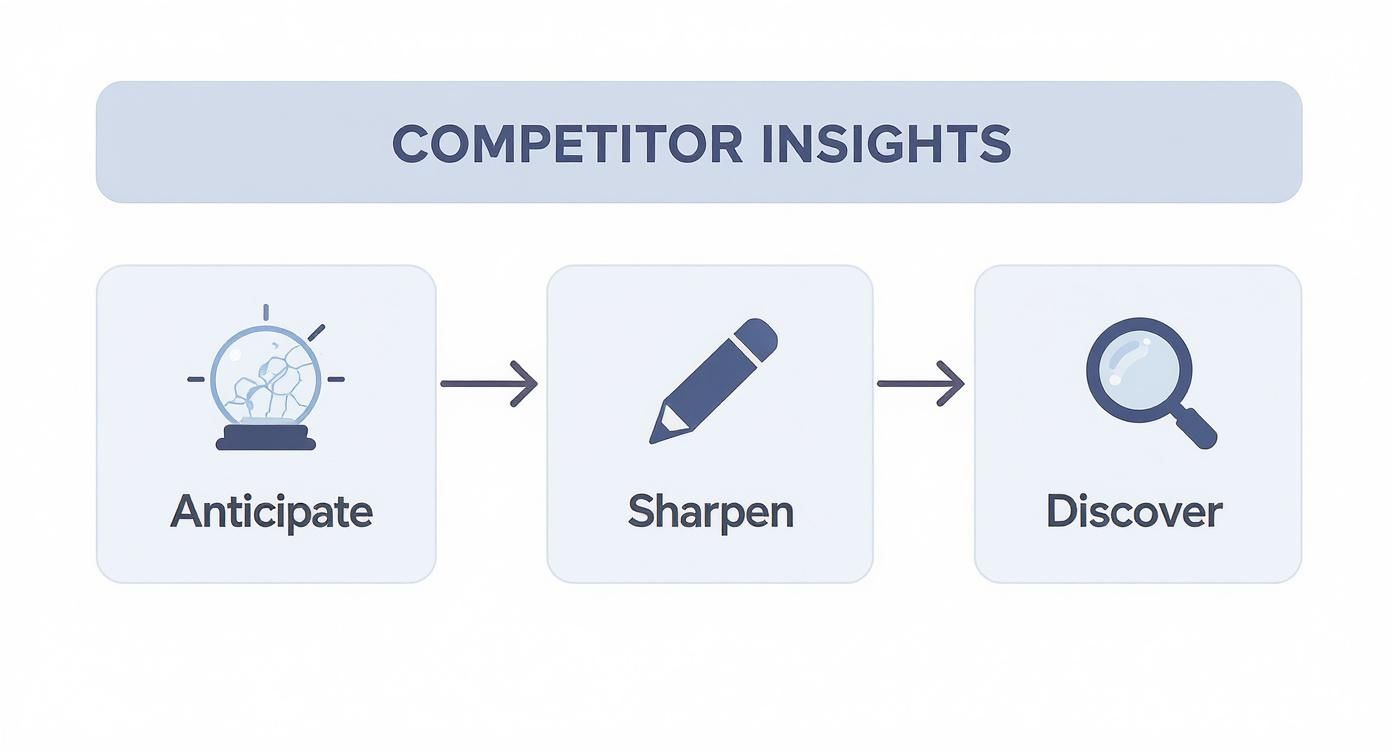
As the infographic shows, a successful analysis isn't a one-off task; it's a continuous cycle of anticipation, strategic refinement, and discovery.
Setting Clear Objectives for Your Research
Once you know who you’re analysing, you have to define what you actually want to achieve. Vague goals like "see what competitors are doing" simply won't cut it. Your objectives must be specific, measurable, and tied directly to a business outcome.
Are you trying to:
- Inform your SEO strategy? Your goal might be to identify untapped keywords they rank for or find high-authority backlink opportunities they're using.
- Guide product development? You could aim to analyse customer reviews of their products to find common complaints or feature requests, revealing a gap you can fill.
- Refine your marketing message? The objective could be to understand a competitor's unique selling proposition (USP) and brand voice to better differentiate your own.
Journalist-Worthy Takeaway: Businesses often fall into the "feature-matching" trap, where competitor analysis just becomes a checklist of what everyone else offers. The smart play is to analyse for sentiment and problems. What are customers consistently complaining about in competitor reviews? That's not just a weakness; it's a market opportunity gift-wrapped for you.
Choosing What Data to Track
With your competitors identified and objectives set, the final piece of the framework is deciding which data points to collect. This is what keeps you from drowning in irrelevant information. A structured template—even a simple spreadsheet—is crucial for organising this data for easy comparison.
Your framework should include categories like:
- SEO & Content Performance: Track their primary keywords, top-performing pages, domain authority, and the quality of their backlink profile.
- Marketing & Social Media: Analyse their most engaging content formats, posting frequency, audience sentiment, and promotional campaigns.
- Product & Pricing: Document their core offerings, pricing tiers, unique features, and customer onboarding experience.
- Brand Positioning: Note their marketing messaging, value proposition, and the overall story they tell about their brand.
A critical metric to include is 'share of voice'. Understanding how to calculate your brand's share of voice gives you real insight into your market visibility against your rivals. By consistently tracking these structured data points, you move from simple observation to strategic action, turning raw information into a powerful competitive advantage.
Choosing the Right Competitor Analysis Tools
Once you have a solid framework, the next step is getting your hands on the right toolkit. Trying to gather every single piece of competitor data manually isn't just slow—it's pretty much impossible. The right tools automate this heavy lifting, digging up insights that would otherwise stay buried and freeing you up to focus on strategy, not spreadsheets.
Picking the right software isn't about finding one magical "best" platform. It's about building a smart, strategic stack that covers your specific needs, from SEO and content right through to social media and brand perception.
All-In-One SEO and Marketing Platforms
These platforms are the powerhouses of competitor analysis. Think of them as giving you a bird's-eye view of a rival's entire digital footprint. They’re often the best place to start because they pull data from multiple sources into a single, cohesive dashboard.
Two of the biggest players here are Ahrefs and Semrush. Both are brilliant at uncovering a competitor's keyword strategy, their backlink profile, what content is performing best, and even their paid ad campaigns. This makes them indispensable for figuring out how your rivals are attracting both organic and paid traffic.
Take Ahrefs' Site Explorer, for instance. It gives you an immediate, high-level snapshot of any domain's SEO health.
This dashboard instantly tells you a competitor's authority (Domain Rating), the size of their backlink portfolio, and their estimated monthly organic traffic. It’s a quick and dirty way to benchmark your own performance against theirs.
Journalist-Worthy Takeaway: Many businesses get bogged down thinking they need a dozen specialised tools to get started. Honestly, one robust all-in-one platform like Ahrefs or Semrush can uncover 80% of the actionable SEO and content insights you need. The real secret is to master one tool's capabilities before you start adding more complexity to your stack.
Specialised Content and Social Listening Tools
While the all-in-one platforms are fantastic for SEO, sometimes you need to go deeper into specific areas, like content trends or what people are really saying about a brand. This is where specialised tools come into their own.
- Content Intelligence Platforms: Tools like BuzzSumo are brilliant for figuring out what content is actually resonating in your industry. You can plug in a keyword or a competitor's domain and see which articles, videos, or infographics are getting the most social shares and backlinks. It’s a shortcut to identifying proven content formats and topics your audience already loves.
- Social Listening Tools: Platforms like Brandwatch or Sprout Social go way beyond just counting likes and shares. They monitor conversations across the web—on social media, forums, and news sites—to gauge the sentiment around your competitors' brands. Are customers raving about a new feature or complaining about their service? This qualitative data is pure gold.
The Australian data analytics market, which powers many of these tools, is absolutely booming. It was valued at around AUD 2.00 billion in 2024 and is projected to skyrocket to AUD 19.08 billion by 2034. This just goes to show how critical data-driven insights have become for any business wanting to stay competitive.
Building Your Analysis Stack
Assembling your toolkit is always a balancing act between your budget, your business goals, and the depth of data you genuinely need. There's no one-size-fits-all answer. To make your life easier, it's vital to evaluate specific competitor analysis tools like Instantly and see how they stack up against your unique requirements.
A practical way to go about it is to start with a core platform and then add specialised tools as and when you need them.
- Start with an SEO Powerhouse: Pick either Semrush or Ahrefs to be your foundation for all things keywords, backlinks, and traffic analysis.
- Add a Content Insight Tool: Layer on a tool like BuzzSumo to help guide your content strategy by spotting viral topics and popular formats.
- Incorporate Social Listening: If brand perception is a key priority, bring in a tool like Brandwatch to keep an eye on public sentiment and conversations.
To help you decide, here’s a quick comparison of the different types of tools and what they’re best for, whether you're a fresh startup or an established enterprise.
Competitor Analysis Tool Comparison
Choosing the right software can feel overwhelming, but breaking it down by function makes it much simpler. This table compares some of the most popular options to help you see where they fit into a potential analysis stack.
| Tool Name | Primary Function | Key Features | Best For |
|---|---|---|---|
| Ahrefs / Semrush | All-in-one SEO and digital marketing analysis | Keyword research, backlink analysis, site audits, rank tracking, ad research | Businesses needing a comprehensive overview of a competitor's entire digital marketing strategy. |
| BuzzSumo | Content intelligence and trend identification | Content discovery, social engagement tracking, backlink analysis for content | Content marketers looking for data-backed ideas that will resonate with their audience. |
| Brandwatch | Social media listening and brand monitoring | Real-time conversation tracking, sentiment analysis, trend identification | Brands focused on reputation management and understanding customer conversations online. |
By strategically combining these different types of tools, you create a powerful, multi-layered view of the competitive landscape. This is how you move beyond just surface-level metrics and start uncovering the nuanced strategies that are truly driving your competitors' success.
Your Deep Dive into Competitor Strategies
Alright, you've got your framework mapped out and your tools ready to go. Now for the real work. This is where we move past surface-level observations and start taking apart the specific strategies your competitors are using to get ahead.
We’re going to break this down into three critical areas, giving you a clear playbook to uncover exactly what makes them tick.
Uncovering Their SEO and Content Playbook
A competitor's SEO and content strategy is the engine driving their organic traffic. Your job is to reverse-engineer that engine. This isn’t just about swiping their keywords; it's about getting inside their head and understanding the why behind their strategy.
Start by digging into their top-performing keywords with a tool like Ahrefs or Semrush. You're looking for their "money" keywords—the ones with high commercial intent that are clearly driving leads and sales. These are the terms they’ve probably poured serious time and money into ranking for.
From there, you can pinpoint their most valuable content. Find the pages pulling in the most organic traffic and, just as importantly, the most backlinks. These are their content cornerstones, the assets that have cemented their authority with both Google and their audience.
Journalist-Worthy Takeaway: It’s easy to get fixated on high-volume keywords and completely miss the real story. Sure, a competitor ranking #1 for a massive keyword is impressive. But the real gold is often in the niche, long-tail keywords they dominate. These can reveal an underserved customer need or a specific problem they're solving better than anyone.
With that data in hand, it's time to analyse their on-page and off-page tactics.
- On-Page SEO: How are their top pages actually built? Look at their heading structure, internal linking, and meta descriptions. Are they using schema markup to snag those fancy rich snippets in the search results?
- Off-Page SEO: This is where you get into their link-building game. Are their links coming from guest posts, industry roundups, or resource pages? Seeing these patterns shows you exactly how they're building authority. For a closer look at this, you might find our guide on the most effective off-page SEO strategies useful.
Analysing Social Media and Brand Positioning
A brand's social media feed is a direct window into its personality and its relationship with customers. It tells you how they want to be seen, what messages are hitting the mark, and where their community hangs out. Your task is to look beyond the likes and shares to understand the real substance of their approach.
Start by looking at how they engage on their main platforms. Don't just count the likes; assess the quality of the conversations. Are they building a real community, or is their feed just a series of one-way broadcasts?
Audience sentiment is another massive piece of the puzzle. What are people actually saying about them in comments, mentions, and reviews? Tools like Brandwatch can help you track this, revealing whether the public perception is positive, negative, or just indifferent.
For any Australian business, you can't ignore social media advertising. With ad spending projected to hit AU$7.5 billion in 2025, it's a major battleground. Keeping an eye on their paid social campaigns can tell you a lot about who they're targeting, the messaging they're using, and the offers they're pushing. You can uncover more insights about Australian marketing statistics on eloquent.com.au.
To give this part of your analysis some structure, ask yourself these questions:
- Which platforms are they actually active on? This shows you where they think their audience lives online.
- What’s their content mix like? Is it all video, slick images, or long-form text? What seems to work best for them?
- How do they handle customer service? Check their response times and tone. It reveals a lot about their commitment to the customer experience.
- What is their brand voice? Professional and serious? Fun and playful? Authoritative?
Deconstructing Product and Pricing Strategies
Getting a handle on a competitor's product and pricing is fundamental. It helps you spot gaps in the market, tweak your own offerings, and really sharpen your unique selling proposition (USP). This goes way beyond a simple price check; it’s about figuring out the value they promise to deliver.
Start by simply documenting their core products or services. What are the main features? Who are they selling to? A simple feature comparison matrix is a great way to see how you stack up side-by-side. This kind of visual can instantly show you where you're leading and where you're falling behind.
Next, take apart their pricing model. Is it a tiered subscription, a one-off fee, or something based on usage? Each model is designed for a different kind of customer. Look for the "why" behind their pricing—are they trying to be the budget option, the premium choice, or something in between?
Ultimately, your goal here is to nail down their USP. What’s the one thing they really hang their hat on? It might be top-tier customer service, a killer feature no one else has, or just being the cheapest option available. Pinpointing their USP is the key to crafting a compelling counter-narrative for your own brand.
Here are some specific questions and metrics to guide your product and pricing deep dive:
| Area of Analysis | Key Questions to Ask | Metrics to Track |
|---|---|---|
| Product Offering | What are their core vs. secondary features? What is their key differentiator? | Number of features, customer ratings, product reviews |
| Pricing Model | What are their pricing tiers? Do they offer a free trial or freemium plan? | Price points, discount frequency, perceived value |
| Unique Selling Prop. | What is the primary benefit they push in their marketing? | Mentions in reviews, website copy, ad campaigns |
| Target Audience | Who are they explicitly trying to sell to? | Customer testimonials, case studies, website imagery |
By breaking down these three core areas—SEO, social, and product—you turn a mountain of abstract data into a clear, actionable picture of your competitor's playbook. This is what allows you to stop reacting and start making strategic, informed moves of your own.
Turning Competitive Data into Actionable Wins
Let’s be honest, gathering stacks of data about your competitors is the easy part. The real work—and where the value truly lies—is turning all those findings into a strategic action plan that actually gives you an edge. Raw data is just noise until you give it meaning.
This is the final, crucial step where intelligence becomes strategy. It’s about taking everything you’ve learned about their SEO, content, and social presence and finding clear, actionable opportunities for your own business to pull ahead.

Using SWOT to Structure Your Insights
A simple SWOT analysis (Strengths, Weaknesses, Opportunities, Threats) is the perfect framework to make sense of the chaos. It forces you to move beyond isolated data points and start thinking strategically about what they mean for your business.
- Strengths (Internal): What are you already doing better than them? Maybe it's your killer customer service, a more polished product, or a stronger brand community.
- Weaknesses (Internal): Where are you falling behind? Be brutally honest. Is your on-page SEO a mess? Is a key rival’s content far more authoritative?
- Opportunities (External): What gaps did your analysis uncover? This is where the gold is. It could be underserved keywords, common customer complaints about competitors, or an emerging social channel they’re completely ignoring.
- Threats (External): What are your competitors doing that could hurt you? This might be a massive content campaign they just launched or a pricing change that undercuts your offers.
This structured approach keeps you from getting lost in the weeds and helps you focus on what really matters.
Journalist-Worthy Takeaway: A common mistake is treating SWOT analysis as a one-and-done task. The market is always shifting. The most successful brands I’ve worked with revisit their competitive SWOT quarterly to make sure their strategy stays relevant and proactive.
From Insights to Actionable Roadmap
With your SWOT analysis complete, it’s time to build a prioritised roadmap. The goal isn’t to do everything at once; it’s to focus on the highest-impact actions first.
For example, your analysis might show a competitor is completely neglecting a cluster of high-intent, long-tail keywords. That’s a massive opportunity. Your action item is clear: create a series of targeted blog posts to own that topic cluster, backed by a solid internal linking strategy. To nail the execution, follow a detailed on-page SEO checklist to ensure every piece of content is perfectly optimised from day one.
Case Study: How Canva Outsmarted Adobe
A classic case study in leveraging competitor weakness is Canva. In the early 2010s, the design world was dominated by Adobe's complex and expensive Creative Suite (Photoshop, Illustrator). This was their strength, but also their weakness.
Adobe's Weakness: Their software was powerful but had a steep learning curve and a high price point, making it inaccessible for non-designers, small businesses, and students.
Canva's Opportunity: Create an incredibly simple, browser-based, and largely free design tool for "the rest of us." They didn't try to compete with Photoshop on features. Instead, they competed on accessibility and ease of use.
The Actionable Win: Canva's entire marketing and product strategy focused on simplicity. They used language like "design for everyone" and built a library of templates that eliminated the need for professional design skills. Today, Canva has over 170 million monthly active users, proving that you don't need to beat a giant at their own game—you just need to create a better game for a different audience.
Your Competitor Analysis Questions Answered
Even with the best tools and a solid plan, it’s normal for questions to come up when you’re deep in the data. Let's tackle some of the most common hurdles we see, giving you the clarity to push through and find those game-changing insights.
How Often Should I Do This?
Competitor analysis isn't a one-and-done job. For most businesses, a comprehensive deep dive every quarter is the right rhythm. This gives you enough time to track strategic changes and see the results of different campaigns without letting the market get too far ahead of you.
But you can't just set it and forget it for three months. You should also be doing more frequent "pulse checks". A quick monthly look at your top 3-5 competitors—what new content have they published? What are they up to on social media? Any big announcements?—will ensure you’re never caught off guard. In a fast-moving industry, this is non-negotiable.
Journalist-Worthy Takeaway: Competitor analysis isn't a project; it's a business process. Brands that treat it as a continuous intelligence-gathering activity are far more likely to anticipate market shifts rather than just react to them.
What If My Competitors Have Massive Budgets?
It’s easy to feel disheartened when you’re up against industry giants with seemingly bottomless pockets. The key is to stop trying to match them dollar for dollar. Instead, you need to be smarter, faster, and more focused.
Large corporations are often slow to adapt. Your advantage lies in being agile. Here’s where you can win:
- Own a Niche: They have to target the masses, which leaves gaps. You can dominate a specific, underserved segment with messaging that speaks directly to them. A 2024 report found that niche "insurgent" brands captured an incredible 39% of growth in their categories, proving just how powerful a focused strategy can be.
- Get Creative: They might have a huge ad budget, but you can win on creativity and authenticity. Build a real community around your brand that they can't just buy.
- Master the Customer Experience: Be the brand that offers incredible, personalised customer service. This is one area where big, bureaucratic companies almost always fall short.
Is It Ethical to Analyse My Competitors?
Absolutely, provided you're using publicly available information. Everything we've discussed here is standard, ethical business practice. Analysing website content, social media activity, public reviews, and using SEO tools to assess public data is simply smart market research.
The line gets crossed when you move into shady or illegal tactics. This includes things like:
- Corporate espionage or trying to get your hands on proprietary documents.
- Posing as a customer to trick them into sharing confidential information.
- Any attempt to hack into their private systems or internal networks.
Stick to the public domain, and you're well within the bounds of smart, ethical strategy. This process is about learning and out-manoeuvring, not stealing.
Ready to turn insights into a powerful SEO strategy that drives real growth? The Brand Express delivers data-driven, performance-led search strategies to help your Brisbane business increase visibility and convert high-value leads. Learn more at https://www.thebrandexpress.com.au.